
Feb 7, 2026
How Long Does Liquidation Take for EU Founders
When you’re facing the tough decision to close your company, the first question on your mind is almost always the same: how long is this going to take? The answer isn't straightforward, as it can swing wildly from 6 to 24 months (or more) for traditional routes, to as little as 3 to 30 days with modern solutions.
The Reality of Company Liquidation Timelines
Closing a business is a difficult journey, and the path you choose makes all the difference. Think of it this way: one option is like taking a long, winding train ride across the country. You'll face countless stops, bureaucratic delays, and complicated connections. This is the classic liquidation process—a journey bogged down by administrative hurdles that can drag on for years.
The alternative is like hopping on a direct flight. It’s quick, efficient, and gets you to your destination without any fuss, freeing you up to focus on what’s next. This is the modern approach, like a 'liquidation-via-sale', which is built for speed and a clean break.
This timeline gives you a clear visual comparison of the two main approaches.
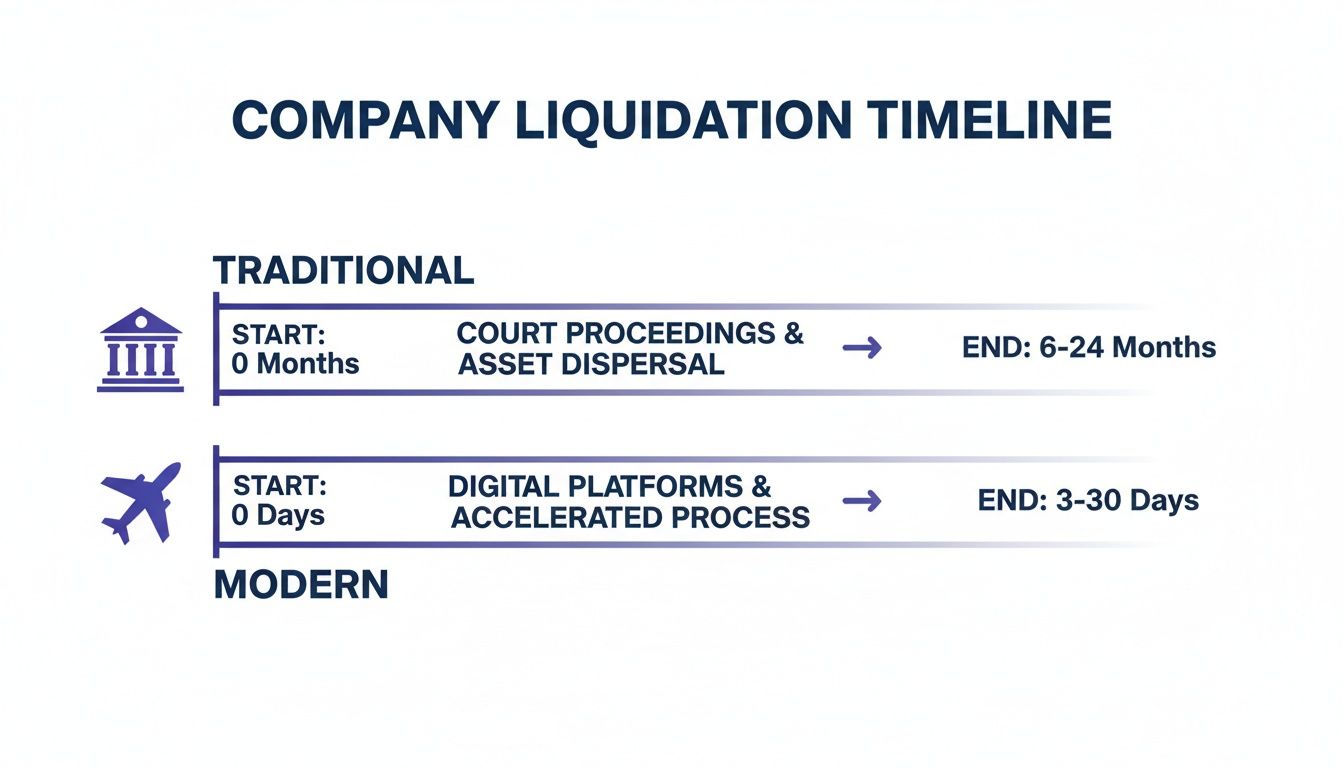
As you can see, the difference in duration is huge. The single biggest factor determining how long you'll be tied up in the process is the method you choose.
Your Options Explained
The right path for you really depends on your company's situation—its financial state, legal commitments, and how quickly you personally need to move on. The key differences come down to who is in control and how many legal and administrative boxes need ticking.
As a founder, your time is your most valuable resource. A lengthy liquidation process keeps you legally and mentally chained to a past venture, stopping you from moving forward. The goal should always be a clean, legal, and fast exit.
Generally, founders in the EU have a few main routes to consider:
Strike-Off (or Dissolution): This is the simplest option, but it's only suitable for dormant companies that have no assets or debts left to settle.
Voluntary Liquidation: This is a formal, director-led process where you actively wind up the company's affairs, pay off any creditors, and distribute remaining assets.
Creditor-Led Winding-Up: Also known as compulsory liquidation, this is a court-ordered process started by creditors. It’s often the most stressful and longest route, and one you want to avoid.
Liquidation-Via-Sale: A modern alternative where another company acquires your business specifically to handle its closure. This offers founders the fastest possible exit.
Company Liquidation Timelines at a Glance
To make things a bit clearer, here’s a quick comparison of what you can expect from each method.
Liquidation Method | Typical Timeline | Best For |
|---|---|---|
Strike-Off / Dissolution | 2–6 months | Dormant companies with no assets, debts, or creditors. A simple administrative closure. |
Voluntary Liquidation | 6–18+ months | Solvent companies where directors want to formally wind down operations in an orderly way. |
Creditor-Led Winding-Up | 12–24+ months | Insolvent companies where creditors force closure. This is the least desirable and longest path. |
Liquidation-Via-Sale | 3–30 days | Founders needing a rapid, clean exit, often from a company with complex but manageable debts. |
This table shows just how much the timelines can vary. While a simple strike-off is fairly quick, any process involving creditors or formal wind-ups can stretch on for a very long time. For founders who need to move on, speed is everything.
Navigating Traditional Liquidation Routes
If you're wondering how long it takes to liquidate a company, the traditional routes can feel like a marathon of paperwork and red tape. These well-established methods are designed to be thorough, but that thoroughness comes at a cost: time. Founders often find themselves entangled in the process for months, sometimes even years. Let's break down why these paths are so lengthy.

The two most common methods are Voluntary Liquidation and Strike-Off (also known as Dissolution). Each one serves a different purpose, and both come with their own drawn-out timeline.
The Voluntary Liquidation Process
Voluntary Liquidation is the official, formal process for closing a company that still has assets to sell off and creditors to pay. This route is split into two types: a Members’ Voluntary Liquidation (MVL) for solvent companies and a Creditors’ Voluntary Liquidation (CVL) for insolvent ones. Both are notoriously slow.
Think about a small services startup. It might only have a handful of employees, a few client contracts, and some office equipment. Even for a business this simple, the list of mandatory steps adds up surprisingly fast.
The process usually involves:
Shareholder Resolutions: First, you have to get formal agreement from shareholders to liquidate and appoint a licensed liquidator. This means holding meetings and filing the proper legal documents.
Appointing a Liquidator: This professional essentially takes over the company. It’s crucial to remember their legal duty is to the creditors, not to you as the founder.
Asset Valuation and Sale: Every single company asset, from laptops to intellectual property, has to be professionally valued and then sold. This stage alone can easily take months.
Creditor Claims: The liquidator must track down and notify all known creditors. Those creditors then have a specific window of time to formally submit their claims for payment.
Tax Clearance: Getting the final all-clear from the tax authorities is a classic bottleneck. This step can single-handedly add several months to the entire process.
Any one of these stages can hit a snag. A single dispute from a creditor or a delay in finding a buyer for an asset can grind the whole process to a halt.
The Strike-Off or Dissolution Alternative
On the surface, a Strike-Off looks like a much simpler, faster choice. It’s an administrative process that just removes the company from the commercial register. But there’s a major catch: it’s only suitable for companies that are truly dormant, with no assets, no debts, and no ongoing operations.
A Strike-Off is not a magic wand for companies with liabilities. If you try to dissolve a company that still owes money, creditors can have it restored to the register, which can lead to serious legal trouble for the directors.
Even if your company is eligible, the process isn't exactly instant. You still have to file applications and then wait out a mandatory notice period—often around three months—during which anyone with a valid interest can object and stop the process.
To give you a real-world example, the traditional process of winding up a company in Portugal often takes anywhere from three months to over two years. This is because of mandatory formalities like officially registering the dissolution and a very long settlement period for creditors.
At the end of the day, these traditional paths are built for a methodical, legally airtight closure, not for speed. While they're the right choice in certain situations, they keep founders legally and emotionally tethered to their old company long after they’re ready to move on. For those who need to get into the nitty-gritty of closing a business, you can check out our guide on how to wind up a company.
The Timeline for Compulsory Liquidation
Sometimes, the decision to close your company is taken out of your hands. This is what’s known as compulsory liquidation, a court-ordered process that’s usually kicked off by a creditor who is tired of waiting to be paid. If you’re wondering how long liquidation takes when you're not in the driving seat, this is by far the most unpredictable and often longest path.

Unlike a process you start yourself, compulsory liquidation begins with a winding-up petition filed at court. From that moment on, the timeline is dictated by legal proceedings and official appointments. As the founder, you have very little influence over how fast things move—or what the final outcome will be.
This route is notoriously lengthy and can easily stretch out for several years. The whole thing becomes a waiting game controlled by external forces, leaving you in a state of professional limbo that can have serious personal and financial consequences.
Why Does Compulsory Liquidation Take So Long?
So, what makes this process drag on for so long? A few key factors come together to make this the most drawn-out way to close a company. The entire procedure is channelled through the legal system, which is where delays really start to stack up.
Here’s a breakdown of the main reasons for the extended timeline:
Court System Backlogs: Just getting a court date for the winding-up petition can take months. It all depends on how busy the courts are in your particular jurisdiction.
Appointment of a Liquidator: Once the court issues a winding-up order, an Official Receiver is put in charge. They might then hand the case over to an insolvency practitioner, and this transfer alone adds another layer of administrative time.
In-depth Investigations: The liquidator has a legal duty to investigate the company's affairs and the conduct of its directors. This is a meticulous, forensic process that can unearth issues needing further legal action, potentially adding years to the clock.
Legal Challenges: It’s not just the liquidator you need to think about. Other stakeholders, like shareholders or other creditors, can raise legal challenges at various points, all of which have to be sorted out through the courts.
A compulsory liquidation isn’t just about shutting down a business; it’s a formal investigation into why it failed. This scrutiny is what really extends the timeline, as every transaction and decision leading up to the insolvency might be put under a microscope.
The Real-World Delays
This isn’t just a theoretical risk—it's a statistical reality. Take Portugal, for example. Data from corporate insolvency cases there shows just how drawn-out these proceedings can be. While the time it takes for the court to make the initial declaration has improved, getting to full closure is still a marathon.
Even with recent improvements, the 75th percentile for a complete closure is 3.5 years. Think about that: a quarter of all cases drag on for over 42 months. You can see more on this in the insolvency duration statistics from the Bank of Portugal.
Ultimately, compulsory liquidation strips you of your control and traps you in a slow-moving legal machine. The indefinite timeline makes it impossible to plan your next venture, leaving you shackled to a failed company long after you’re ready to move on.
A Modern Alternative for a Faster Exit
Let’s be honest, the traditional ways to close a company can be a drawn-out nightmare. For any founder wanting a clean break, asking "how long does liquidation take?" and hearing "months, maybe years" is incredibly frustrating. But there’s a direct solution built for speed and finality: Liquidation Via Sale.

This method completely sidesteps the usual administrative slog. Instead of you having to wind down the company piece by piece, a specialist firm buys your company’s shares, transferring all legal ownership away from you. This single, clean transaction is the secret to a fast exit.
How Liquidation Via Sale Works
The entire process is designed to do one thing really well: sever your ties to the company as quickly and cleanly as possible. For you, the founder, direct involvement is boiled down to a few simple steps that are typically wrapped up in 3 to 30 days.
Here's what your part of the journey looks like:
Initial Consultation: You’ll have a conversation with the firm to go over your company's situation and confirm it's a good fit. This is usually free and makes sure everything is above board.
Share Purchase Agreement: If you decide to go ahead, you'll get a simple contract to sell all your company shares for a nominal sum, often just €1. This is the legal document that transfers ownership.
Ownership Transfer: Once the papers are signed, the new owner is officially registered. From that exact moment, you are no longer the director or shareholder. All of your legal and administrative connections to the company are cut.
And that’s it. You’re out. The firm that bought the company takes on full responsibility for everything—all assets and all liabilities.
The Founder's Immediate Relief
The real power of this method is the instant peace of mind it delivers. Your name is removed from the public commercial registry almost immediately, which creates a powerful buffer between you and the company's history.
The moment the sale is complete, all communications from creditors, tax authorities, and other official bodies are redirected to the new owners. The administrative burden is no longer yours to carry.
This means the constant stress of juggling liquidation paperwork and chasing deadlines disappears overnight. You are legally free to put your energy into your next big idea without being dragged down by the old one. The new owner’s team then handles the formal winding-down process according to all local laws, but this all happens behind the scenes, without you.
This approach gives you a predictable and controlled exit, a world away from the open-ended timelines of traditional liquidation. For a detailed breakdown, you can learn more about how this method compares to traditional routes. Ultimately, it turns a potential multi-year headache into a solution that takes just a few weeks, handing you back your most valuable asset: your time.
What Really Dictates Your Liquidation Timeline?
When you ask, “how long does liquidation take?”, the answer isn't a simple number. It's less about the specific method you choose and more about the unique reality of your company. Several key variables can either clear the path for a quick exit or bog you down in a long, drawn-out process. Getting a handle on these factors is the first step to setting realistic expectations.
The biggest single factor? Your company's financial health. A solvent company—one with enough cash and assets to pay all its bills—will almost always have a faster and smoother ride. When creditors know they’re getting their money back, there’s little room for disputes or legal challenges.
An insolvent company, on the other hand, changes the game entirely. Insolvency immediately brings in a higher level of legal scrutiny and forces negotiations with creditors, stretching the timeline out significantly.
The Devil in the Details: Company Complexity and Legal Hurdles
Beyond solvency, the very nature of your business can add months, or even years, to the clock. The more moving parts your company has, the longer it takes to carefully dismantle everything.
Here’s what can really slow things down:
Tricky Assets: Selling off office chairs is easy. But what about intangible assets like intellectual property, custom software, or complex financial contracts? Valuing and finding a buyer for these takes specialised expertise and a whole lot of time.
Lots of Stakeholders: A company with a handful of suppliers and one employee is straightforward. A business juggling hundreds of creditors, multiple bank loans, and a large team with employment contracts? That requires a mountain of administrative work and communication, adding serious delays.
Existing Legal Battles: If your company is already tied up in a lawsuit, the liquidation often hits a brick wall. The entire process might have to wait until that legal dispute is fully resolved, which can be an indefinite pause.
Think of your company's paperwork as a hidden accelerator—or a brake. Clean, organised, and up-to-date corporate records can literally shave months off the process. Messy or missing documents are a red flag that can trigger investigations and grind everything to a halt.
Local Laws and Market Conditions
Finally, where your company is based matters. Every EU country has its own legal quirks and bureaucratic hurdles, from how long you have to notify creditors to how backed up the courts are. The wider economic climate can also make a difference.
For example, Portugal’s approach to insolvency has changed a lot in recent years. While reforms have sped up certain parts of the process, a full wind-down can still take years, especially with the economic ups and downs we’ve seen. This variability is highlighted in insights reported by INSOL Europe, showing just how much timelines can differ.
An honest look at these factors is essential. If you’re a founder staring down a tangled web of assets, debts, and legal issues, these potential delays build a powerful case for looking at faster, more direct exit strategies. To get a better feel for how this plays out in practice, take a look at some real-world company closure scenarios.
Your Top Liquidation Questions Answered
When you’re facing the end of a company, the questions come thick and fast. It's a stressful time, and founders usually have the same worries spinning around in their heads: personal risk, company debt, and what the future holds. Let's tackle those critical questions head-on so you can get the clarity you need to make the right call.
Can I Just Abandon My Company Instead of Liquidating It?
In a word: no. Walking away from your company without formally closing it is one of the riskiest things you can do. It might seem like the easiest option, but it leaves a trail of legal and financial problems that can follow you for years.
As a director, you are personally on the hook for the company’s administrative duties and debts until it is properly dissolved. If you just abandon it, you open yourself up to hefty fines, legal action from people you owe money to, and even being disqualified from acting as a director in the future. It’s a messy ending that can seriously damage your reputation and make it harder to get funding for your next big idea. A clean, legal closure is the only real way to move on.
What Happens to Company Debts During Liquidation?
In a classic liquidation, a liquidator is brought in to sell off what's left of the company's assets. That cash is then used to pay back creditors in a specific, legally-required order. If there isn’t enough money to cover everything, any remaining unsecured debts are usually written off once the company is officially dissolved.
This is where a Liquidation Via Sale really changes the game. When you sell the company, the legal responsibility for its debts and liabilities transfers to the new owner. You're no longer the one managing the process or dealing with creditors. It's important to be crystal clear on one thing, though: this doesn't get you out of any personal guarantees you might have signed for loans.
That transfer of liability is precisely why the process is so much quicker for the founder. The burden is lifted from your shoulders.
How Does the Liquidation Timeline Affect Me Personally?
The length of the liquidation process has a huge impact on your life. A long, drawn-out liquidation means you remain listed as a director for months, sometimes years. You’re still tied to the company, answering to the liquidator, and dealing with enquiries from creditors.
That prolonged stress is more than just an administrative headache; it holds you back. It drains your energy and stops you from focusing on what’s next.
The real advantage of a faster route, like a liquidation-via-sale, is how quickly you get your personal freedom back. Your name is removed from the company registry within days, not years. That simple act severs your official ties, stops the creditor calls, and gives you a clean slate to start fresh almost immediately.
Is a Fast Liquidation Service Suitable for Every Company?
A rapid liquidation service can be a lifesaver for many EU founders with limited liability companies, but it's not a one-size-fits-all solution. It's designed for a swift, compliant exit, not as a magic wand to make serious problems disappear.
This kind of service isn't the right path for companies already facing active fraud investigations, or for founders trying to dodge legitimate personal liabilities. Reputable providers aren't in the business of helping directors walk away from undisclosed personal guarantees they've signed.
Any trustworthy service will start with a free, no-strings-attached chat. That first call is crucial. It’s for them to understand your company's situation, check if it’s eligible, and make sure this is the correct, fully legal path forward for you. The goal is always an honest, efficient exit for genuine founders.