
Feb 9, 2026
The Best Way to Liquidate a Company in Portugal in 2026
Figuring out the best way to liquidate a company in Portugal in 2026 really comes down to one thing: its financial state. If your company is solvent, a simple administrative strike-off might be all you need. But for a business carrying debt, you're looking at a more formal process like liquidation or an innovative Liquidation Via Sale to keep the directors protected.
For most business owners, particularly those living outside Portugal, the goal is a quick, clean, and legally sound exit that sidesteps personal risk and avoids getting bogged down in the courts.
Choosing Your Exit Path in Portugal for 2026

Winding down a Portuguese company isn't a walk in the park. It’s a process fraught with potential pitfalls related to timelines, costs, and complex legal obligations. For any founder in 2026, the very first step towards a clean break is getting a firm grip on the exit routes available. Believe me, the choice is rarely obvious, as each path is built for a very specific business situation.
This guide will lay out a direct, no-nonsense comparison of the main options you have, from traditional, court-driven procedures to more modern and much faster alternatives. The aim here is to give you the clarity you need to pick the right path for your company's unique circumstances.
Key Company Closure Options at a Glance
The most critical decision you'll make hinges on two factors: your company's solvency and how quickly you want to move on. Each method has different consequences for director liability, overall cost, and the sheer amount of hassle involved.
The four main routes are Voluntary Liquidation, Formal Insolvency, Administrative Strike-Off, and Liquidation Via Sale. It can be helpful to explore real-world scenarios to see how these methods play out in practice.
The single biggest mistake a director can make is picking a closure route that doesn't match the company's financial reality. For example, trying to strike off a company that still owes money can expose you to serious personal liability down the road.
Here's a high-level overview to get you started. We'll dive deeper into each one in the sections that follow to help you pinpoint the best way to liquidate a company in Portugal in 2026 for your specific needs.
Feature | Voluntary Liquidation | Formal Insolvency | Liquidation Via Sale | Administrative Strike-Off |
|---|---|---|---|---|
Ideal For | Solvent companies with assets to distribute. | Insolvent companies unable to pay debts. | Solvent or indebted companies seeking a fast exit. | Dormant, solvent companies with no activity. |
Typical Speed | 6-18 months | 12-24+ months | 3-30 days | 3-6 months |
Director Involvement | High | High | Low (after transfer) | Low |
Primary Goal | Orderly wind-down and asset distribution. | Fair creditor repayment under court supervision. | Fast, clean break for the founder. | Simple removal from the company register. |
Comparing Company Liquidation Methods in Portugal
Choosing how to close down your company in Portugal for 2026 isn't a one-size-fits-all decision. You're looking at a few distinct paths, and each one is built for a very different business situation. The differences in time, cost, and the personal risk you carry as a director are huge. Let's break down the four main routes: the traditional Voluntary Liquidation, the court-led Insolvency process, a simple Administrative Strike-Off, and a modern alternative, Liquidation Via Sale.
Getting this choice right is more than just a box-ticking exercise; it's about securing a clean, compliant exit. The wrong move can easily pull you into protracted legal issues, surprise costs, and even make you personally liable for the company's debts. This breakdown will give you the clarity needed to match your company's reality with the right closure strategy.
Voluntary Liquidation (Dissolução e Liquidação Voluntária)
Think of Voluntary Liquidation as the standard, by-the-book process for a solvent company. Your business has stopped trading, but it still has some assets. The entire point here is to wind things down in an orderly fashion: sell off what's left, pay any final creditors, and give whatever is left back to the shareholders.
It all kicks off with a shareholders' resolution. You'll appoint a liquidator—often a director or accountant—to manage the whole affair. This isn't a simple form-filling exercise; it involves public notices, final tax declarations, and a fair bit of legal paperwork. It's thorough, but it definitely isn't fast.
While this route guarantees you've met every legal requirement for a solvent closure, be prepared for a long haul. Directors should realistically budget for a timeline of 6 to 18 months, which demands a lot of administrative effort and patience.
Formal Insolvency (Insolvência)
When a company simply can't pay its debts, Formal Insolvency isn't just an option—it's often the only legally and ethically responsible one. This is a court-supervised process governed by Portugal's Insolvency and Recovery Code (CIRE). The court’s primary goal is to make sure creditors are repaid as fairly as possible from whatever assets remain.
Either a director or a creditor can start the proceedings. The court then steps in and appoints an insolvency administrator who takes complete control. They'll dig into the company's finances, sell off assets, and pay back creditors based on a strict legal hierarchy. This route gives you legal protection from creditor lawsuits, but you sacrifice control and have to accept public scrutiny.
The reality of this path is often challenging for directors. The process is public, invasive, and can take 12 to 24 months or even longer to conclude, with the administrator scrutinising past director conduct for any signs of wrongful trading.
The bureaucratic weight of this process is immense. In 2025 alone, Portugal saw 3,640 business insolvencies, and the procedures are notorious for dragging on. The major business hubs of Lisbon and Porto were hit hardest, with 876 and 882 insolvencies respectively, showing just how strained the legal system is in these areas.
Administrative Strike-Off (Dissolução Administrativa)
An Administrative Strike-Off is by far the simplest and cheapest way to close a Portuguese company, but it comes with a big catch: its use is extremely limited. This is only for companies that are completely solvent, have zero assets or liabilities, and have been dormant for a while.
You're essentially just asking the Commercial Registry Office (Conservatória do Registo Comercial) to take the company's name off the register. It’s a low-cost, paperwork-driven process that lets you skip the headaches of a full liquidation. However, if you try to use this for a company that still has debts, you're making a serious mistake. The company can be restored, and you could be held personally liable for those outstanding bills.
This is the perfect exit for a business idea that never launched or one that has tidily wrapped up every single one of its affairs. Expect it to take around 3 to 6 months.
Liquidation Via Sale (EndCorp's Method)
Liquidation Via Sale is a modern approach designed for one thing: a quick, clean break. It works for both solvent and indebted companies, as long as there are no active fraud investigations. Instead of you overseeing a long wind-down, the company's shares are legally sold and transferred to a specialist firm like EndCorp.
As soon as the share transfer is notarised, your name is removed from the company register. The new owners take on full legal responsibility for winding the company down correctly under Portuguese law. This single action cuts your ties to the business, often in just a few days.
This method is a game-changer for non-resident directors or any entrepreneur who needs to exit a failed venture quickly and legally, without the stress and time drain of the other options. From your perspective, the entire process is over and done with within 3 to 30 days.
At-a-Glance Comparison of Liquidation Options
To help you see the differences more clearly, we’ve put together a table summarising the key points for each method.
Comparison of Company Liquidation Methods in Portugal (2026)
This table offers a side-by-side look at the critical attributes of each closure route, helping you quickly see which one best fits your situation. For a deeper dive, check out our full comparison of company closure methods.
Method | Typical Timeline | Estimated Cost | Best For | Director Liability Risk |
|---|---|---|---|---|
Voluntary Liquidation | 6-18 Months | €3,000 - €8,000+ | Solvent companies with assets to distribute. | Low, if procedure is followed correctly. |
Formal Insolvency | 12-24+ Months | €5,000 - €15,000+ | Insolvent companies unable to pay debts. | High, due to investigation of past conduct. |
Administrative Strike-Off | 3-6 Months | €500 - €1,500 | Dormant, solvent companies with no assets or debts. | Very high, if used improperly with existing debts. |
Liquidation Via Sale | 3-30 Days | Fixed Fee (e.g., from €2,000) | Solvent or indebted companies seeking a rapid, clean exit. | Low, as liability is transferred with ownership. |
As you can see, there’s no single "best" way to liquidate a company in Portugal in 2026. The right path really comes down to your company's financial health, your personal appetite for risk, and how quickly you need to move on to your next chapter.
Matching the Right Liquidation Method to Your Situation

Knowing the different ways to close a company is one thing, but figuring out which one fits your business is where the real work begins. The best way to liquidate a company in Portugal in 2026 isn't a one-size-fits-all solution; it comes down to the unique reality of your situation—your finances, your relationship with creditors, and what you, as the founder, need to achieve.
Let’s move from theory to practice. To make this choice clearer, we’ll walk through three very common scenarios that entrepreneurs face. By matching each one with the most logical exit strategy, you can see your own circumstances reflected and find the most compliant, low-stress path forward.
Scenario 1: The Dormant But Solvent Company
Let's say you registered a Portuguese company a couple of years back for a project that never quite launched. It has a bank account with a small balance, has never actually traded, has no employees, and—crucially—has zero debts or liabilities. The company is perfectly solvent but is now just a dormant entity racking up annual compliance costs.
Your goal is straightforward: shut it down as cheaply and quickly as possible. You don't need a complicated, drawn-out process because there are no assets to sell off or creditors to manage.
Recommended Method: Administrative Strike-Off (Dissolução Administrativa)
This is precisely what an Administrative Strike-Off was designed for. It's a clean, low-cost procedure for inactive, solvent companies with a completely clean slate.
Why it works: It directly solves the founder's problem by providing a simple, inexpensive exit without the formalities of a full liquidation.
Key benefit: You sidestep the need to appoint a liquidator and all the associated legal and accounting fees that come with it, saving you a great deal of time and money.
Timeline: The whole process usually wraps up in 3-6 months, a mere fraction of the time a formal liquidation would take.
This route is wonderfully clean and efficient, but it only works because the company is entirely debt-free. Trying to strike-off a company with any outstanding liabilities would be a critical error, leaving the director personally on the hook.
Scenario 2: The Online Business with Creditor Demands
Now, picture the founder of an e-commerce business. The company isn't technically insolvent yet, but it's definitely struggling. Sales have slumped, and there are outstanding bills from suppliers, a digital marketing agency, and the Portuguese tax authority (Autoridade Tributária e Aduaneira). Creditors are starting to chase for payment, and the pressure is building.
The founder isn't a resident in Portugal, wants to avoid a public court battle at all costs, and is worried about their personal assets. The absolute priority is a fast, clean break that legally resolves the creditor issues before they escalate.
Recommended Method: Liquidation Via Sale
In this situation, a Liquidation Via Sale is often the most strategic move. It delivers a swift and final exit by transferring the company's ownership to a specialist firm that handles the wind-down.
The real power of this method is its speed and finality. As soon as the shares are transferred, the original director is removed from the company register. The new owners legally take on the responsibility of the formal closure process, which immediately cuts off creditor communications and lifts the personal burden from the founder.
Here’s a breakdown of why this is so effective here:
Speed of Exit: The ownership transfer can be completed in just 3 to 30 days, providing immediate relief from the stress.
Liability Shield: This legal transfer of ownership acts as a shield, protecting the original director from the wind-down process and creditor negotiations.
Remote Process: It's a perfect fit for non-resident directors, as the entire transaction can be managed remotely with the assistance of a notary.
This path draws a definitive line under the uncertainty, allowing the founder to move forward without the looming threat of a protracted and public insolvency fight.
Scenario 3: The Heavily Indebted Business Facing Legal Action
Finally, imagine a construction company that is deeply insolvent. It owes huge sums to its subcontractors, has defaulted on a bank loan, and has just been served with a legal notice from a major supplier. The company’s assets are nowhere near enough to cover its liabilities, and there’s no realistic path to recovery.
The directors have exhausted every option to save the business. Now, they have a legal and ethical duty to act in the best interests of their creditors. Their primary concern is to fulfil these legal obligations and avoid any accusation of wrongful trading (culpa na insolvência), which could bring disastrous personal financial consequences.
Recommended Method: Formal Insolvency (Insolvência)
When a situation is this dire, formal insolvency isn't just the best option—it's the only legally sound one. Attempting any other route could be interpreted as an attempt to duck responsibility, exposing the directors to serious personal risk.
Legal Protection: Filing for insolvency places the company under the court's protection, which immediately freezes all creditor lawsuits and legal actions.
Orderly Process: A court-appointed administrator takes over, ensuring that any remaining assets are sold and the proceeds distributed to creditors according to a strict legal hierarchy. This takes the weight of decision-making off the directors' shoulders.
Director Compliance: By proactively putting the company into insolvency, the directors are demonstrating that they are acting responsibly. This is a crucial defence in any later investigation into their conduct prior to the collapse.
While formal insolvency is a public and lengthy process, often taking 12-24+ months, it is the mandatory path for a company this deep in debt. It provides the necessary legal structure for closure, complies fully with Portuguese law, and offers the strongest possible protection against personal liability for directors who have acted in good faith.
Understanding the Personal Risks of Company Closure

Deciding how to close your company isn't just about paperwork. It's a choice that can have a serious, direct impact on your personal finances. That corporate veil you think separates you from your business? It’s not bulletproof. A poorly handled closure can rip it right down, leaving you exposed to some pretty severe personal consequences.
Too many directors get this wrong. They assume their limited company status is a fortress, but that's a dangerous mistake to make in Portugal. Specific actions—or even a lack of action—can make you personally liable for company debts, trigger legal investigations, and even get you banned from being a director again. Before you even think about the best way to liquidate a company in Portugal in 2026, you absolutely have to get your head around these risks.
The Hidden Danger of Personal Guarantees
The personal guarantee is probably the most common trap directors fall into. When you're just starting, signing a supplier contract or a lease with a personal guarantee clause seems like a minor formality to get things moving.
Fast forward a few years to a liquidation, and that signature can come back to bite you. Hard. A personal guarantee is a legally binding promise that you will personally cover the company's debt if it can't pay. Creditors know this, and they won't hesitate to come after you directly, completely sidestepping the company's liquidation process.
Bank Loans: Nearly all business loans and credit lines from financial institutions will have a director's personal guarantee baked in.
Property Leases: Landlords almost always demand them to cover their backs against unpaid rent or damages.
Major Supplier Agreements: Key suppliers often require a guarantee before they’ll extend a significant line of credit, especially to a newer business.
You need to go through every single contract with a fine-tooth comb to find these clauses. It's critical to understand that no closure method, not even a Liquidation Via Sale, can magically erase a personal guarantee you’ve signed.
Wrongful Trading Investigations and Fault in Insolvency
In the Portuguese legal system, the concept of fault in insolvency is a very serious matter. If your company has to go through a formal insolvency, an administrator is appointed to dig into exactly what led to the failure. They will put your conduct as a director under a microscope to see if you acted improperly.
The current economic climate only adds to the pressure. A recent study found that a staggering 23% of Portuguese companies feel they face a 'real risk' of failure within two years if things don't improve. That number jumps to an alarming 29% for SMEs. With so much strain, and with traditional liquidations being so complicated, the temptation to cut corners or make desperate moves increases, which in turn ramps up your personal risk. The 2025 European Payments Report has more detail on these pressures.
A crucial question in any fault in insolvency investigation is whether a director kept trading when they knew, or should have known, that there was no realistic chance of avoiding insolvency. This is 'wrongful trading', and it can make you personally liable for all the debts the company racked up during that time.
Other red flags for investigators include things like hiding assets, paying off one creditor but not others, or simply failing to file for insolvency when you were legally obligated to. Getting caught can lead to being disqualified as a director for 2 to 10 years and being held personally responsible for the company’s entire financial shortfall.
Clarifying Which Methods Offer Protection
Different closure routes provide very different shields against these personal risks. A formal insolvency, when done correctly, can be a gruelling process, but it shows you've acted responsibly. For directors who have acted in good faith, it can offer a strong defence against personal liability.
On the other hand, trying to use an Administrative Strike-Off when it’s not appropriate offers zero protection. In fact, it's like sending an open invitation for creditors to chase you personally. A Liquidation Via Sale gives you a powerful shield by legally transferring the ownership—and the responsibility for winding down—to a new owner.
But even this protection has its limits. A service like EndCorp's is not a get-out-of-jail-free card. If you're facing active investigations for fraud or other criminal matters, those liabilities stick to you personally, not the company. Your only real defence is a transparent, legally sound exit strategy.
How Does a Liquidation Via Sale with EndCorp Actually Work?
If you're looking for a fast, remote, and legally robust way to close your Portuguese company, you need to understand how a Liquidation Via Sale works in practice. It’s a world away from the slow, drawn-out traditional methods. Our entire approach is built on getting you a clean break, managed by specialists who handle everything on the ground in Portugal.
It all starts with a simple, no-obligation eligibility check. This free consultation is the most important first step, as it’s where we determine if this route is genuinely the right one for your specific situation. We’ll take a look at your company's financials, any outstanding creditors, and potential legal hurdles to make sure our process gives you the legal finality and protection you need.
The Key Stages of Your Exit
Once we’ve confirmed you’re a good fit, things move very quickly. Every stage is designed to be as hands-off for you as possible, while we focus on ensuring full legal compliance.
Here’s how the process unfolds:
Agreement and Payment: We send you a straightforward service agreement that details every step. Once you’ve signed and the fixed fee is settled, we get started.
Notarised Share Transfer: This is the core legal action. We prepare all the paperwork for you to sign before a notary. You can do this in Portugal, or more conveniently, remotely through a Portuguese consulate or a designated lawyer in your home country. This single act transfers 100% of the company’s shares to EndCorp.
Director Removal from Company Registry: As soon as the shares are transferred, we file to have your name formally removed as a director from the Portuguese Commercial Registry (Conservatória do Registo Comercial). This is the exact moment your legal liabilities and responsibilities for the company are officially cut.
Final Wind-Down Managed by EndCorp: The company is now legally ours. Our local Portuguese team takes complete control of the formal winding-down process, strictly following Portuguese law. From this point on, any creditor communications or administrative filings are our problem, not yours.
What Do We Need from You?
Honestly, not much. Your main involvement is right at the start. You’ll need to provide accurate information for the initial review and then sign the share transfer documents. After that, we take the wheel completely.
This entire model was built for non-resident founders who can't afford to be bogged down by months of Portuguese bureaucracy. The whole point is to achieve a clean break in 3 to 30 days, not the typical 12 to 24 months.
When speed and certainty are non-negotiable, this process is the definitive answer to the question of the best way to liquidate a company in Portugal in 2026. It swaps the ambiguity and heavy administrative load of a traditional liquidation for a clear, predictable, and remote solution. It lets you close one chapter with confidence and move on to the next.
Choosing the Right Path to Close Your Company
By this point, you should have a much clearer picture of how each closure method works. The goal is to match your company's real-world situation—its financial health, creditor relationships, and your own personal circumstances—with the most appropriate and legally sound exit strategy.
Ultimately, your decision hinges on a few critical questions. Is the company solvent? How much pressure are you under from creditors? And how quickly do you need to achieve a clean break?
A Quick Recap of Your Options
Let's quickly review the scenarios. If you have a solvent company that's no longer trading, the straightforward Administrative Strike-Off is almost certainly your best bet. It’s simple and cost-effective.
On the other hand, if your business is buckling under debt and you need to prove you’ve acted responsibly as a director, a Formal Insolvency is the only legally compliant route. For those somewhere in the middle—perhaps facing creditor demands but wanting a fast and final exit—our Liquidation Via Sale offers a unique blend of speed and director protection.
Mapping Out Your Next Steps
The decision-making process often starts with one simple question: is the company solvent? This initial fork in the road will largely determine the options available to you.
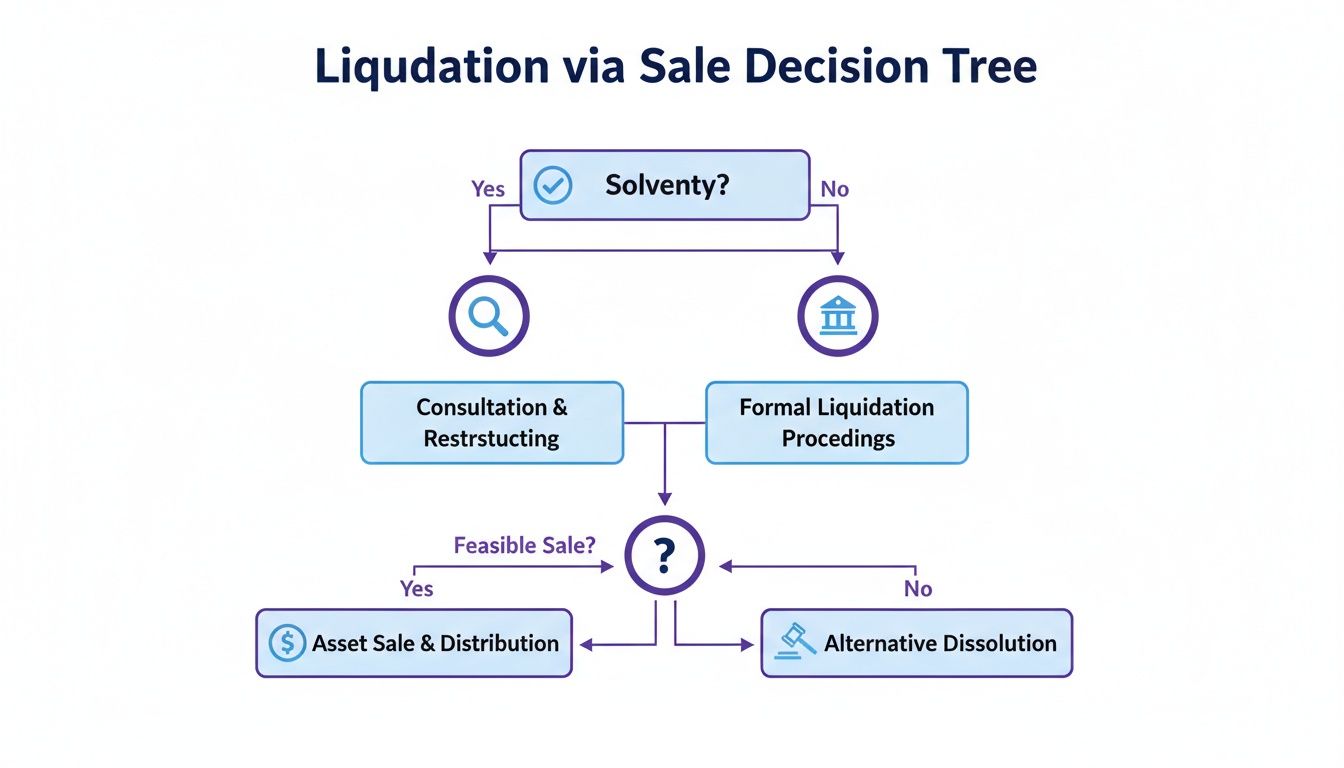
As the diagram shows, solvency opens up more streamlined paths, whereas insolvency requires a more structured, legally-driven process to protect all parties involved.
Deciding on the best way to liquidate a company in Portugal in 2026 is a major step, and it’s not one you should take lightly or alone. The nuances of director liability, creditor negotiations, and legal compliance are complex. Getting it wrong can have serious personal consequences.
Key Takeaway: Your final step should always be to get professional advice. A short, no-obligation chat with an expert can confirm you're on the right track, flag any risks you might have missed, and give you the confidence to move forward.
Ready to make a final decision with complete clarity? Book a free, confidential consultation with our specialists at EndCorp. We can review your specific circumstances and help you secure the peace of mind that comes from a professionally managed company closure.
Your Questions Answered: Closing a Portuguese Company
Closing down a business naturally comes with a lot of questions. As experts in this field, we’ve put together straightforward answers to the most common queries we hear from founders looking to liquidate a company in Portugal in 2026.
Can I close my Portuguese company if I no longer live there?
Yes, absolutely. Being a non-resident doesn't stop you from closing your Portuguese company.
Every formal closure route, including our Liquidation Via Sale, can be handled from abroad. Key steps, like signing share transfer forms, are easily managed either at a Portuguese consulate in your country or by granting a lawyer power of attorney. This gives international founders the flexibility they need.
What happens to the company’s debts when it’s liquidated?
How debts are handled really boils down to the path you take. In a formal insolvency, for instance, a court-appointed administrator takes over, selling off company assets to pay back creditors based on a strict legal pecking order.
A Liquidation Via Sale works differently. The legal duty to manage and settle the company’s debts shifts to the new owners. Once the company is transferred, the original directors are no longer on the hook for dealing with creditors, as long as they haven't given any personal guarantees.
It's crucial to understand the difference between corporate debt and personal liability. Unless you've signed a personal guarantee, creditors can only make a claim against the company's assets, not your personal ones.
Is Liquidation Via Sale a legitimate way to close a company in Portugal?
Of course. The Liquidation Via Sale process is 100% legal and is built on standard Portuguese corporate law. It's essentially a straightforward, notarised sale and transfer of the company's shares.
As soon as the share transfer is finalised and your name is removed from the company registry, the new owners take on all legal responsibility for the final winding-down. This ensures everything is handled correctly and in full compliance with the law. The speed of this process is often a key consideration, and you can learn more about how long different liquidation methods take in our detailed guide.