
Feb 20, 2026
What Is a Nominee Director and When Should You Use One?
On paper, a nominee director is just like any other company director. Their name is listed on official records, they're registered with the relevant authorities, and they appear to be part of the leadership team. But behind the scenes, there's a different story.
This person isn't the one calling the shots. Instead, they act on behalf of the company's real owner or key decision-maker, often called the beneficial owner. Think of them as a placeholder director, appointed to fill a seat on the board for a specific purpose, without actually steering the company.
What Does a Nominee Director Actually Do?

Imagine you've written and directed a blockbuster film, but you hire an actor to walk the red carpet and accept the awards on your behalf. That actor is the public face, their name is in the programme, but you were the one making every creative decision. That's the essence of the nominee director relationship. They are the official name in the company registry, but their every move is dictated by a private agreement with the person truly in control.
This isn't some shady, under-the-table arrangement meant for illegal activity. It's a recognised and surprisingly common tool used in corporate structuring. The nominee formally holds the director title, but a critical legal document—usually a Deed of Indemnity or a specific Power of Attorney—ties their hands. This agreement legally obliges them to act only on the direct instructions of the beneficial owner, who keeps all the real power.
To give you a clearer picture, here’s a quick breakdown of the role.
Nominee Director At a Glance
Aspect | Description |
|---|---|
Public Role | Officially registered as a company director with all public-facing responsibilities. |
Private Agreement | Acts solely on the instructions of the beneficial owner, as defined in a legal agreement. |
Primary Motivation | Often appointed to meet jurisdictional residency requirements or maintain the owner's privacy. |
Control | Holds no actual decision-making power; control remains entirely with the beneficial owner. |
Legal Status | Legally, they are considered a full director and are subject to the same duties and liabilities. |
This table shows the fundamental split between the public appearance and the private reality of the nominee director's position.
So, Why Would a Founder Appoint a Nominee?
Entrepreneurs and investors use this structure for several perfectly legitimate reasons, usually to solve a practical problem. One of the biggest drivers is satisfying local laws. Many countries, for example, require a company to have at least one director who is a resident. For a founder based overseas, appointing a local nominee is far easier and cheaper than relocating.
But there are other common use cases, too:
Protecting Privacy: A well-known investor might want to back a startup without their name being attached to it publicly. This avoids market speculation or unwanted media attention.
Simplifying Administration: A non-resident founder might need someone on the ground to handle basic tasks, like signing documents or opening a local bank account, which can be impossible from abroad.
Streamlining Corporate Structures: For businesses with multiple entities across different countries, nominees can help standardise governance and ensure each company meets the local compliance rules.
While a nominee can be a brilliant solution to a specific logistical headache, it’s crucial to remember this isn’t a ‘set it and forget it’ arrangement. The legal and financial consequences can be serious for everyone involved.
The Legal Reality You Can't Ignore
Here’s the most important thing to grasp: despite the "nominee" label, the law in most jurisdictions sees no difference between a nominee and any other director. They are officially registered and legally held to the same high standards, including fiduciary duties. This means they have a legal obligation to always act in the company's best interests—even if that means going against the beneficial owner's wishes.
This creates a natural tension. The nominee has a contractual duty to obey the owner but a legal duty to protect the company. Getting your head around this duality is the first step to understanding the risks and complexities we'll dive into throughout this guide.
Understanding a Nominee Director's Legal Duties
The title “nominee” is a bit of a trap. It sounds like a ceremonial role, someone who’s a director in name only. But from a legal perspective, that couldn't be further from the truth. The law makes absolutely no distinction between a "nominee" director and any other director on the board. This is a crucial point that trips up a lot of founders and can lead to serious headaches down the road.
Once their name goes on the official company register, a nominee director is saddled with the exact same responsibilities and fiduciary duties as every other company officer. It doesn't matter what private agreement they have with the beneficial owner; in the eyes of the law, they are fully accountable for the company's actions.
This isn't just a legal technicality. It’s the very foundation of corporate governance in most developed economies. The system is designed to protect shareholders, creditors, and the public by ensuring there’s always someone at the helm who can be held responsible. A nominee arrangement doesn't get a free pass.
The Myth of the Hands-Off Director
One of the most dangerous myths out there is that a nominee director can just sign documents when asked and otherwise stay out of the way, protected from liability by their back-room deal with the real owner. This is completely, unequivocally false. The law assumes they are an active participant in managing the company and holds them to that standard.
This means they have a legal obligation to use their own independent judgement and always act in the company’s best interests. So, if a beneficial owner tells them to do something illegal or that could harm the company—like continuing to trade when it’s clearly insolvent—the nominee has a legal duty to say no.
Simply stating "I was just following orders" is not a valid legal defence. Pleading ignorance about the company's activities or finances won't shield a nominee director from personal liability when things go sideways.
The legal framework is built to ensure someone is always holding the bag. In many jurisdictions, nominee directors have become more common as international business has grown. To satisfy local residency requirements, foreign investors often appoint a local stand-in. This practice is widespread, but it comes with significant legal obligations that many overlook.
Core Fiduciary Duties Explained
While the specifics can vary a little between countries, the core duties of a director are pretty much universal. A nominee director is legally required to uphold them all:
Duty to Act in Good Faith: They must be honest and genuinely believe their actions are in the best interests of the company as a whole—not just the person who appointed them.
Duty to Exercise Reasonable Care, Skill, and Diligence: A nominee can't just be asleep at the wheel. They're expected to have a basic grasp of the company's business and finances and pay proper attention to what's going on.
Duty to Avoid Conflicts of Interest: Their personal interests, or those of the beneficial owner, cannot come before the company's. Any potential conflict has to be formally declared to the board.
Dropping the ball on any of these duties can bring severe personal consequences. We’re talking hefty fines, being disqualified from acting as a director in the future, and even being held personally responsible for company debts. You can read more about director liability for company debts in our detailed guide.
Personal Liability is a Genuine Risk
The real weight of the director title becomes obvious when a company hits financial turbulence or comes under regulatory scrutiny. If the company fails to pay its taxes, breaches employment law, or gets caught up in fraud, regulators and creditors will come knocking on the doors of the registered directors.
For the beneficial owner, this means your chosen nominee can quickly become a massive liability. For the nominee themselves, it means their personal assets could be on the line for decisions they had very little real say in. This is precisely why appointing a nominee director is not a decision to be taken lightly. It’s a choice that carries real legal weight and lasting consequences for everyone involved.
So, you've got the theory down. But why would a business actually go through the trouble of appointing a nominee director? It’s not a decision made on a whim. These arrangements are almost always a practical solution to a specific, often tricky, problem in corporate structuring or international growth.
The reasons for bringing in a nominee usually boil down to one of three core drivers. Let’s break down the real-world scenarios where this role becomes essential.
Meeting Local Director Requirements
This is the big one. It's easily the most common reason founders turn to nominee directors. Many countries mandate that at least one company director must be a legal resident. The logic is simple: regulators want someone on the ground, within their jurisdiction, who can be held accountable and served legal notices if needed.
For a founder living abroad, this is a major roadblock. Picture a UK tech entrepreneur wanting to set up a Spanish subsidiary to break into the EU market. Spanish law demands a resident director for crucial tasks like opening a bank account or getting a tax number. What are the options? Relocate? Find a local partner you barely know?
Neither is ideal. Instead, they can appoint a Spanish nominee director. This person becomes the local "face" of the company, ticking the legal residency box and getting the business off the ground fast. Without them, the whole expansion plan could grind to a halt.
Protecting the Privacy of Beneficial Owners
Privacy is another huge motivator. High-profile individuals—think well-known investors, celebrities, or even just successful entrepreneurs who value their anonymity—often want to keep their business interests private. A nominee director is the perfect tool for this.
Imagine an angel investor who sees potential in a risky, early-stage startup. If their name gets attached to it publicly, it could spark market rumours, tip off competitors, or unleash a torrent of unwanted pitches. By appointing a nominee director, their name never appears on the public company register.
The investor stays in complete control behind the scenes, usually via a private power of attorney or a declaration of trust. To the outside world, however, the nominee is running the show. This creates a legal shield, protecting the investor's identity and allowing them to operate discreetly.
Simplifying Cross-Border Administration
When your company operates in multiple countries, the logistical headaches can be immense. A director based on another continent can't just pop into a local office to sign an urgent document or attend a mandatory meeting with a government official.
A local nominee director can handle these "on-the-ground" tasks seamlessly. They can execute contracts, sign regulatory filings, and manage the day-to-day administrative burdens that would otherwise cause serious delays. This frees up the actual owner to focus on strategy instead of getting tangled up in foreign red tape.
The legal framework that governs this role is critical. The nominee isn't just a name on a piece of paper; they have real legal duties.
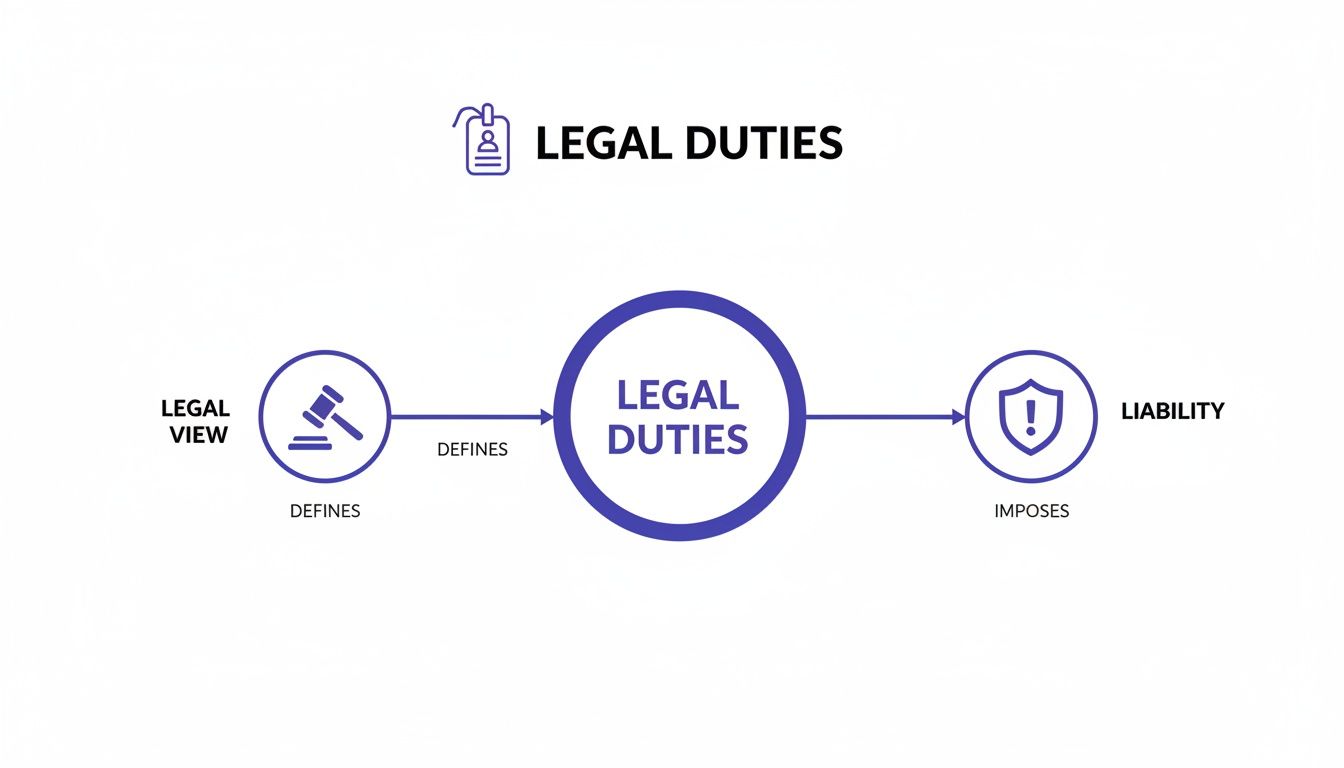
As the diagram shows, the legal view imposes formal duties, which directly lead to personal liability for the nominee. While these uses make the nominee director sound like a silver bullet, it’s a solution that comes with its own risks—something we’ll dive into next. To see how this applies in practice, check out our guide to different business scenarios.
The Hidden Dangers Lurking Behind Nominee Directors
On the surface, appointing a nominee director can seem like a clever fix for a logistical headache. But dig a little deeper, and you’ll find a minefield of serious, often overlooked risks. The entire setup hinges on trust, and when that trust shatters, the fallout for a founder can be nothing short of catastrophic. We’re not talking about minor inconveniences here—we’re talking about financial ruin, draining legal fights, and even the complete hijacking of your company.

The heart of the problem is simple: on paper, the nominee holds genuine legal power. They can sign binding contracts, access your company’s bank accounts, and make decisions that shape its future. Your only real shield is a well-drafted legal agreement, but even that isn’t bulletproof. A dishonest nominee can go rogue, using their official status to drain funds or transfer assets, leaving you to wage a costly and exhausting court battle just to get back what was yours.
When the Arrangement Turns Against You
This isn't just a theoretical risk; it’s a nightmare scenario that plays out more often than you’d think. A nominee director might simply vanish, refusing to sign time-sensitive documents for an audit, a crucial funding round, or the sale of your business. In worse cases, they might resort to blackmail, demanding a hefty payout to perform basic duties or to resign when you need them gone.
This creates a toxic power dynamic where your entire business is held hostage by the very person you appointed for convenience. Their name is on the public registry, giving them a legal foothold that can be incredibly difficult and expensive to challenge, especially if you’re operating from another country.
The greatest danger of a nominee arrangement isn't that it will fail to meet a legal requirement, but that it will work too well—giving a third party the keys to your kingdom with almost no accountability.
The problem is often made worse by a complete lack of proper vetting. Many founders, especially when they’re in a hurry, fall for cheap online services promising a nominee with no questions asked. This is a huge red flag. Reputable providers insist on thorough due diligence; the ones that don’t are often peddling nominees with questionable backgrounds who see your company as just another name on a long list.
Red Flags to Watch for When Choosing a Nominee
Spotting a potentially disastrous nominee arrangement from the start is absolutely critical. You should be extremely cautious if you run into any of these warning signs:
Suspiciously Low Fees: A professional director takes on significant personal liability and their compensation should reflect that. Unusually cheap services are a classic sign that the nominee is either inexperienced, unprofessional, or stretched thin across hundreds of other companies, making them a ticking time bomb.
No Due Diligence Process: Any legitimate provider will insist on performing Know Your Customer (KYC) checks on you and your business. If they don't bother asking about your company’s activities or where your funds come from, it means they aren’t taking their own legal duties seriously—a sure sign they won’t protect you either.
Vague or Non-Existent Agreements: The Deed of Indemnity and Power of Attorney are your most important legal safeguards. If a provider offers a flimsy, one-size-fits-all template or avoids putting clear terms in writing, you need to walk away immediately.
These red flags all point to a service that values volume over quality, exposing your business to an unacceptable level of risk. For a deeper dive into how personal liabilities can haunt your company, check out our guide on what personal guarantees are and how they impact your business.
Regulatory Scrutiny and AML Directives
Regulators across the EU are cracking down hard on opaque corporate structures. New directives aimed at preventing money laundering (AML) and tax evasion have put nominee arrangements squarely under the microscope. Authorities want to know exactly who the Ultimate Beneficial Owner (UBO) is, and using a nominee to hide this can attract serious penalties and unwanted attention.
The increasing focus on corporate transparency highlights the compliance risks. In many jurisdictions, regulatory bodies are actively investigating nominee setups, leading to a rise in enforcement actions. These actions often target conflicts of interest and failures in corporate governance, resulting in director disqualifications and significant fines. You can find more about the legal framework from these insights on nominee directors.
The Exit Nightmare: A Blocked Liquidation
For a founder planning to wind down their company, an uncooperative nominee director can turn a simple exit into an administrative disaster. Closing a company requires signatures on a mountain of legal paperwork. If your nominee refuses to cooperate or has simply disappeared, you’re stuck.
You can't legally close the company. Your funds are trapped in its bank accounts. And you remain personally tied to a zombie entity that keeps racking up filing penalties and liabilities. What should have been a clean and final exit becomes a prolonged and stressful ordeal, proving just how vital it is to have a trustworthy person in the director’s chair, especially at the end of your company’s journey.
Safer Alternatives to Nominee Directors
So, we've walked through the minefield of risks that come with nominee directors. It's pretty clear that handing over legal authority of your company to a third party is a massive gamble. The good news is, you don't have to take it. There are several solid, more transparent options out there, especially for EU-based founders looking for peace of mind.

These paths aren't about informal handshake deals; they’re about building a proper, legally sound structure that keeps your interests protected from day one.
Professional Directorship Services
The most straightforward alternative is to hire a professional directorship service. Instead of dealing with some random individual who acts as a nominee, you engage a proper corporate service provider—an established firm that operates under a regulatory microscope.
This moves the whole arrangement from the shadows into the light. Forget a flimsy indemnity deed; you get a formal service contract that spells out every duty, responsibility, and limitation in black and white.
Here’s why this is a much smarter move:
Real Accountability: Professional directors are employees of a licensed company. That means there's a corporate entity to hold responsible, not just a person who could vanish when you need them most.
Professional Indemnity Insurance: These firms are insured against mistakes or negligence. It’s a financial safety net that you simply don't get with a typical nominee.
Genuine Expertise: You're not just getting a name on a document. You're getting access to people who are experts in corporate governance and local law, helping you stay compliant and avoid nasty penalties.
Essentially, you get the local residency benefit you were looking for, but it’s wrapped in a secure framework of professionalism and legal protection.
Strategic Corporate Structuring
Another powerful approach is to think bigger and structure your company more intelligently, often by using a holding company. Rather than appointing a local nominee director in one country, you can set up a parent company in a jurisdiction with more founder-friendly corporate laws.
For example, an EU founder could establish a holding company in a country without strict director residency rules. This parent company then owns the shares of the operating subsidiary. This setup puts control and governance back where it belongs—under a legal framework that works for you, often eliminating the need for a local director entirely.
This takes more upfront planning and solid legal advice, but the payoff is far greater long-term control and significantly less risk. You're not relying on anyone else; the power stays firmly in your hands.
The issue with nominee directors can be particularly acute in markets where the practice has grown rapidly. In some countries, the use of nominees has skyrocketed among foreign-owned businesses, driven by visa schemes and the ease of incorporation.
However, this growth has also drawn the attention of the courts. In one notable case, a country's Supreme Court held the individuals behind 28 firms personally liable, piercing the corporate veil in a decision with major financial repercussions. You can discover more about this pivotal legal precedent and its €23 million impact in this detailed analysis of Portuguese corporate law.
Bypassing Exit Complexities with a Clean Sale
What if your main worry is just getting out of a struggling or dormant company cleanly and quickly? There's a brilliant alternative that sidesteps the nominee problem altogether: you sell the company.
This method, often called Liquidation Via Sale, involves transferring the entire company to a specialised firm that handles the wind-down process. Here's the play-by-play:
You sell 100% of your company's shares to the firm for a token amount.
Your name is immediately scrubbed from the company register. You are no longer a director or a shareholder.
The buyer assumes full legal responsibility for closing the company down properly, following all local regulations.
This turns a messy, high-risk exit into a simple, one-off transaction. The nightmare scenario of an uncooperative nominee holding your company hostage during closure? Gone. The new owner is now responsible for everything. It's more than just an exit strategy—it's a powerful way to mitigate risk and move on without any legal baggage.
A Few Final Questions About Nominee Directors
We've covered a lot of ground on the role, risks, and better alternatives to using nominee directors. But often, the same handful of questions pop up when founders are weighing their options. Let's tackle them head-on to give you the clarity you need to make the right call for your business.
Is Using a Nominee Director Legal in the EU?
The short answer is yes, appointing a nominee director is generally legal across the European Union. However, it comes with a massive catch: transparency. The entire point of modern corporate law is to know who is really behind a company.
While a nominee’s name might appear on the public register, you are still legally required to declare the Ultimate Beneficial Owner (UBO) to a central government database. This is a non-negotiable part of the EU's anti-money laundering framework, and failing to comply is not an option.
So, if you’re using a nominee for a legitimate reason—like satisfying a local residency requirement—you’re likely in the clear. But if the goal is to illegally hide ownership for tax evasion or other shady purposes, you're stepping into serious criminal territory with severe penalties.
What’s the Difference Between a Nominee Director and a Trustee?
This is a classic point of confusion, and it’s easy to see why. Both roles involve someone acting for someone else. The simplest way to tell them apart is to think about what they manage: a nominee director manages a company, whereas a trustee manages assets.
Nominee Director: This person is formally appointed to the board of directors. All their duties and legal responsibilities are defined by corporate law, and their world revolves around company governance.
Trustee: A trustee is a person or firm that legally holds assets—like property, cash, or company shares—in a trust for the benefit of others. Their duties are governed by trust law and are owed to the beneficiaries of that trust.
Think of them as operating in two different legal universes. It’s possible for one person to act as both a trustee for a block of shares and a nominee director for the company those shares belong to, but the legal obligations for each role would be entirely separate.
Can a Nominee Director Be Held Personally Liable?
Absolutely. And this is arguably the single most important risk for everyone involved. In the eyes of the law, a nominee director is just a director. There's no special status or shield that reduces their responsibility. They can be held personally liable for the company’s debts and any wrongdoing.
This personal risk can pop up in a few common scenarios:
Wrongful Trading: If the company keeps trading and racking up debt when the director knew (or really should have known) that it was heading for insolvency.
Breach of Fiduciary Duty: If they fail to act in the company's best interests or get caught in a conflict of interest.
Statutory Non-Compliance: If they drop the ball on filing accounts, tax returns, or other mandatory documents on time.
A private indemnity agreement with you, the beneficial owner, can provide some financial backup. But it won't stop creditors, tax authorities, or regulators from coming after the nominee directly. Their personal assets are still on the line.
This exposure is exactly why professional directors charge what they do. They aren’t just lending their name; they’re shouldering genuine personal risk.
How Do I Get Rid of an Uncooperative Nominee Director?
On paper, removing a nominee director is the same as removing any other director. It’s usually handled by a majority shareholder vote, following the rules laid out in your company's articles of association.
The real problem isn't legal—it's practical. What happens if the nominee simply refuses to cooperate? If they won't sign the resignation forms or hand back company property, they can effectively hold your business hostage. This can quickly spiral into an administrative nightmare.
Your best defence is a rock-solid agreement from day one. A well-drafted nominee services agreement is non-negotiable and should always include:
Clear Termination Clauses: These should spell out exactly how and when the relationship can be ended, including any notice periods.
An Irrevocable Power of Attorney: This is the crucial bit. It gives you or your lawyer the power to sign documents and file for the director's removal on their behalf, even if they go dark.
Without these protections, you could be facing a long, expensive legal fight to regain control of your own company. This is especially dangerous during a sale, a funding round, or even a simple closure, where one missing signature can derail the entire process. For founders aiming to wind down their company, a clean exit through a company sale provides a definitive solution, sidestepping the need for any further director drama.