Feb 10, 2026
Director liability for company debts: Personal Asset Protection Guide
As a company director, the idea of being held personally responsible for business debts can be terrifying. And rightly so. While your company structure is designed to shield your personal assets, certain missteps can shatter that protection, leaving you financially exposed.
The Corporate Shield: Your First Line of Defence
Most entrepreneurs start a company precisely for the protection of limited liability. It’s the legal wall that separates your business finances from your personal life. This "corporate veil" means that if the company racks up debt and fails, creditors can typically only go after the company's assets—not your house, your car, or your savings.
It’s this very principle that fuels innovation and encourages the kind of risk-taking that builds great businesses.
But this shield isn't invincible. Think of it less as a right and more as a privilege earned through responsible leadership. When directors act improperly, particularly when the company is struggling, the courts can—and will—"pierce the corporate veil." This action dissolves the limited liability protection, putting your personal wealth squarely in the line of fire.
Cracks in the Armour: When the Shield Fails
Every director needs to understand exactly when this protection can crumble. The law places a duty on you to act in the best interests of the company and, crucially, its creditors. If you neglect those duties, personal liability stops being a theoretical risk and becomes a very real threat.
This isn't always about outright fraud. More often, it's about poor judgement or simply failing to act when the company hits a crisis. The most common situations that lead to personal liability for company debts include:
Wrongful Trading: You keep the business running and take on new credit when you knew (or really should have known) there was no realistic chance of avoiding insolvency.
Breach of Fiduciary Duty: You make decisions that help you personally but hurt the company, or you simply fail to show the reasonable care and skill expected of someone in your role.
Personal Guarantees: You voluntarily sign a contract to personally back a company loan or lease. In this case, you’ve willingly set aside the corporate shield from day one.
To help clarify, let's look at a quick comparison of when the shield protects you versus when you're exposed.
Limited Liability vs Personal Liability At a Glance
Scenario | Limited Liability (The Shield Holds) | Personal Liability (The Shield Breaks) |
|---|---|---|
Business Failure | The company closes with outstanding debts to suppliers. Creditors can claim against company assets only. | You continued to order goods on credit knowing the company couldn't pay, making you liable for those new debts. |
Taking a Loan | The company secures a standard business loan based on its own creditworthiness and assets. | You signed a personal guarantee to secure a bank loan. If the company defaults, the bank will chase you for the money. |
Decision Making | You make a reasonable business decision that, in hindsight, turns out to be a mistake but was made in good faith. | You pay off a loan you personally guaranteed ahead of other creditors just before the company collapses (a "preference" payment). |
Tax Obligations | The company owes VAT but enters liquidation before it can pay. The liability generally stays with the company. | You deliberately failed to pay employee tax contributions, and the tax authority can transfer that debt to you personally. |
This table is just a snapshot, but the underlying principle is what truly matters.
The moment your company becomes insolvent, your primary duty shifts. It's no longer about creating value for shareholders; it's about protecting the company's remaining assets for the benefit of its creditors. Any action you take that drains those assets can have severe personal financial consequences.
This guide will now dig deeper into each of these triggers. By understanding the map of potential pitfalls, you can steer your business through tough times and safeguard your own financial future, even when things get rocky.
What Triggers Personal Liability for Directors?
Knowing the "corporate veil" isn't bulletproof is one thing. Understanding what actually tears it apart is another, and it’s critical for your financial survival. There are specific actions and decisions that can turn a company's problem into your personal problem. These aren't just obscure legal footnotes; they're often choices made under immense pressure when a business is on the ropes.

Let's break down the most common legal tripwires every director needs to be able to spot. These are the specific things you might do—or fail to do—that can pierce that corporate veil and leave you personally liable for company debts.
Wrongful Trading: Knowing When to Stop
Wrongful trading is probably the most frequent trap directors fall into when their company hits rough seas. It happens when you keep the business running and take on new debt at a point when you knew, or really should have known, there was no realistic chance of avoiding an insolvent liquidation.
Think of it this way: your company is a ship taking on water. You, as the captain, know the pumps have failed and it's going down. Wrongful trading is like continuing to sell tickets for the voyage, knowing full well your new passengers will end up in the water. The law says you're personally on the hook for the new losses racked up from that moment on.
This isn’t about penalising a failed business. It's about protecting creditors from directors who start gambling with other people’s money when the game is clearly over.
The crucial test isn’t whether the company was technically insolvent at that exact second. It's whether a reasonably careful director, looking at the same facts, would have realised the situation was hopeless. Simply ignoring the flashing red lights is no defence—it's the very foundation of the claim against you.
Fraudulent Trading: Deception with Intent
If wrongful trading is about negligence or misplaced optimism, fraudulent trading is something far more serious. This involves a deliberate, conscious intent to deceive creditors. We're not talking about poor judgement here; this is flat-out dishonesty.
Real-world examples look like this:
Taking customer pre-payments for products or services you are certain the company will never be able to deliver.
Ordering huge amounts of stock on credit with zero intention of ever paying the supplier, often with a plan to sell it off cheap for cash before the company goes under.
Creating fake invoices or accounts to fool a bank into granting a loan or to trick a creditor into believing the company is financially stable.
Because this involves an intent to defraud, the consequences are incredibly severe. You’re not just looking at unlimited personal liability for the company's debts, but very often criminal prosecution as well. It's seen as a fundamental abuse of the privilege of limited liability.
Breach of Fiduciary Duties: Putting Your Own Interests First
As a director, you have a core legal responsibility—a fiduciary duty—to always act in the best interests of the company. When things are going well, that generally means acting for the benefit of the shareholders. But the second insolvency becomes a real threat, that duty pivots to protecting the interests of the company's creditors.
Breaching this duty can land you in hot water and make you personally liable. Common breaches include:
Preferential Payments: This is when you pay off one creditor but not others right before the company collapses. A classic example is paying back a loan that you personally guaranteed, effectively using company money to get yourself off the hook.
Transactions at an Undervalue: Selling a company asset—like a van, property, or equipment—for far less than it's actually worth. This often happens when the sale is to a friend, family member, or another business you control.
General Negligence: This is a catch-all for simply failing to apply reasonable care, skill, and diligence to your role, which in turn causes the company to lose money.
All these actions strip value out of the company when every last cent should be preserved for the creditors. A liquidator has the power to scrutinise these deals and can force you to personally repay the money that was lost.
Unpaid Taxes and Social Security
This is one of the most direct paths to personal liability. Many jurisdictions give tax authorities strong powers to make directors personally responsible for specific company tax debts, particularly anything related to employee payroll.
If your company deducts income tax or social security from your employees' wages but then fails to hand that money over to the government, you have a serious problem. The authorities can often issue a Personal Liability Notice, which legally transfers the debt from the company directly to the directors. The thinking here is that you were holding that money in trust for the state, and failing to pass it on is a major breach.
Personal Guarantees: The Voluntary Surrender
Finally, we have the most straightforward trigger of all: signing a personal guarantee. This is a separate contract where you explicitly agree to cover a specific company debt if the business can't. It's a willing waiver of your limited liability status.
When you sign a personal guarantee for a bank loan, a commercial lease, or a large supplier agreement, you are voluntarily giving that creditor a key to your personal assets. There's no corporate veil to pierce because you handed them a way around it from day one. If the company defaults, the creditor can come after you directly, without needing to prove any wrongdoing. It's a direct, contractual route to director liability for company debts.
It's vital to remember that while these principles are common, the specifics can vary depending on jurisdiction. A lot of advice focuses on UK or US law, but every country has its own rules. The path forward always depends on local regulations, and understanding how to wind up a company correctly within those rules is essential.
Navigating Director Duties Across Different Jurisdictions
It's a common and dangerous assumption to think the rules for director liability are the same everywhere. They're not. While you'll find similar concepts, like wrongful trading, in many countries, how they're applied and the penalties involved can change drastically once you cross a border. For a founder with international operations, a one-size-fits-all approach is a surefire way to get into serious trouble.
This isn't just about small print, either. We're talking about fundamental differences in what legally constitutes "insolvency" or the exact point a director must stop trading. These variations create a minefield where a step that’s considered responsible in one country could land you with personal liability in another.
Country-Specific Legal Landscapes
The legal differences are sharp and have very real consequences. For instance, some countries are far quicker to hold directors personally responsible for unpaid taxes or social security, while others are more focused on how quickly you file for insolvency once you know the company is in trouble.
Let's look at a few examples to see just how different things can be:
Germany is notoriously strict. Directors have a legal duty to file for insolvency almost the moment they realise the company is illiquid or over-indebted. The grace period is incredibly short, and getting it wrong can lead to huge personal fines and even criminal proceedings.
Spain, in contrast, gives directors a bit more breathing room to try and restructure the business before insolvency becomes a mandatory step. The system is designed to give the business a fighting chance, but that extra time has to be used proactively, or liability will follow.
France has a system that's all about early warning signs. Auditors can trigger formal "alert procedures," and the expectation is for directors to act on the very first indications of financial distress. Doing nothing is not an option and is penalised heavily.
This patchwork of laws means managing a business across different jurisdictions requires a tailored, country-by-country strategy. Your game plan for a struggling office in Berlin will look very different from your approach in Madrid.
The crucial takeaway for any director is simple: local laws matter profoundly. Your legal obligations are tied to the country where your company is registered, not some vague "international standard." This is absolutely critical to grasp if you have teams, customers, or suppliers in different countries.
The Importance of Local Expertise
The sheer complexity of these differing legal systems makes getting local, specialised advice essential the moment your company hits financial turbulence. The legal framework in Portugal, for example, has its own unique nuances regarding director liability that are quite distinct from those in other major economies. You can find more insights on this topic by exploring officer liability considerations on cullenllp.com.
Ultimately, managing director liability for company debts on an international scale means throwing out any idea of legal uniformity. Each country has its own unique set of tripwires, and ignorance is no excuse. For founders running international businesses, acknowledging this diversity isn't just good practice—it's the first and most important step in protecting your personal finances.
Practical Steps to Mitigate Your Personal Risk
Knowing the theory behind director liability is one thing; building a real-world defence against it is another entirely. This isn't about last-minute crisis management. It’s about weaving good governance into the very fabric of your company, long before the storm clouds of financial distress gather.
Think of the following steps as your personal liability playbook. Each action you take creates another piece of evidence, a clear record that proves you fulfilled your duties with care. When the company’s future is on the line, this paper trail becomes your best friend, helping you protect your own financial destiny.
Maintain Meticulous Financial Records
Let’s be blunt: the single most important defence you have is a set of accurate, up-to-date financial records. Without a clear view of your company's financial health, you're flying blind. It's impossible to argue you made informed decisions if you didn't have the information in the first place. Pleading ignorance won't work in court; it's more likely to be seen as negligence.
Your books tell the story of your stewardship. Make sure they tell the right one. This includes:
Regular Management Accounts: Don't just rely on year-end figures. You need monthly, or at the very least quarterly, accounts to keep your finger on the pulse of performance, cash flow, and solvency.
Cash Flow Forecasts: Always have a rolling forecast for at least the next 12 months. This isn’t just a nice-to-have; it shows you were looking ahead and trying to anticipate problems before they became terminal.
Detailed Invoices and Receipts: Keep everything. A clean, organised paper trail for all transactions is non-negotiable and a hallmark of professional management.
This goes far beyond simple bookkeeping. It's about creating a verifiable narrative of the company’s financial journey and your responsible role in it.
Document Every Major Decision
When a company goes under, liquidators will put every major decision you made under a microscope. A choice that felt perfectly reasonable at the time can look reckless with the benefit of hindsight. Your protection is to document why you made a decision, not just what the decision was.
Board meetings are not a formality. They are a critical risk management tool. Use them to formally discuss the company's financial position, debate the forecasts, and make key strategic choices. And most importantly, take detailed minutes.
These minutes need to capture the data you reviewed, the different options you considered, and the clear rationale behind your final choice. If you ever have to defend your actions, these documents are proof you acted reasonably based on the information you had. A contemporaneous record is infinitely more powerful than trying to piece together your memory months or even years down the line.
Seek Professional Advice Early
One of the costliest mistakes directors make is waiting too long to call for help. The second you sense real financial trouble—a major client defaults, suppliers start putting you on stop, the cash flow forecast looks grim—is the time to bring in the experts. If you wait until the situation is desperate, your options shrink dramatically, and your personal risk skyrockets.
Your professional support network should include:
Your Accountant: They can give you an objective, numbers-based view of your financial position and tell you if you’re nearing the insolvency danger zone.
A Solicitor Specialising in Insolvency: Their advice is vital for understanding your precise legal duties and the specific risks you face under the law in your jurisdiction.
An Insolvency Practitioner: They can walk you through the real-world options, from restructuring to formal insolvency procedures, and help you navigate the correct path forward.
Bringing in these professionals shows you took your duties seriously. Document their advice and the actions you took as a result. This is compelling evidence that you weren't burying your head in the sand but were proactively trying to find the best possible outcome for the company and its creditors. Following that advice is your strongest shield against future claims of director liability for company debts.
Your Response Plan When the Company Is Failing
There’s a gut-wrenching moment in every struggling business when the hope runs out. The numbers just don’t work, the runway is gone, and you have to face the hard reality: the company can’t be saved. What you do in the next few hours is absolutely crucial. It will define whether you walk away cleanly or face years of personal financial fallout.
The very first rule is also the most important: stop trading immediately. Seriously. Every single transaction you make after you know—or should have known—the company is insolvent puts you at greater risk of a wrongful trading claim. Taking on new debt or placing another supplier order at this point isn't a calculated risk anymore; it's a direct route to being held personally liable for those company debts.
Hitting the brakes like this is your first and best line of defence. It demonstrates to any future liquidator or court that the moment you realised the situation was hopeless, you acted decisively to protect creditors and stop digging the financial hole any deeper.
The Problem with Traditional Liquidation
Once you’ve ceased trading, the textbook next step is a formal liquidation process. But be warned, this is often a long, stressful, and expensive ordeal for any director. It can drag on for anywhere from six to twenty-four months. All the while, you’re still legally the director, stuck answering endless questions from liquidators and fielding calls from justifiably angry creditors.
The entire process is designed to put your every decision under a microscope. The mental and emotional toll is immense. It's a period of prolonged uncertainty that keeps you legally and financially chained to a failed business, preventing you from moving on.
A Modern Alternative: Liquidation Via Sale
Thankfully, there's a more efficient, modern alternative for directors who have acted responsibly. A Liquidation Via Sale is a strategic exit where a specialised firm, like EndCorp, acquires your entire company. They purchase the shares for a nominal sum, take over the directorships, and assume full responsibility for managing the entire shutdown.
This offers a swift and clean conclusion. Once the sale is finalised, your name is legally removed from the company registry. You are no longer the director. This means:
Creditor communications stop. All calls, emails, and demands are immediately redirected to the new owners.
The administrative burden is lifted. The new directors handle all the legal filings and communications with the authorities.
You are removed from the direct line of fire. The acquiring firm manages the liquidation according to all local laws, creating a clean break for you.
This infographic lays out the core principles for mitigating director risk, which really form the foundation for a clean exit.
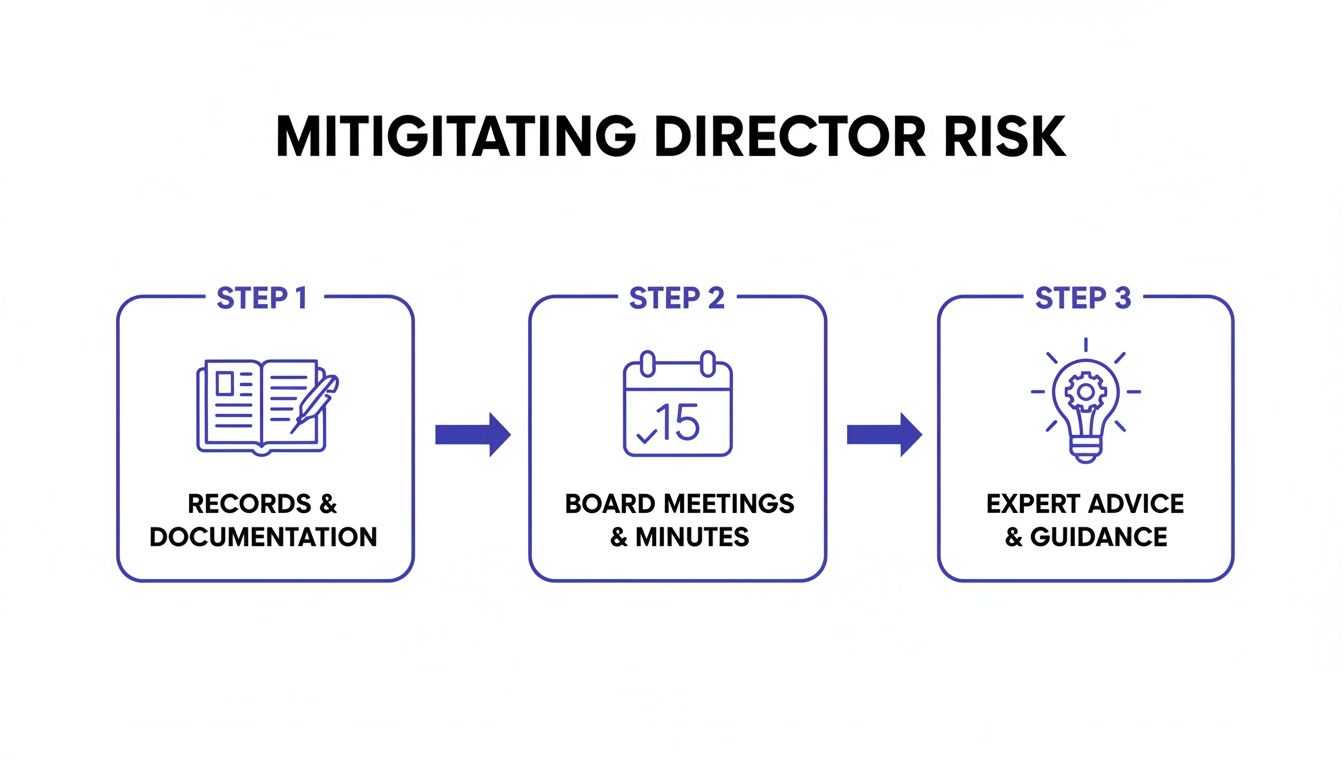
As you can see, keeping good records, holding documented meetings, and getting professional advice aren't just best practices—they're your shield.
How a Managed Exit Protects You
Let's be clear: this isn't a get-out-of-jail-free card. It's not a way to escape legitimate debts or dodge responsibility for actual wrongdoing. Instead, it’s a proactive solution for founders who have acted in good faith but whose business has simply failed. It acknowledges that the end of a company shouldn't have to mean the end of your financial stability or mental health.
By transferring the company to a professional firm, you are effectively handing over the complex, time-consuming, and stressful task of winding down to experts. This allows you to legally step away, confident that the closure is being handled correctly while you focus on what's next.
For founders facing this tough situation, understanding the procedural differences between your closure options is vital. To help you see the contrast more clearly, let's compare the two main paths side-by-side.
Comparing Company Closure Options
Aspect | Traditional Liquidation | Liquidation Via Managed Sale |
|---|---|---|
Director's Role | You remain the director throughout the process (6-24 months). | Your directorship ends immediately upon sale. |
Creditor Contact | You are the primary point of contact for all creditors. | The new owners handle all creditor communications. |
Timeline | Lengthy and uncertain, often lasting over a year. | Fast and definitive, typically completed in a few days. |
Administrative Burden | You are responsible for providing all documents and answering all questions. | The new directors handle all administrative and legal filings. |
Stress & Uncertainty | High. You face prolonged scrutiny and potential legal action. | Low. You achieve a clean break and can move on. |
Cost | Can be very expensive with liquidator fees and potential personal costs. | A fixed, predictable fee. |
This comparison shows that a managed sale is designed to give responsible directors a clean, fast, and certain exit.
Choosing the right path is the final, crucial step in managing your liability. If you want to dive deeper into the terminology, you might be interested in our guide that clarifies the difference between bankruptcy and liquidation for EU founders. Making an informed choice here is the last piece of the puzzle in protecting yourself from personal liability for company debts.
Securing Your Clean Exit and Next Chapter
Let's be clear: the idea of being held personally liable for company debts is daunting, but it's a risk you can absolutely manage. The end of a business is never easy, but it doesn’t have to spell personal financial disaster. Your strongest shield, now and always, is simply good governance. Keep clean records, write down the reasons for your decisions, and get professional advice the moment you sense trouble brewing.
When it's clear the company can't continue, knowing your options is everything. A strategic exit can save you from the drawn-out stress and intense scrutiny that often comes with a traditional liquidation process.
By taking decisive action, you can put a clean, legal end to this chapter of your career. This isn't just about closing a business; it's about protecting your personal assets and saving your energy for what you want to do next.
The real takeaway here is about control. Armed with the right information and a proactive plan, you can steer through your company's closure with confidence, safeguarding both your finances and your future.
A smart approach means you can walk away knowing everything was handled properly. If you're weighing up what to do, it’s worth understanding how long a typical liquidation takes and seeing how that compares to more modern, faster alternatives.
Choosing the right path gives you a clean break, freeing you up to focus on your next venture.
Frequently Asked Questions
Closing a company is a tough, stressful process, and it's the questions about personal liability that usually keep founders up at night. Here are some straight answers to the most common worries we hear.
If I Resign as a Director, am I Still Liable for Company Debts?
Unfortunately, resigning doesn’t give you a free pass for past actions. It’s a common misconception, but stepping down isn’t a get-out-of-jail-free card.
Think of it this way: your liability is tied to your conduct while you were a director. Liquidators are tasked with looking back at the company's history, and they can scrutinise the decisions of both current and former directors. If wrongful trading or a breach of duty happened on your watch, you can still be held personally accountable for the debts racked up during that time. Your resignation simply marks the end of your tenure; it doesn't wipe the slate clean.
What’s the First Thing I Should Do if I Think My Company Is Insolvent?
The second you suspect your company is insolvent, you have one immediate, non-negotiable priority: stop trading. That means no new sales, no new credit, no paying suppliers – nothing.
Every transaction you make after you knew (or should have known) the company couldn't pay its debts could be seen as wrongful trading, and that puts your personal assets directly on the line. Once you’ve pulled the emergency brake, your very next call should be to an insolvency specialist or a solicitor. You need expert, objective advice right away to navigate your legal duties and protect yourself. From that moment on, document everything.
This immediate halt to trading is the single most important action you can take to protect yourself. It demonstrates to any future liquidator or court that you acted responsibly to prevent further losses to creditors the moment you understood the severity of the situation.
How Does a Personal Guarantee Affect My Company Closure?
A personal guarantee sits entirely outside the company's limited liability structure. It's a separate contract you signed in your own name, making a personal promise to a lender – like a bank for a loan or a landlord for a lease.
When the company is closed down, that personal contract is still very much in force. Even after the liquidation is complete, the creditor can, and likely will, come directly to you to make good on that promise. These guarantees don't just vanish when the business does, so you have to tackle them head-on with your creditors as part of your winding-up plan.
Can Creditors Come After My House or Personal Savings?
In a normal, by-the-book business closure, the answer is no. The "corporate veil" is designed to separate your personal assets from the company's debts. This is the core principle of limited liability that makes entrepreneurship possible.
However, that protection disappears the moment you're found guilty of wrongful trading, fraud, or a major breach of your director duties. In those situations, the answer becomes a very clear and frightening yes. A court can grant an order that allows a liquidator to "pierce the corporate veil" and go after your personal assets – your home, savings, car, everything – to repay the company’s creditors. This is exactly why understanding the risks and acting responsibly is so vital.