Feb 13, 2026
Finding the Best Way to Liquidate a Company in Cyprus in 2026
Deciding on the best way to liquidate a company in Cyprus in 2026 really comes down to a trade-off between speed, cost, and your legal exposure. For most founders looking for a clean and predictable exit, a modern approach called Liquidation-Via-Sale (LVS) often makes the most sense. It offers a clear, straightforward path compared to traditional liquidation methods, which can get bogged down in bureaucracy and mounting costs.
Navigating Your Cyprus Company Liquidation Options

Closing a business is a huge decision, and the route you take in Cyprus will shape the entire experience. It all hinges on your company’s financial situation, how quickly you need to move on, and just how much administrative hassle you're willing to put up with. You essentially have three main choices: a Members’ Voluntary Liquidation (MVL), a Creditors’ Voluntary Liquidation (CVL), and the increasingly popular Liquidation-Via-Sale (LVS).
Each one is built for a different scenario. An MVL is for solvent companies that can easily pay off all their debts. A CVL, on the other hand, is the necessary path for insolvent businesses where the directors’ main duty is to the creditors. LVS provides a strategic alternative for founders who simply want to hand over the keys—and the responsibilities—fast.
Understanding the Current Climate
The economic ground in Cyprus has been shifting, and that’s putting real pressure on businesses. In 2025, we saw a startling jump in business insolvencies. Filings shot up by a massive 66.8% in Q2 compared to the first quarter, which was the second-highest increase in the entire EU. This trend underscores just how vital it is to have an efficient way to wind down a company. You can read more about the increase in Cyprus bankruptcies on dom.com.cy.
This kind of volatility makes long, drawn-out processes like MVL and CVL feel particularly risky. Their timelines and costs can easily get out of hand when the economic situation is so unpredictable.
For a founder, certainty is everything. A long liquidation doesn't just drain your bank account; it stops you from moving on to your next project. A quick, clean exit is almost always the smarter play.
Quick Comparison of Cyprus Liquidation Methods in 2026
To give you a bird's-eye view, here's a simple table summarising the main differences between your options. We'll dive much deeper into each of these in the next sections, but this should help you get your bearings.
Method | Best For | Typical Timeline | Founder Involvement |
|---|---|---|---|
Members' Voluntary Liquidation (MVL) | Solvent companies with no debt issues | 6-24+ months | High |
Creditors' Voluntary Liquidation (CVL) | Insolvent companies needing to manage creditor claims | 12-24+ months | Very High |
Liquidation-Via-Sale (LVS) | Founders seeking a fast, remote, and fixed-cost exit | 3-30 days | Low (post-sale) |
This guide will walk you through a detailed comparison of all these methods under 2026 rules, helping you pinpoint the best way to liquidate a company in Cyprus in 2026 for your unique circumstances.
Understanding the Traditional Paths to Closing a Cyprus Company

When you need to close a Cypriot company, you're typically funnelled into one of two conventional routes set out by local law. While these procedures are legally sound and thorough, they've earned a reputation for being slow, paperwork-heavy, and expensive. Understanding them is key, as they provide the baseline for comparing newer, more efficient alternatives.
The fork in the road is determined by one simple question: can the company pay its debts? This issue of solvency dictates which legal process you must follow, kicking off a journey that can take anywhere from six months to well over two years to complete.
Members' Voluntary Liquidation: For solvent companies
If your company is in the black and can cover all its debts within a 12-month period, the correct path is a Members’ Voluntary Liquidation (MVL). This is essentially an orderly, shareholder-controlled wind-down for a financially healthy business.
The whole process hinges on a crucial legal document known as the Declaration of Solvency. Here, a majority of the directors must swear an affidavit confirming the company’s strong financial position. This isn't just a formality; it has to be filed with the Department of Registrar of Companies before any shareholder votes, acting as a critical check against any misuse of the process.
Once the declaration is filed, the shareholders pass a special resolution to start the liquidation and bring in a licensed insolvency practitioner to act as the liquidator. At that point, the liquidator takes the reins and gets to work on:
Selling off any company assets that remain.
Paying off all outstanding creditor claims.
Distributing any leftover funds to the shareholders.
Finalising all tax returns and legal filings.
Even though it’s designed for simple closures, an MVL is anything but fast. The mountain of paperwork, mandatory meetings, and waiting for official clearances can keep founders legally tied to the company for a year or more. This long-tail liability significantly delays their ability to focus on what's next.
Creditors' Voluntary Liquidation: For insolvent companies
What happens when a company can't pay its bills? At that point, the directors' legal duty flips from serving the shareholders to protecting the creditors. The only appropriate route here is a Creditors’ Voluntary Liquidation (CVL), a process initiated by the directors themselves to show they're acting responsibly.
There’s no Declaration of Solvency in a CVL. Instead, directors must call separate meetings for both shareholders and creditors. The shareholders pass a resolution to wind up the company, but it's the creditors who hold the power, formally approving the appointment of a liquidator to oversee the process.
A liquidator’s job in a CVL is far more intense. Their primary goal is to sell the company's assets to get the best possible return for the creditors. This often involves digging into the company's recent history and the directors' actions leading up to the insolvency. As a founder, you can expect to be heavily involved, attending meetings and answering a lot of detailed questions.
These traditional methods, governed by the Cyprus Companies Law (Cap. 113), are built for legal precision, not speed. They’re simply not a good fit for modern founders who need a clean and quick exit. To get a better sense of these timeframes, you can read our deep dive into how long a typical company liquidation takes. The mix of steep professional fees, endless admin, and prolonged personal liability is precisely why exploring alternatives is so crucial when figuring out the best way to liquidate a company in Cyprus in 2026.
Comparing Cyprus Liquidation Methods Side by Side
Deciding how to close your company in Cyprus isn’t just a formality—it’s a critical decision with real, long-term consequences. The path you choose will directly dictate your timeline, final costs, and personal liability. Let’s put the three main options—Members’ Voluntary Liquidation (MVL), Creditors’ Voluntary Liquidation (CVL), and Liquidation-Via-Sale (LVS)—under a microscope to see how they stack up for founders in 2026.
This isn't just a list of features. It's about understanding the real-world impact of each choice. We’ll break down how they perform on speed, cost predictability, and the amount of risk you’re left holding as a director.
Comparing Speed and Timelines
The most obvious difference between these methods is time. For any founder, time is the one resource you can never get back. A drawn-out liquidation can feel like an anchor, holding you back from your next venture.
MVL and CVL Timelines: These traditional routes are notoriously slow, bogged down by strict legal procedures and long waits for administrative sign-offs. An MVL, even for a straightforward solvent company, typically takes anywhere from 6 to 24 months to finalise. A CVL is often worse, stretching beyond 12 to 24 months because of the added complexity of dealing with creditor claims.
LVS Timeline: In sharp contrast, a Liquidation-Via-Sale is built for speed. The entire process, from your first enquiry to the final share transfer, is over and done within 3 to 30 days. This means your legal ties to the company are cut in weeks, not years.
This time difference has become even more critical lately. For instance, in Q3 2025, Cyprus saw a massive 50% drop in business bankruptcies from the previous quarter, the largest in the EU. As reported by politis.com.cy, such wild swings show just how unpredictable administrative backlogs can be, making it nearly impossible to guess how long a traditional liquidation will really take.
Analysing Costs and Financial Predictability
The bill for closing your company can vary wildly. Traditional liquidations often come with vague, escalating costs, while modern alternatives are built on transparency and fixed pricing.
With an MVL or CVL, you have to appoint a licensed liquidator. Their fees are usually based on time spent on the case or a percentage of the assets recovered. This creates a variable cost structure that can easily get out of hand. On top of that, you’re on the hook for ongoing accounting fees, legal advice, and government filing charges for that entire 12-to-24-month slog.
The real cost of a traditional liquidation isn’t the initial quote; it’s the unpredictability. An estimate that seems reasonable at first can quickly balloon due to unforeseen problems, creditor disputes, or bureaucratic delays, leaving you with a much bigger bill than you ever planned for.
Liquidation-Via-Sale works on a completely different model. The entire service comes with a single, fixed fee, which you agree to upfront. That fee covers everything needed to wind down the company, managed by the new owners. This eliminates any risk of surprise costs. For a founder, that financial certainty is a huge relief.
Examining Founder Liability and Risk Exposure
This is probably the most important comparison point: how much personal risk are you left carrying? This is where the fundamental differences between the methods really show.
In both an MVL and a CVL, you, the director, are legally tied to the company until the Registrar of Companies officially declares it dissolved. This means for up to two years, you’re the go-to person for creditors, government agencies, and the liquidator. Your name stays on the public register, and you have to show up for meetings and answer questions throughout the whole process.
The Liquidation-Via-Sale method flips this script entirely. The process is a legal sale of your company shares. The moment the share purchase agreement is signed and filed, ownership and all legal responsibilities immediately shift to the new owner.
This gives you:
Your name removed from the company registry within days.
All creditor communications handled by the new management.
A clean legal break from the company's subsequent wind-down.
This immediate transfer of responsibility provides a clean break that traditional methods simply can’t match. It’s a powerful way to shed the personal stress and legal exposure that come with a long, drawn-out liquidation. For a deeper dive into how these options compare, you can explore our detailed liquidation methods comparison page.
Feature-by-Feature Liquidation Method Analysis
To lay it all out clearly, this table breaks down the three methods across the metrics that matter most when you're making this decision. It’s designed to help you see, at a glance, which path aligns with your priorities as a founder.
Criteria | Members' Voluntary Liquidation (MVL) | Creditors' Voluntary Liquidation (CVL) | Liquidation-Via-Sale (LVS) |
|---|---|---|---|
Solvency Status | Only for solvent companies | Primarily for insolvent companies | Suitable for both solvent and insolvent companies |
Timeline | 6-24+ months | 12-24+ months | 3-30 days |
Cost Structure | Variable (liquidator fees, ongoing costs) | High & Variable (liquidator, legal fees) | Fixed, one-time fee |
Founder Liability | Retained until final dissolution | High and retained until dissolution | Transferred immediately upon sale |
Founder Involvement | High (meetings, paperwork, queries) | Very high (creditor meetings, investigations) | Low (only during the sale process) |
Remote Execution | Difficult; may require Power of Attorney | Very difficult; requires extensive interaction | Fully remote and digital process |
In the end, while MVL and CVL are the required legal paths in certain specific cases (like distributing large surplus assets to shareholders), they are rarely the most strategic choice for founders who need an efficient exit. For a fast, predictable, and low-risk closure, the analysis consistently shows that Liquidation-Via-Sale is the best way to liquidate a company in Cyprus in 2026 for the vast majority of business situations.
So, Which Liquidation Method Is Right for You?
Knowing the nuts and bolts of each liquidation method is one thing, but figuring out which one actually fits your situation is a completely different ball game. The best way to close your Cyprus company in 2026 really boils down to your specific circumstances—where you're based, what your relationship with creditors looks like, and frankly, how quickly you need to move on.
Let's be honest, theoretical comparisons only get you so far. The best way to make a real-world decision is to walk through a few common scenarios that founders face all the time. See if one of these sounds familiar; it'll give you a much clearer idea of the most strategic path forward.
This decision tree below maps out the crucial questions you need to ask. It's a quick visual guide based on solvency, creditor status, and your need for a clean, fast exit.
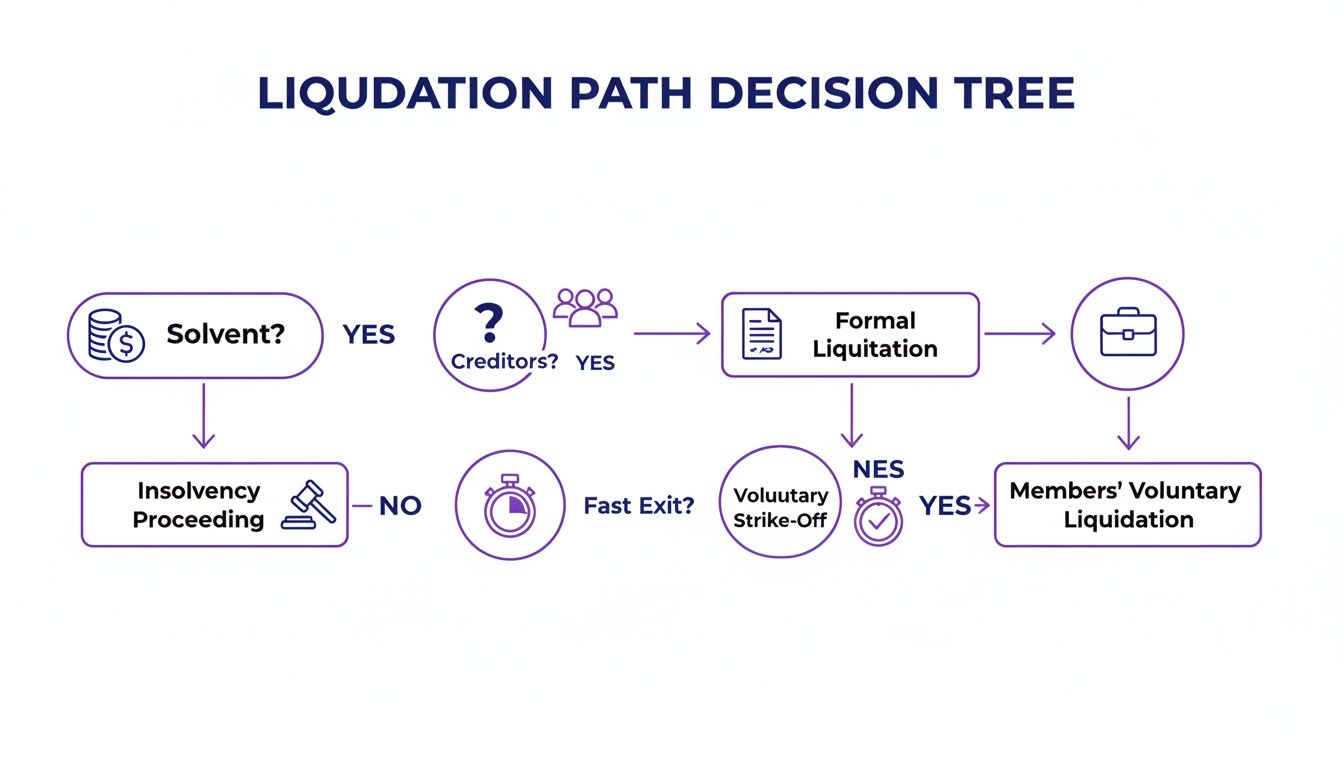
As the flowchart makes clear, founders who are prioritising a swift and clean exit—whether the company is solvent or not—will find their path diverges sharply from the slower, more traditional routes.
The Non-Resident Founder Scenario
Picture this: you're an EU citizen living and working outside of Cyprus. You set up a Cypriot company to tap into the European market, but the business has now run its course. The legal entity, however, is still sitting there, quietly racking up administrative costs and compliance headaches.
Trying to manage a traditional MVL or CVL from abroad is a logistical nightmare. You're looking at authorising a local representative via Power of Attorney, dialling into meetings across different time zones, and dealing with a relentless stream of paperwork demanding your signature. It's a slow, disconnected process that leaves you feeling completely out of the loop.
A Liquidation-Via-Sale (LVS) was practically designed for this exact challenge. The entire process, from the first chat to the final e-signature on the share purchase agreement, is handled digitally and remotely. It cuts out the need for travel or complicated legal authorisations, delivering a seamless exit in just a few days.
Recommendation: For non-resident founders, the speed and completely remote nature of LVS make it the clear winner. It offers a clean break without the logistical drain of a traditional liquidation.
The Founder Facing Creditor Pressure Scenario
Now, imagine a founder whose e-commerce venture has hit a wall and is now insolvent. Suppliers are calling, payment reminders are flooding their inbox, and the stress is becoming unbearable. The number one goal is to handle the debts responsibly and just make the constant creditor communications stop.
Kicking off a Creditors' Voluntary Liquidation (CVL) is the standard, formal route, but it’s a marathon, not a sprint. For 12-24 months, you remain the public face of the company. You have to endure intense creditor meetings, answer to a liquidator, and face continuous scrutiny over past decisions. The pressure doesn't disappear; it just gets formalised. You might also want to read up on director liability for company debts in our detailed article.
A Liquidation-Via-Sale, on the other hand, provides immediate relief. As soon as the company shares are sold, the new owners take over all creditor negotiations. Your name is removed from the public registry within weeks, and the phone calls and emails simply stop. This lets you step away from the stress while the company's liabilities are handled by professionals.
Recommendation: For founders buckling under creditor pressure, LVS is the fastest way to transfer responsibility and reclaim your peace of mind. It’s a far more practical solution than a drawn-out CVL.
The E-commerce Seller with Frozen Assets Scenario
Let's consider an online seller whose main revenue stream—say, a major marketplace account—has been frozen, along with all the funds inside. The company has outstanding debts to suppliers and the tax authorities, but with its primary assets locked up, it can't operate or pay anyone.
In a situation like this, speed is everything. You need to unlock value and settle obligations before things get worse. A CVL would take far too long. Those months tied up in legal proceedings would only see the value of any remaining stock plummet while creditor demands intensify. The goal is to liquidate the company and its assets fast to pay off as much debt as possible.
An LVS is built for this type of urgency. The new ownership can immediately get to work on resolving the frozen account and liquidating physical inventory. Because the sale is completed in days, the wind-down can begin almost instantly, maximising the value recovered from the assets and leading to a much faster resolution for creditors.
Recommendation: For businesses with time-sensitive assets or liabilities, the rapid execution of an LVS is the most effective way to preserve value and manage debts efficiently.
How Does a Liquidation-Via-Sale Actually Work?

Think of a Liquidation-Via-Sale (LVS) as less of a formal winding-up and more of a straightforward commercial deal. It completely sidesteps the long, drawn-out legal marathon of traditional liquidation. For founders who just want a clean, fast exit from a business that's run its course, it's a game-changer. You won't be appointing a liquidator or waiting on administrative processes that seem to have no end.
At its core, the process is exactly what it sounds like: a sale of your company's shares. This one action transfers ownership—and with it, every legal and administrative responsibility—to a new party. It provides a final, immediate end to your involvement, a crucial advantage given Cyprus's recent economic volatility.
We've seen some wild swings lately. Bankruptcy declarations shot up by a staggering 399.3% in the last quarter of 2024, only to jump another 66.8% by mid-2025. When you couple that with Cyprus’s relatively low World Bank insolvency readiness score of just 47%, the appeal of a predictable, certain exit becomes crystal clear. You can dig into these economic trends on Eurostat's official site if you want the full picture.
The Step-by-Step LVS Journey
The whole LVS method is designed to be transparent and as hands-off for you, the founder, as possible. It’s a clear, structured path from start to finish.
Initial Free Consultation: It all starts with a chat. This is a no-cost, no-obligation conversation to see if an LVS is genuinely the right fit for your company’s specific situation.
Due Diligence and Agreement: Next comes a quick but thorough review of your company's legal and financial standing. Once that’s done, a formal Share Purchase Agreement (SPA) is drafted, laying out the terms of the sale for a nominal amount.
Digital Signature and Transfer: The SPA is signed digitally, so the whole thing can be done remotely. As soon as you sign and the fixed fee is paid, the company shares are officially transferred to the new owners.
Immediate Responsibility Shift: This is the key moment. The second the sale is finalised, all legal and administrative burdens shift away from you. The new owners take over everything—filings, creditor communications, and the ultimate wind-down.
What Happens Post-Sale: Your Clean Break
The real value of an LVS is what happens the day after the deal is done. Your legal ties to the company are severed—not in a year, but almost immediately.
Your name is quickly removed from the records at the Cyprus Department of Registrar of Companies. This is a matter of days, a stark contrast to the months or even years you'd wait with a traditional liquidation. From that point on, you’re no longer the one fielding calls from creditors or dealing with tax authorities. The new ownership team handles all of it.
This instant and total transfer of responsibility is what makes the LVS method so powerful. It lets founders walk away without the mental weight of lingering liabilities, freeing them up to focus 100% on whatever comes next.
Is This Right for You? The Suitability Checklist
While an LVS is a fantastic tool, it’s not a magic wand for every situation. It's a professional service built on transparency, and there are clear rules to ensure it's used legally and ethically.
An LVS is not an option for companies where:
Undisclosed Personal Guarantees Exist: If you, as a director, have signed any personal guarantees, these must be fully disclosed. A share sale transfers the company's liabilities, but it can't erase your personal obligations.
There Are Active Fraud Investigations: This service cannot be used to sidestep criminal proceedings or active fraud investigations connected to the company or its directors.
This framework is in place for a good reason. It ensures the process remains a legitimate, responsible exit for founders looking for the best way to liquidate a company in Cyprus in 2026. It’s a clean break, not a loophole.
Your Top Questions About Cyprus Company Liquidation
Wrapping up a business brings a lot of questions to the surface. Let's tackle the most common ones founders ask when they're deciding how to close their Cyprus company in 2026. Getting these answers right is key to making a smart, final decision.
Can I Close My Cypriot Company from Abroad?
Yes, you can, but the method you choose makes all the difference. Traditional routes like a Members’ or Creditors’ Voluntary Liquidation (MVL/CVL) are notoriously difficult to handle remotely. They often involve trips to Cyprus or navigating the complexities of giving a Power of Attorney to someone locally.
A Liquidation-Via-Sale (LVS), on the other hand, is built from the ground up to be done entirely online. Every single part of the process, from the first chat to the final e-signature on the sale agreement, happens digitally. This makes it the go-to option for founders living outside of Cyprus.
What Happens to the Company's Debts in a Liquidation‑Via‑Sale?
Once you complete a Liquidation-Via-Sale, the company—along with everything it owns and owes—is no longer yours. The new owner takes over legal responsibility for all its assets and liabilities. This means they are now in charge of dealing with any legitimate creditor claims.
You are formally removed as a director, so creditors will stop contacting you directly. It's crucial to understand, however, that this process does not erase any personal guarantees you may have signed. These are separate legal commitments and must always be disclosed from the start.
The real game-changer with an LVS is the immediate handover of all operational headaches. As soon as the sale goes through, the new owners deal with every piece of correspondence. You're insulated from the stress of creditor calls, and you can be confident that the company's liabilities are being handled professionally.
Is It Legal to Close a Company with a Liquidation‑Via‑Sale?
Absolutely. A Liquidation-Via-Sale is a 100% legal and compliant way to exit your business. At its core, it’s a standard, legitimate corporate transaction: the sale of company shares. It's simply a modern, efficient alternative to the older, slower liquidation procedures.
After the sale, the new owners take on the duty of winding down the company correctly, following all Cypriot laws. They engage their own network of local legal professionals to handle the final paperwork and filings, guaranteeing a closure that is by the book. It's a secure and recognised exit strategy.
How Fast Can I Get My Name off the Cyprus Company Register?
This is where the difference between methods really stands out. With a traditional liquidation (MVL or CVL), your name stays attached to the company in the public register until the very end. That process can drag on for 12 to 24 months, sometimes even longer.
An LVS offers a much quicker, cleaner break. As soon as the share purchase agreement is signed, the change of ownership is filed with the Department of Registrar of Companies. This means your name can be officially removed from the public records in as little as 3 to 30 days, giving you a fast and final legal exit.