Feb 11, 2026
The Best Way to Liquidate a Company in Sweden in 2026
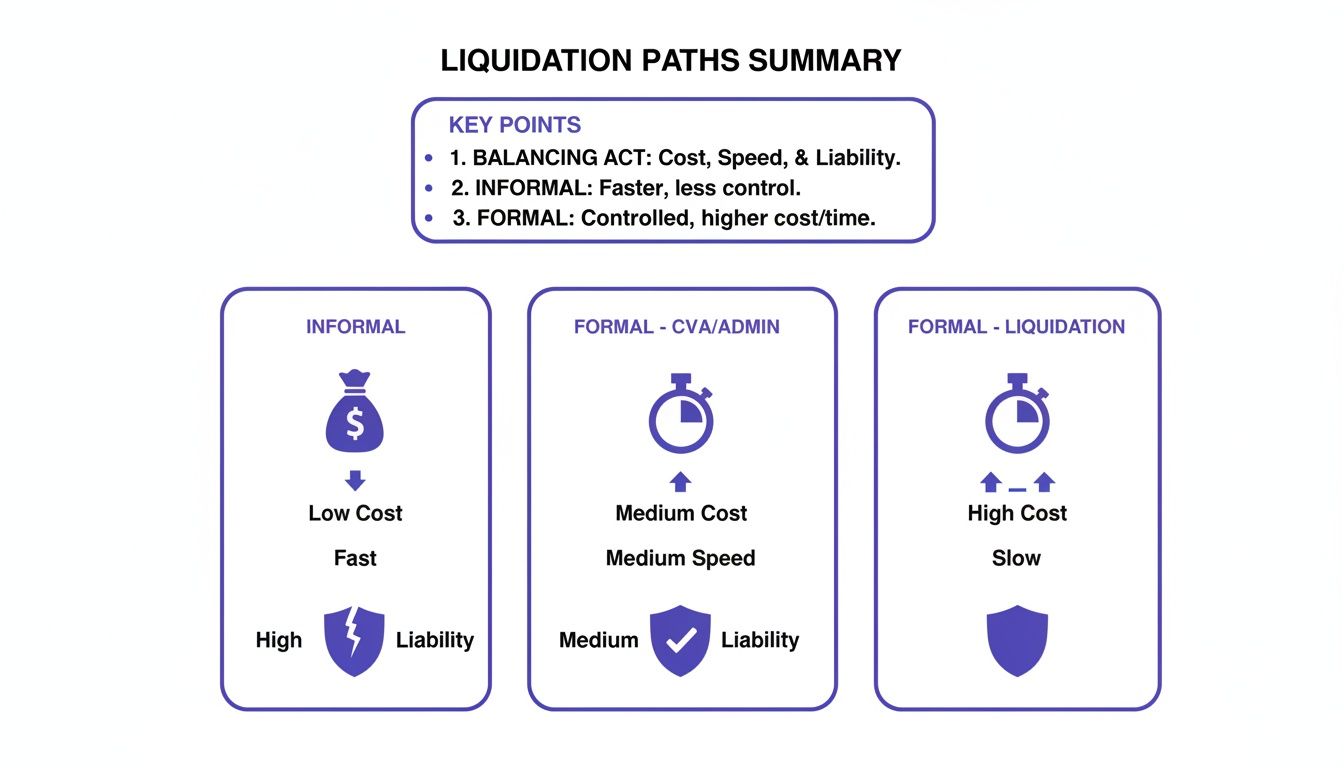
When you’re ready to close your Swedish company, you're really trying to balance three things: how fast it happens, how much it costs, and how much personal risk you’re carrying. For most founders who just want a clean and quick exit without getting bogged down in paperwork, selling the company to a liquidation specialist is often the fastest way out—sometimes in just a few days.
But if your company is financially sound and you're not in a rush, the traditional voluntary liquidation route is a more conventional, though much slower, option.
Choosing Your Swedish Company Liquidation Path
Shutting down a Swedish limited company (Aktiebolag) is a serious move with real legal and financial ripple effects. The path you take will dictate the timeline, the final cost, your personal liability, and just how much administrative work you’ll have to personally manage. Getting it right means knowing exactly what you're getting into.
In 2026, there are four main ways to go about it, and each one fits a very different business situation.
Voluntary Liquidation (Frivillig likvidation): The formal, shareholder-led process for a company that can pay its bills.
Bankruptcy (Konkurs): A court-driven process for insolvent companies that can't cover their debts.
Deregistration: A simple closure for companies that are completely dormant—no assets, no liabilities, no activity.
Liquidation Via Sale: A modern approach where you sell the company shell to a firm that takes over and handles the entire wind-down process.
Comparing the Core Liquidation Methods
The current economic climate makes choosing the right path more important than ever. In 2023, Sweden saw a significant rise in bankruptcies. That trend, detailed in recent Creditsafe data, highlights the harsh reality of traditional closure methods, which can drag on for 6-24 months while you're stuck dealing with paperwork and creditors.
To make a smart decision, you need to see how these options stack up side-by-side.
Attribute | Voluntary Liquidation | Bankruptcy (Konkurs) | Deregistration | Liquidation Via Sale |
|---|---|---|---|---|
Typical Timeline | 7–12 months | 12–24+ months | 1–3 months | 3–30 days |
Best For | Solvent companies, orderly wind-down | Insolvent companies | Dormant companies with zero activity | Founders needing a fast, clean exit |
Director Control | Relinquished to a liquidator | Immediately lost to a court administrator | Maintained by director | Immediately transferred to new owner |
Public Record | Public liquidation notice | Public bankruptcy filing | Public deregistration | Private share sale, name removed |
Grasping these core differences is the first step in protecting your assets and your reputation. The right choice really boils down to what matters most to you: speed, cost, privacy, or simply managing an insolvency correctly.
This guide will break down each of these paths, giving you the detail you need to pick the most strategic and efficient exit for your company.
Comparing Your Liquidation Options in Detail
When it comes to closing your Swedish company in 2026, you've got a few different roads you can take. Choosing the right one means looking beyond the basics and getting real about what matters most to you as a founder: how fast it happens, what it costs, how much control you keep, and what happens with your personal liability. Each path has its own set of trade-offs, and your decision will absolutely shape your financial and personal future.
Let's break down the four main ways to close a Swedish limited company. We’ll look at the timelines, the real costs, what it means for your liability as a director, how it appears on public record, and how creditors are handled. This will give you a clear framework to see which option actually fits your situation.
Speed and Timeline: A Critical Differentiator
The first thing you’ll notice is the huge difference in how long each process takes. A traditional voluntary liquidation is a marathon, not a sprint. It’s a formal, multi-stage process governed by the Swedish Companies Act (Bolagsverket), and you’re looking at a timeline of 7 to 12 months from start to finish.
Bankruptcy (konkurs) takes even longer. Once the district court (tingsrätt) gets involved, a court-appointed administrator starts digging into the company’s affairs. This process can easily drag on for 12 to 24 months, and sometimes much longer depending on the complexity.
On the other end of the spectrum is a Liquidation Via Sale. This is your fast-track exit. The entire transaction—selling your company shares to a specialist firm—is typically done in just 3 to 30 days. For founders who need to move on quickly, whether it's to jump on a new venture or just stop a failing business from bleeding more money, this speed is a game-changer. You can get a deeper look into these timelines in our guide on how long liquidation takes.
Financial Costs and Predictability
The cost to close your doors can be all over the place. With a voluntary liquidation, the final bill is a bit of a mystery. You're on the hook for the liquidator's fees, which are usually charged by the hour, plus various administrative costs. Over the many months it takes, these expenses can really add up, especially if any complications arise.
Bankruptcy brings even more financial uncertainty. While the costs are paid from the company's remaining assets, the administrator's investigation and legal fees can easily eat up whatever value is left, often leaving nothing for creditors or shareholders.
A Liquidation Via Sale gives you total cost certainty. You agree on a single, fixed fee upfront. That’s it. This fee covers the entire dissolution process, which the new owners handle, so there are no surprise bills down the road. It lets you budget for your exit with complete confidence.
The economic reality for Swedish businesses makes these costs a major factor. The insolvency numbers tell a tough story. Official statistics show a challenging environment for companies. These figures really highlight how slow and expensive the traditional dissolution routes can be, often making a bad situation worse.
Control and Director Liability
How much control you have—and how exposed you are to personal liability—varies dramatically with each option. In a voluntary liquidation, you hand over the keys to a liquidator appointed by Bolagsverket. They take over the board's duties, and you step back.
In bankruptcy, you lose control completely, and you lose it instantly. The court puts an administrator in charge who has total authority. They will investigate your past actions as a director and can hold you personally liable for things like wrongful trading.
This is where Liquidation Via Sale offers a clean break. When you sell your shares, you legally transfer ownership and all the responsibilities that come with it. Your name is removed from public registries, and the new owner takes on the full responsibility for managing the company, its creditors, and its final dissolution. This puts a definitive end to your involvement and shields you from future claims.
To help you see the differences at a glance, we've put together a comparison table.
Key Differences in Swedish Company Liquidation Methods
This table compares the critical attributes of the four main liquidation paths for a Swedish Aktiebolag (AB) to help you make an informed decision.
Attribute | Voluntary Liquidation | Bankruptcy (Konkurs) | Deregistration | Liquidation Via Sale |
|---|---|---|---|---|
Timeline | 7-12 months | 12-24+ months | 6-8 months | 3-30 days |
Cost | Unpredictable, hourly fees | Very high, drains all assets | Low administrative fees | Fixed, upfront fee |
Director Control | Ceded to liquidator | Lost immediately to administrator | Maintained by director | Transferred upon sale |
Liability | Ceases after dissolution | High risk of personal liability | Remains until dissolved | Ends at the point of sale |
Public Record | Public liquidation notice | Public bankruptcy record | Public deregistration record | Clean, private exit |
Eligibility | Solvent companies only | Insolvent companies only | Dormant, debt-free companies | Solvent or distressed companies |
As you can see, the path you choose has significant implications. The faster, more cost-effective methods like Liquidation Via Sale are specifically designed to provide a swift and clean exit while minimising director liability.
The Old-School Routes: Traditional Liquidation and Bankruptcy
When you start looking into how to close a Swedish company, you'll quickly run into two well-trodden paths: voluntary liquidation and bankruptcy. These are the traditional, formal legal routes, each designed for entirely different financial circumstances. Getting to grips with how they work, how long they take, and what they really mean for you is crucial, especially if a formal wind-down is on your radar for 2026.
Let's start with the "clean" option. Voluntary liquidation, or frivillig likvidation, is what you do when your company is solvent but you've decided it's time to close the doors. It's a deliberate, structured process kicked off by the shareholders. Think of it as an orderly dismantling of the business—but don't mistake "orderly" for "fast".
The Voluntary Liquidation Process
It all begins with a formal shareholders' decision to dissolve the company. Once that resolution is filed with Bolagsverket (the Swedish Companies Registration Office), they appoint an official liquidator, known as a likvidator.
This is a major turning point. The moment the liquidator is appointed, the board of directors and CEO are out. The liquidator takes complete control. Their job is to:
Pay off every single company debt.
Sell all remaining business assets.
Compile a final, detailed report on the entire process.
Distribute whatever money is left over to the shareholders.
The whole thing is highly regulated and very public, typically dragging on for 7 to 12 months. The costs can also be a bit of a black box, as you're on the hook for Bolagsverket's fees plus the liquidator's hourly rate, which racks up over that long timeframe.
The bottom line? Voluntary liquidation is a controlled, by-the-book process. But you give up all control to a third-party professional, and the entire affair plays out in the public eye for the better part of a year. It's really only a fit for solvent companies where time is not a factor.
The Bankruptcy Minefield
Bankruptcy, or konkurs in Sweden, isn't a strategic choice; it's what happens when a company becomes insolvent. A business is legally insolvent when it can't pay its debts on time and this isn't just a temporary cash flow problem. The company itself can file, or a creditor can force the issue by filing at the local district court (tingsrätt).
Once the court declares a company bankrupt, things move quickly and harshly. The directors are immediately stripped of all control. The court appoints a bankruptcy administrator (konkursförvaltare) to take over everything.
The administrator’s sole focus is to manage the company's assets to get the best possible return for the creditors. This includes a full public investigation into the company's books and, crucially, the past actions of its directors. If they find evidence of mismanagement, directors could find themselves personally liable for the company's debts. We dive deeper into this in our guide on the difference between bankruptcy and liquidation for EU founders.
This process is incredibly slow, often taking one to two years, sometimes longer. It leaves a permanent black mark on your public record and comes with serious personal risks for directors. It’s the absolute last resort, a path taken only when a company has truly run out of road. Both of these traditional methods are a world away from the faster, more modern solutions available in 2026.
Liquidation Via Sale: A Modern Approach to Closing Your Company
For many founders, the traditional paths to closing a company feel outdated. They're often too slow, too public, and far too expensive. But there's another way forward. Liquidation Via Sale is a clean, fast, and private route to exit your Swedish limited company, sidestepping the bureaucratic hurdles of Bolagsverket or the courts. At its heart, it's a straightforward commercial transaction, not a lengthy legal process.

The entire mechanism is built around a single, decisive action: selling 100% of your company's shares to a specialised firm. This transaction immediately transfers all ownership, along with every administrative and legal responsibility tied to it. For you, the founder, that's it. You're done.
How Does The Share Sale Work?
The process is refreshingly simple. After agreeing on the terms, you sign a share purchase agreement. This document legally transfers your ownership to a buyer—a firm whose entire business is acquiring companies to manage their final dissolution in full compliance with Swedish law.
The moment that agreement is signed, the weight is lifted from your shoulders. The new owner becomes the legal director and shareholder, taking full control. They are now responsible for everything that follows, from negotiating with creditors to filing the last pieces of paperwork. Crucially, your name is removed from public registers like Bolagsverket almost immediately.
This handover is absolute, covering every last detail of the company's closure.
Administrative Duties: The buyer takes over all filings, accounting, and communications with government agencies.
Legal Obligations: They assume the full responsibility for winding down the company according to the Swedish Companies Act.
Creditor Management: Any calls or letters from creditors are now their problem, not yours.
This method is fundamentally about transferring responsibility. Instead of you overseeing a months-long liquidation, you are effectively selling the problem itself to an expert who handles it on your behalf.
The Key Benefits of a Clean Break
The real power of this approach lies in its speed and finality. A traditional voluntary liquidation can drag on for 7–12 months. A Liquidation Via Sale, on the other hand, is usually wrapped up within 3 to 30 days. For an entrepreneur ready to move on to their next project, that time difference is everything.
Then there’s the cost. Traditional liquidators often work on an hourly rate, meaning your final bill can be a nasty surprise. This method offers total cost predictability with a fixed, upfront price. You know exactly what your exit will cost from the very beginning, with no hidden fees. This financial clarity makes it the best way to liquidate a company in Sweden in 2026 for many founders looking to protect their capital.
Finally, it gives you complete disengagement. The stress of managing a complex closure, fielding calls from creditors, and worrying about making a procedural mistake is gone. The sale provides a clean, immediate break, freeing you to focus your energy and resources on what's next. It’s a strategic exit built for the modern founder who values their time and peace of mind above all.
Which Liquidation Path Fits Your Business Scenario?
Deciding how to close your Swedish company in 2026 isn’t a one-size-fits-all exercise. The best path forward really hinges on your unique situation — the company’s financial health, your own tolerance for risk, and frankly, how quickly you need to move on. While comparing options on paper is helpful, the choice becomes much clearer when you see how they play out in the real world.
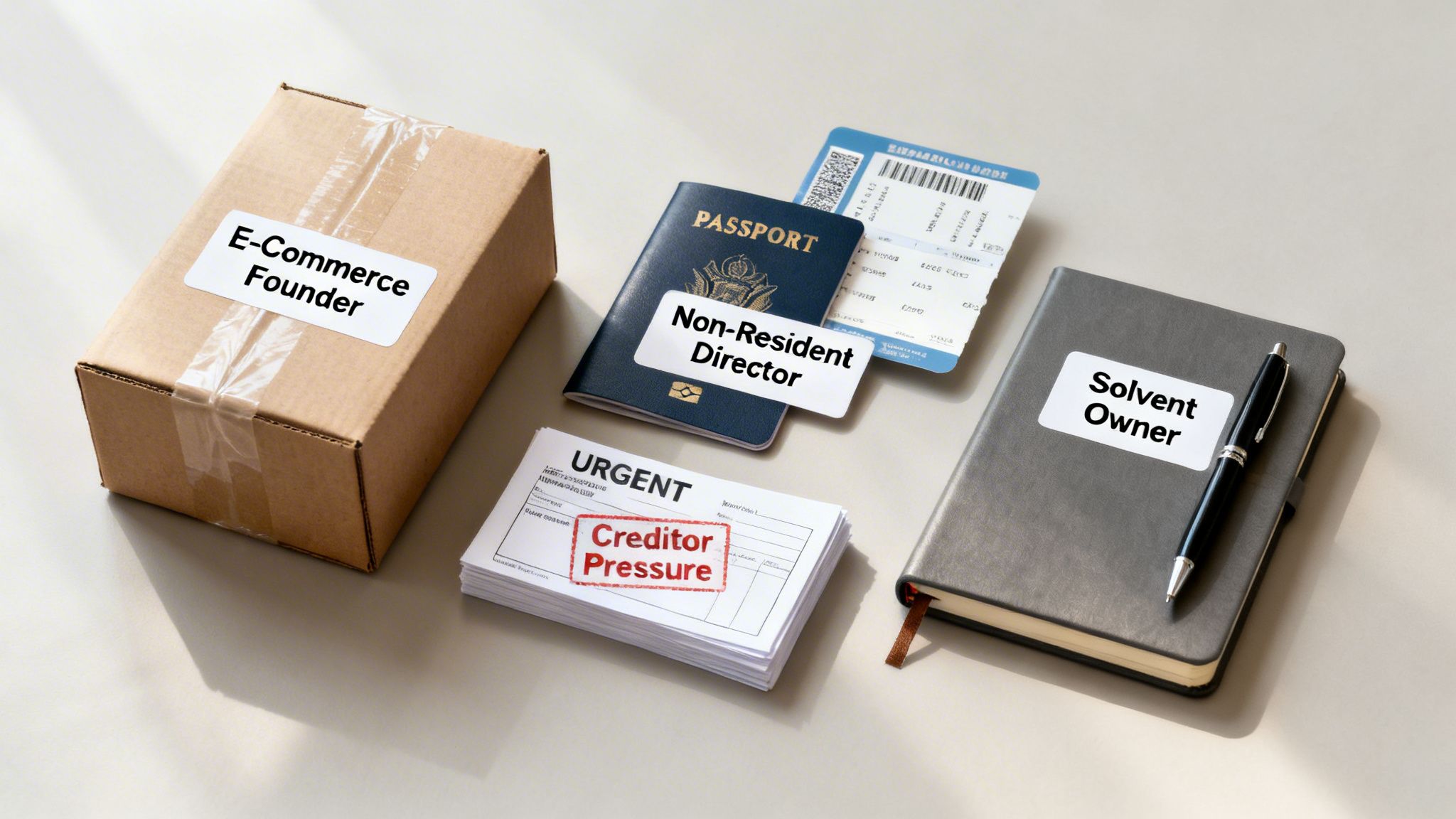
Let's walk through four common scenarios entrepreneurs find themselves in. By looking at these practical examples, you can start to see which exit strategy aligns with your own goals.
The E-commerce Founder With Unsold Stock
The Situation: An Amazon FBA seller has been blindsided by new platform rules, leading to a suspended account. Now, they're stuck with a warehouse full of unsold goods in Sweden, with storage fees piling up and supplier invoices coming due. The goal is simple: cut the losses and get out fast before things spiral into insolvency.
For this founder, every day counts. A traditional voluntary liquidation is a non-starter; it would drag on for 7-12 months while costs continue to mount. Bankruptcy isn't the right fit either, as the company is still solvent, and the public record that comes with it can be damaging.
Recommended Path: Liquidation Via Sale.
Why it Works: It's all about speed and finality. This route provides an immediate exit, often wrapped up in just a few days. The founder sells the company shares, effectively handing off the entire problem—the inventory, the supplier debts, everything—to the new owner. The financial bleeding stops instantly, allowing the founder to walk away clean.
The Non-Resident Director of a Dormant Company
The Situation: An entrepreneur living abroad established a Swedish Aktiebolag (AB) for a project that never got off the ground. The company is a clean slate—no assets, no debts—but it’s been sitting dormant for over a year. The director just wants it gone, with minimal fuss, minimal cost, and without having to fly to Sweden.
This director’s priority is a straightforward, remote process. While simply deregistering might sound easy, it can involve a surprising amount of paperwork with Bolagsverket, and the director remains legally on the hook until it's all finalised.
For a non-resident director, the biggest headache isn't the process itself, but the risk of a small mistake causing major delays or complications. They need a fire-and-forget solution.
This is where a Liquidation Via Sale shines. The entire share transfer can be managed remotely. Once the sale is complete, the director is immediately and fully detached from the company and its legal responsibilities. The new owner then takes care of all the final filings with the Swedish authorities, guaranteeing a compliant, hassle-free closure.
The Founder Facing Mounting Creditor Pressure
The Situation: A small consulting firm is hitting a serious cash flow crunch. A few big clients have paid late, and now the company is falling behind on payments to suppliers and the Swedish Tax Agency (Skatteverket). The phone has started ringing with calls from creditors. The company isn’t insolvent yet, but it’s getting dangerously close, and the founder is desperate to avoid the stigma and personal stress of bankruptcy.
Here, the main goal is to sidestep the harsh reality of a formal bankruptcy while still handling the company’s debts responsibly. A voluntary liquidation is just too slow; creditors could easily force the company into bankruptcy long before the process is finished.
Recommended Path: Liquidation Via Sale.
Why it Works: Selling the company transfers the entire burden of creditor negotiations to a specialist buyer. This gives the founder a fast, private exit, stopping the situation from escalating into a public bankruptcy proceeding. The new owner then manages the entire wind-down, including settling liabilities, in a professional and legally sound manner. For a deeper dive into how different circumstances require different approaches, you may find our article on common liquidation scenarios insightful.
The Solvent Company Owner Planning Retirement
The Situation: The owner of a consistently profitable, debt-free service business is ready to retire. There’s no successor, so the plan is to simply close up shop and access the company’s capital. Time isn’t a pressing issue; the priority is a methodical, transparent, and completely official wind-down.
This founder’s needs are entirely different from the others. There's no financial pressure, the company is in great shape, and the goal is a traditional, by-the-book closure to properly distribute the final assets.
Recommended Path: Voluntary Liquidation.
Why it Works: When a company is solvent and there’s no rush, the formal, state-supervised process of voluntary liquidation is the perfect choice. It guarantees that every single legal and financial requirement is met, providing a clean and indisputable end to the company’s life. The appointment of an official liquidator ensures everything is handled correctly, leading to a clean distribution of assets back to the owner.
Your Swedish Company Liquidation Questions, Answered
When it's time to close your company in Sweden, a lot of questions pop up. As a founder, you need straight answers to choose the right path for your situation. Let's tackle the most common questions we hear from entrepreneurs in 2026, giving you the clarity to move forward.
Winding down a business can feel like navigating a minefield of legal and financial rules. We'll clear up the confusion around everything from liquidators and debts to the newer, faster exit strategies.
Can I Liquidate a Swedish Company Without a Liquidator?
For a formal voluntary liquidation (frivillig likvidation), the law is black and white: you can't do it alone. The Swedish Companies Act mandates that an officially appointed liquidator, approved by Bolagsverket, must take over. This person effectively replaces the board and handles the entire process.
It's the same story with a bankruptcy (konkurs), where a court-appointed administrator takes full control. The only exception is a simple deregistration of a completely dormant company, but that comes with very strict conditions.
The one route where you sidestep the whole process of appointing and managing a liquidator is Liquidation Via Sale. Here, the responsibility for formally dissolving the company passes entirely to the new owners. They handle all the legal steps from that point on.
What Happens to Company Debts in a Liquidation Via Sale?
This is a big one for most founders. When you opt for a Liquidation Via Sale, the company’s debts don't just disappear—they stay with the company. The crucial difference is that you are no longer the owner.
By selling your shares, you transfer the company and everything in it—assets and liabilities—to the buyer. This cuts your ties as a director, as long as you haven't personally guaranteed any of the company's debts. The specialist firm that buys your company takes on the full responsibility for dealing with creditors and settling any outstanding obligations according to Swedish law. You're completely removed from any future creditor calls or negotiations.
How Long After Liquidation Can Creditors Pursue Me?
How clean your break is really depends on the method you choose. In a traditional bankruptcy, for instance, the administrator will look into past transactions, and you could still be held personally liable if they uncover any director misconduct. Once a voluntary liquidation is complete and the company is struck off the register, claims generally stop.
But the real advantage of a Liquidation Via Sale is how immediate and final your exit is.
The moment the share transfer agreement is signed, your legal connection to the company is severed.
The new owners become the only point of contact for creditors.
This gives you the strongest possible guarantee of a clean break, shielding you from any lingering claims down the road.
Is Liquidation Via Sale a Legal Method in Sweden?
Yes, it's completely legal. A Liquidation Via Sale is a legitimate and compliant way to exit a company. The whole thing is based on a standard share sale, a transaction governed by the Swedish Companies Act (Aktiebolagslag 2005:551). It's not some obscure loophole; it’s a smart application of established corporate law.
The service itself is what's innovative. Specialised firms buy the company specifically to manage its formal, lawful dissolution. This lets the original owner exit quickly while ensuring the company's affairs are wound up professionally and in full compliance with all Swedish legal standards. It’s simply a modern, efficient solution for today's founders.