
Feb 22, 2026
Best Way to Liquidate a Company in Denmark in 2026
Deciding to close your business in Denmark can feel like a heavy weight, but choosing the right path forward doesn't have to be. The best way to liquidate a company in Denmark in 2026 is simply the one that fits your company's health and your own personal needs. For founders who need a quick and clean break, a Liquidation Via Sale can provide a definitive exit, sometimes in just a few days. On the other hand, if your company is solvent and you have the time for a more traditional route, a voluntary liquidation gives you full control over the process.
Your Guide to Closing a Danish Company in 2026

When it's time to shut the doors on your Danish company, you'll find there are a few distinct legal routes available. Each one is built for a specific situation, whether you're closing a healthy business in an orderly fashion or dealing with an urgent, debt-laden scenario. Getting this choice right from the start is absolutely critical for a smooth, cost-effective exit that lets you focus on what's next.
In 2026, the main options on the table for founders are:
Voluntary Liquidation: A formal, director-controlled process that works well for solvent companies. You'll appoint a liquidator to wrap up business affairs, settle any outstanding debts, and distribute the remaining assets to the shareholders.
Bankruptcy (Konkurs): This is the necessary path for insolvent companies that simply cannot pay their bills. It’s a formal court process, which can be started by the company itself or by its creditors.
Liquidation Via Sale: A much faster, more modern approach where you sell the shares of your company to a specialist firm. The new owner then assumes all director duties and handles the formal closure, giving you an immediate and clean exit.
Choosing Your Exit Strategy
Closing a company in Denmark has historically been a long, drawn-out process. A formal liquidation could easily drag on for 18 to 24 months, leaving entrepreneurs tangled in administrative duties and negotiations with creditors. The sheer number of businesses that close is telling; Denmark has seen an average of 308 company bankruptcies each month over the years, which underscores the constant need for better, more efficient exit strategies.
The biggest difference between these methods really comes down to time versus control. A traditional voluntary liquidation gives you the driver's seat, but it's a long journey. A Liquidation Via Sale, in contrast, is all about speed and finality—it lets you cut ties with the company in a matter of days, not months.
It’s important to grasp the practical consequences of each closure method. For a deeper dive, our guide on what happens when you liquidate a company breaks it down further.
To give you a quick overview, here’s a table that lays out the core differences at a glance.
Danish Company Liquidation Methods at a Glance
The table below offers a snapshot comparison of the main liquidation routes in Denmark. Use it to quickly assess which path might align best with your timeline, budget, and business situation.
Method | Typical Timeline | Best For | Key Feature |
|---|---|---|---|
Voluntary Liquidation | 6–12+ months | Solvent companies with simple affairs and no time pressure. | Directors maintain control over an orderly wind-down process. |
Bankruptcy | 12–24+ months | Insolvent companies unable to pay their debts. | Court-appointed trustee manages assets for creditors. |
Liquidation Via Sale | 3–30 days | Founders needing a rapid, clean exit, including non-residents. | Immediate removal of director's name and liabilities. |
As you can see, the trade-offs are clear. If you have a simple, solvent business and want to manage every detail yourself, a voluntary liquidation is a solid, albeit slow, choice. For everyone else, especially those needing to move on quickly, the Liquidation Via Sale presents a compelling and highly efficient alternative.
Comparing the Three Danish Liquidation Routes
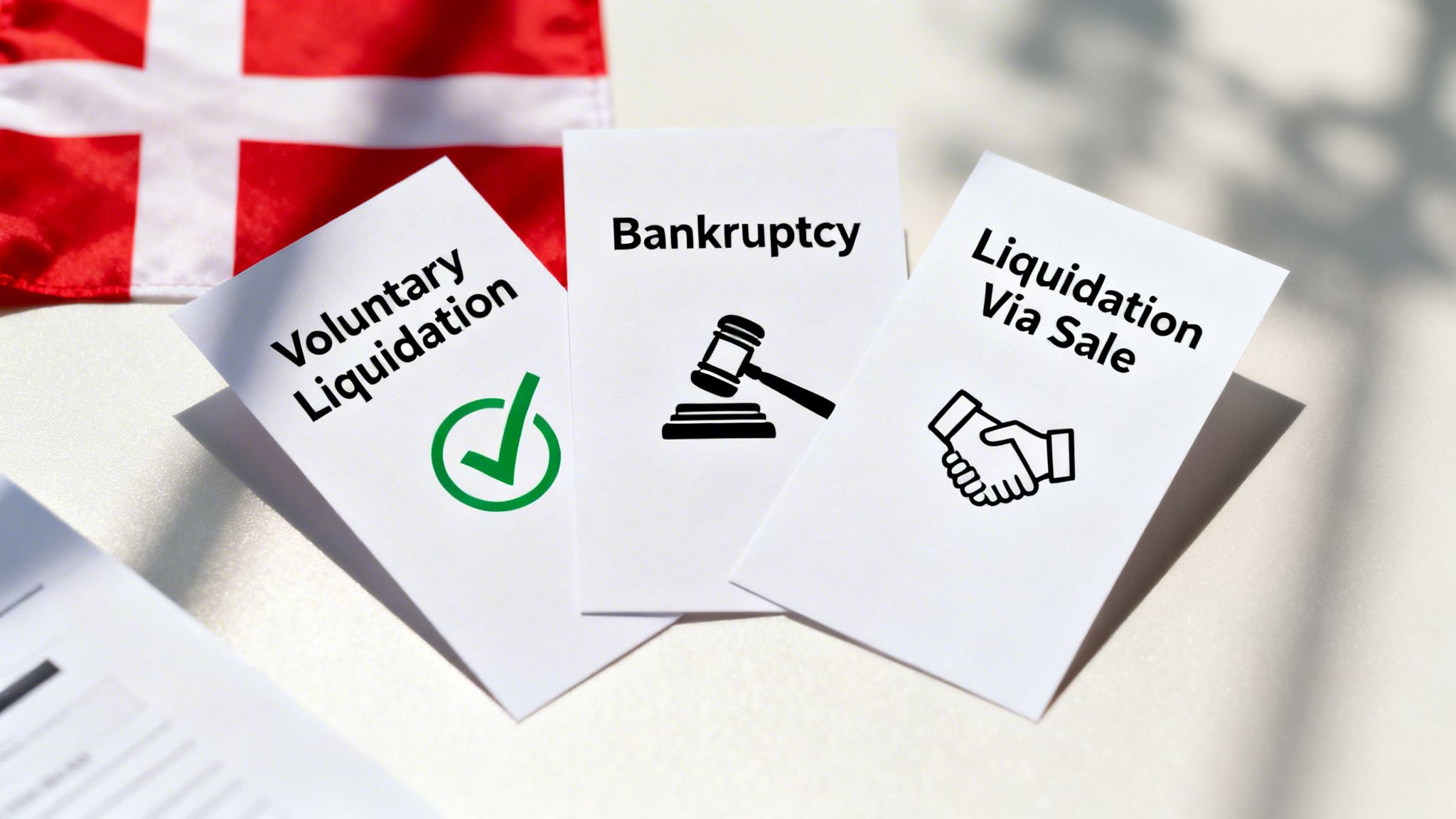
So, you’ve decided it’s time to close your Danish company. The big question is, how do you actually do it? In Denmark, you’re essentially looking at three main paths for company liquidation in 2026: Voluntary Solvent Liquidation, Bankruptcy, or a more modern approach, Liquidation Via Sale.
Each one is built for a different situation and has its own set of timelines, costs, and headaches. Choosing the right one isn't just about ticking boxes; it's about understanding the real-world impact on you, your time, and your wallet. Let's break down what matters most to a founder: how it works, how long it takes, what the risks are, and what it costs.
Voluntary Solvent Liquidation: The Controlled but Slow Route
Think of this as the traditional, by-the-book way to wind up a company that can still pay its bills. It's a formal process started by the shareholders, giving you a good deal of control over an orderly shutdown.
The Process: It starts with a shareholder vote to put the company into liquidation. You then appoint a professional liquidator—usually a lawyer or an accountant—who steps in. Their job is to sell off the company's assets, make sure every creditor is paid, and then distribute whatever is left over to the shareholders.
Director Liability: Your personal liability is generally low, but there's a big "if": you must have acted responsibly, and all debts must be settled. The real catch is that you remain formally tied to the company until it's officially struck off, which can drag on for a very long time.
Timeline and Cost: And here’s the major drawback. A voluntary liquidation isn't quick. You're looking at 6 to 12 months—often longer. The costs also stack up quickly. Between the liquidator’s fees, legal filings, and administrative tasks, it can easily run into thousands of euros. For founders who need a fast, affordable exit, this just isn't it.
This path really only makes sense for solvent companies with very simple affairs, where the owners have plenty of time on their hands and want to personally oversee every step of the closure.
Compulsory Liquidation (Bankruptcy): The End of the Line for Insolvent Companies
Compulsory liquidation, known in Denmark as konkurs (bankruptcy), isn't a strategy you choose; it's what happens when a company simply can't pay its debts. Either the company can file for it, or, more often, a creditor will force the issue.
The experience is a world away from a solvent wind-down. As soon as the court issues a bankruptcy order, a trustee is appointed and takes complete control. As a director, your authority is gone—instantly.
While traditional liquidation offers control, it demands time. Bankruptcy is a last resort with public consequences. A Liquidation Via Sale prioritises speed and finality, severing your ties in days, not years.
The trustee’s one and only job is to serve the creditors. They will liquidate all company assets to raise cash and pay off debts according to a strict legal pecking order.
Public Visibility: Bankruptcy is a very public affair. The company's status is logged in public registries, which can damage a founder’s reputation and make it harder to get credit down the road.
Director Liability: This is where things get serious for directors. The trustee will put your actions under a microscope, investigating the company’s finances leading up to the insolvency. If they find any evidence of wrongful trading or other misconduct, you could be held personally liable for the company's debts.
Timeline and Cost: It's the longest, most complicated route by a mile, frequently lasting 12 to 24 months or even more. The company's assets are used to cover the costs, but the drawn-out legal battle and public fallout make it an outcome every entrepreneur wants to avoid.
Liquidation Via Sale: The Fast-Track Exit
For founders who just want a clean break and to move on, Liquidation Via Sale is a modern and remarkably efficient solution. It’s not a "liquidation" in the classic sense; instead, it's a share transfer that gets you, the owner, to the same finish line: a complete and final exit.
The process itself is refreshingly simple. A specialist firm buys 100% of the shares in your company for a nominal sum. They become the new owners and directors, and your name is immediately removed from the Danish Business Authority (CVR) registry.
The moment the sale is complete, the acquiring firm takes on all responsibility for the company. That includes dealing with any outstanding creditors and completing the formal wind-down process in full compliance with Danish law. For you, it means an almost instant release from all duties and liabilities.
Comparison Point | Voluntary Liquidation | Bankruptcy (Konkurs) | Liquidation Via Sale |
|---|---|---|---|
Control | Director-led and controlled | Court and trustee-controlled | Director control ends at sale |
Timeline | 6–12+ months | 12–24+ months | 3–30 days |
Publicity | Moderate; public notices required | High; public record of bankruptcy | Low; a standard share transfer |
Director Liability | Low, but association continues | High risk of personal liability | Immediately severed at sale |
Best Scenario | Solvent, simple company; no rush | Insolvent company; no other option | Any founder needing a fast, clean exit |
This option is a game-changer for non-resident directors, e-commerce sellers with lingering liabilities, or any founder who wants to sidestep the time, stress, and bureaucracy of a traditional closure. It offers speed, a clear fixed fee, and—most importantly—closure you can count on.
Strike-Off vs. Liquidation: Understanding the Difference
Many founders hunting for a quick and easy exit often ask if they can just ‘strike off’ or deregister their company instead of going through a formal liquidation. It’s a common question, but it’s absolutely critical to understand the massive difference between these two paths in Denmark. One is a deliberate, strategic choice, while the other is a penalty for failing to follow the rules.
Simply put, a voluntary liquidation is a planned, orderly process you kick off yourself to close down a solvent company. On the other hand, an administrative strike-off, known as tvangsopløsning in Danish, is a forced dissolution. This isn't a voluntary exit strategy; it's a measure taken against your company by the Danish Business Authority (Erhvervsstyrelsen) when you haven't met your legal obligations.
A Strike-Off Is Always Involuntary
A strike-off is almost always triggered by a serious compliance slip-up. This could be anything from not filing your annual accounts on time, failing to have a legally registered management team, or not submitting other required documents. When this happens, the Business Authority doesn't give you an easy way out; it forces your company into a compulsory liquidation process.
Far from being a simple escape, a strike-off can throw some serious wrenches in the works:
Loss of Control: The moment it begins, you lose all control over the company's affairs. A court appoints a liquidator to take over completely.
Public Record: The forced dissolution is noted on public records, which can cast a shadow on your professional reputation.
Uncertain Timeline: The process can still drag on, and worse, the timeline is entirely out of your hands.
This route is fundamentally reactive and packed with risks that a proactive closure completely avoids. It's a nuanced topic, and you can get a deeper look into what striking off a company entails in our detailed guide.
A huge misconception is that a strike-off is a cheap shortcut. In reality, it can expose directors to severe personal liability if any unresolved debts or obligations pop up later. What looked like an easy exit can quickly spiral into a costly legal nightmare.
Comparing Risks and Founder Control
The core difference really boils down to control and liability. In a planned solvent liquidation, you and the liquidator you choose manage the entire process. You make sure all creditors are paid fairly and the remaining assets are distributed correctly, working methodically toward a clean and final closure.
With a strike-off, you're no longer in the driver's seat. A court-appointed liquidator takes charge, and their first priority is to dig into the company’s affairs and settle any claims from creditors. If they find any evidence that you, as a director, acted irresponsibly or knew the company had outstanding debts, you could be held personally liable for them.
This potential for personal financial risk is the single most compelling reason to avoid letting a company get struck off for non-compliance. It is never the best way to liquidate a company in Denmark in 2026; it's a clear sign that proper procedures were ignored from the start.
How a Liquidation Via Sale Provides a Rapid, Clean Exit in Denmark
Let's be honest, for most founders, the idea of a traditional liquidation dragging on for six, twelve, or even twenty-four months is a complete non-starter. That kind of timeline is a serious roadblock when you're ready to move on to your next project. This is where the Liquidation Via Sale model comes in – it offers a clean, fast alternative that collapses a years-long headache into just a few days.
The whole thing hinges on a straightforward legal principle: a share transfer. Instead of you bringing in a liquidator and getting bogged down in a lengthy wind-down, a specialist firm steps in and buys all the shares in your company. Legally, they become the new owners and directors.
The most immediate and powerful result? Your name is wiped from the Danish Business Authority's Central Business Register (CVR). That single step legally cuts your ties to the company and all its ongoing duties, giving you a clean and incredibly quick exit.
The Share Transfer and New Ownership
At its heart, the process is just a simple share purchase agreement. Once you're happy with the terms, the acquiring firm buys your company for a token amount. It’s a transaction that’s fully compliant with Danish corporate law—no different, really, from any other change in company ownership.
The moment that sale is done, the new directors take over all legal and administrative responsibilities. Their team of legal pros then gets to work on winding the company down. The key thing for you is that you’re completely out of the picture, freed from any further involvement or stress.
This is a game-changer for founders who dread the thought of dealing with creditors. After the share transfer, any and all communication from creditors goes straight to the new owners. They handle all the letters, the calls, and the settlements according to the letter of the law.
"A Liquidation Via Sale completely flips the script on closing a company. Instead of you managing a slow, painful wind-down, you get immediate closure through a legal sale. The new owner takes on the administrative burden, and you walk away with a clean break in days, not years."
Who Is This Really For?
While it sounds great, this method isn't for everyone. It's specifically built for founders who value speed and certainty above all else. I’ve found the clients who get the most out of it are:
Non-Resident Owners: Trying to manage a traditional Danish liquidation from another country is an absolute administrative nightmare. This approach lets you handle everything remotely, from the first chat to the final signature on the share transfer.
E-commerce Founders: If you have a dormant company linked to an online marketplace, this is a quick way to sever those ties and sort out any lingering platform headaches.
Founders Under Pressure: Maybe you have a new opportunity you can't miss, or perhaps you're just plain exhausted by a business that's not going anywhere. This gives you a fast exit without the emotional and financial drain of a long, drawn-out liquidation.
In the current economic climate, this kind of efficiency is more valuable than ever. Fast-exit models can take the typical 24-month process and turn it into a buyout that’s done in 3-30 days. It’s an incredibly effective way to stop creditor pressure in its tracks. You can dig deeper into business restructuring trends over on the Eurofound website.
Understanding the Legal Boundaries
It’s really important to be clear on this: Liquidation Via Sale is a legitimate corporate transaction. It's not some magic loophole for dodging personal responsibilities. If you’ve signed personal guarantees, this process won't make them disappear.
Likewise, it’s not an option if there are active criminal investigations for fraud or other serious misconduct. The process is designed for honest entrepreneurs who simply need a more efficient way to close a chapter and move on. It provides a legal, compliant, and—most importantly—fast route to finality, making it a very compelling choice for finding the best way to liquidate a company in Denmark in 2026.
Which Liquidation Path is Right for You?
Closing a company isn’t just a financial decision; it’s a personal one. The right path for you depends entirely on your company's current state, what you want to achieve, and how quickly you need to move on. Getting this right from the start saves an immense amount of time, money, and stress down the line.
Let's start with the single most important question: Is your company solvent? Can you confidently say it can pay all its debts, including any potential costs that might pop up during the closure process?
If the answer is a clear 'yes', several doors are open to you. If it's 'no', your options shrink dramatically. At that point, Danish law requires you to protect your creditors, which almost always points toward bankruptcy.
Once solvency is established, you need to be honest about your personal priorities. You're usually juggling three main factors: speed, cost, and control. The catch is, you can rarely have all three.
Speed: Do you need to be free and clear in a matter of weeks? Maybe you have a new opportunity waiting or just want the mental space to move forward.
Cost: Is your top priority to minimise the cash outlay for the closure, even if that means the process will drag on for months?
Control: Do you feel the need to personally manage every detail, from selling off the last assets to paying the final invoice yourself?
Your answers here will immediately highlight which methods are a good fit and which are simply non-starters.
Your Situation Dictates the Strategy
The nature of your business plays a huge role. Shutting down a dormant company with zero assets is a world away from winding up a busy e-commerce store with inventory, customer data, and international tax obligations.
Let's look at a few common scenarios I see all the time:
The E-commerce Seller: An online shop typically deals with complex liabilities. Think potential customer returns, VAT in different countries, and rules set by platforms like Amazon or Shopify. A fast-track closure through a Liquidation Via Sale is often perfect here, as it shifts the responsibility of untangling that complexity to the buyer.
The Non-Resident Director: Trying to manage a traditional Danish liquidation from another country is an administrative nightmare. It’s a constant battle with paperwork, notarisation requirements, and time zone differences. For many, a remote sale-based exit is the only realistic way out.
The Solvent but Tired Founder: Your company is in the black, but you're completely burned out. You just don't have the energy for a formal wind-down that could take 12 months or more. In this case, sacrificing some control for a quick, clean break makes perfect sense.
After years of advising founders, especially those based abroad or facing creditor pressure, I’ve found the conversation almost always circles back to one thing: time. The sheer uncertainty and ongoing liability of a long, drawn-out process are a huge burden. A rapid, final exit often provides the most value.
This decision tree shows just how direct and efficient a Liquidation Via Sale can be.
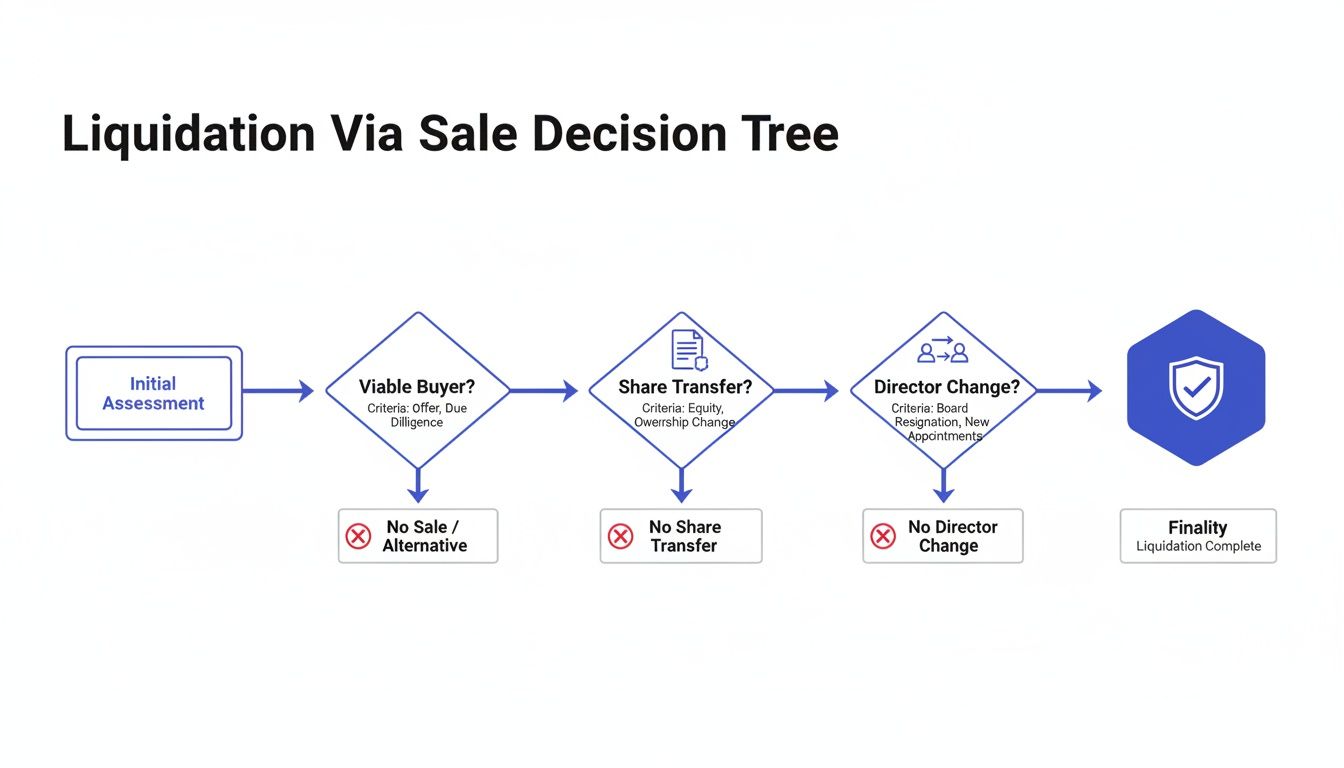
As you can see, a simple legal share transfer is all it takes to change the directorship. This gives the original owner a swift and complete exit.
Your Danish Liquidation Decision Checklist
To help you crystallise your thoughts, I've put together this simple checklist. Use it to get a clear, honest picture of your circumstances and see which closure method aligns best with your needs.
This table isn't about getting a perfect score. It's about spotting the dominant patterns in your answers.
Key Question | If 'Yes' | If 'No' |
|---|---|---|
Is your company 100% solvent? | You have multiple options, including Liquidation Via Sale or Voluntary Liquidation. | Bankruptcy is likely your only legal path. Act immediately. |
Do you need to exit in under 30 days? | A Liquidation Via Sale is your fastest option. | A traditional Voluntary Liquidation (6-12 months) might be feasible. |
Do you live outside of Denmark? | A remote Liquidation Via Sale is highly recommended to avoid administrative hurdles. | You can manage a traditional process, but it will require significant local coordination. |
Is your company dormant with zero assets or debts? | Administrative strike-off (tvangsopløsning) may be an option, but carries risks. You should seek expert advice. | You must use a more formal process like liquidation or sale. |
Does your company have active contracts, stock, or complex liabilities? | A Liquidation Via Sale can transfer these obligations to a new owner. | You must resolve all these yourself in a Voluntary Liquidation. |
Do you want to avoid all future liability and administrative follow-up? | A Liquidation Via Sale provides a clean break upon signing. | With other methods, you remain responsible until the company is formally dissolved. |
If your answers consistently point toward a need for speed, simplicity, and risk avoidance, a Liquidation Via Sale is almost certainly your best bet. If, on the other hand, you have a very simple, debt-free company and plenty of time, a traditional voluntary liquidation could work, though it will be slow.
Preparing for Your Company's Clean Break
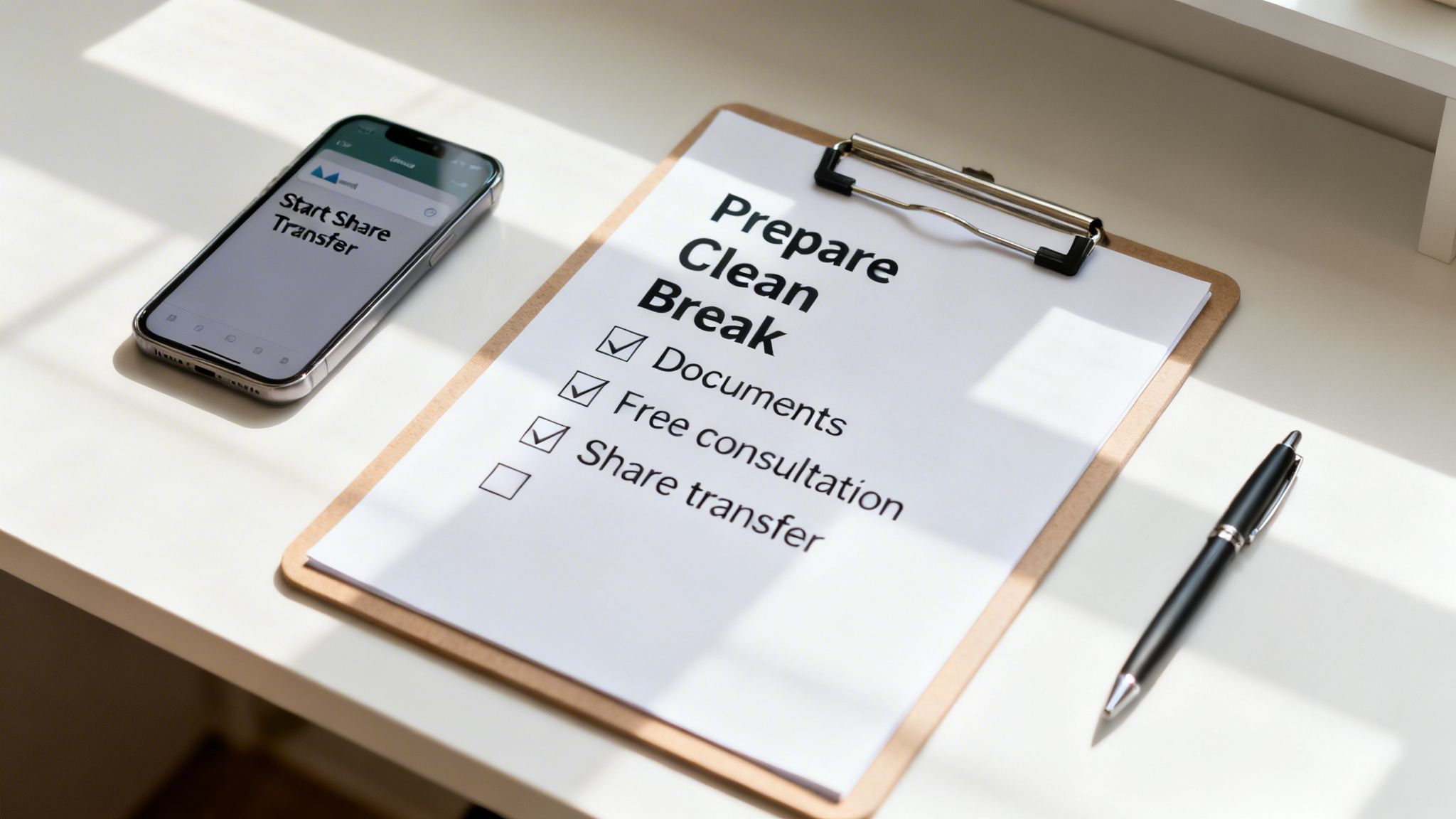
Once you’ve settled on the best way forward for your company, it’s time to act. This is where the decision-making ends and the real work of executing a clean, legally sound exit begins, freeing you up to concentrate on what’s next. Your immediate priorities will, of course, depend entirely on the path you’ve chosen.
For founders going down the traditional voluntary liquidation route, the first phase is all about careful preparation. This means getting all your corporate and financial documents in order, ready to hand over to the liquidator you’ve appointed.
Initial Steps for a Liquidation Via Sale
If you've decided the speed and certainty of a Liquidation Via Sale is right for you, the process is refreshingly direct. The action plan is simple, and you can get started on it today.
Request a Free Consultation: Your first move should be to get in touch with a specialist firm. They’ll conduct a no-obligation review of your company's specifics to confirm you’re eligible and give you a fixed-fee quote.
Provide Core Details: To get the share transfer process rolling, you'll need to supply some basic information. This usually just means the company’s CVR number, your personal identification, and a quick summary of any assets or liabilities you’re aware of.
Review the Share Purchase Agreement: You’ll then be sent an agreement to review. This is the contract that formally transfers ownership of the company—and all director responsibilities—to the acquiring firm.
The real prize in a swift, legal exit is finality. By cleanly severing ties with a dormant or struggling company, you clear the decks for your next venture without the weight of lingering admin or potential liabilities holding you back.
This straightforward roadmap is designed to remove the final hurdles and give you a clear plan. Whether you're dealing with a complicated wind-down or simply want to close a chapter, taking these first steps is what truly matters. It's the practical starting point for finding the best way to liquidate a company in Denmark in 2026 and reclaiming your focus for whatever comes next.
Your Top Questions About Closing a Danish Company Answered
Closing down a business naturally brings up a lot of questions. I've pulled together some of the most common queries we hear from founders to give you clear, straightforward answers. Here’s what you need to know about navigating the process in Denmark for 2026.
What Happens to Company Debts in a Liquidation Via Sale?
Once a specialist firm buys your company's shares, they also legally take on all its existing liabilities. This is a fundamental part of the transaction.
From that point forward, all creditors are instructed to communicate directly with the new owners. Your formal ties to the business and its debts are cut, so long as you haven't personally guaranteed any of those debts. This complete transfer of responsibility is one of the biggest draws of this method.
Can I Close a Danish Company if I Don't Live in Denmark?
Yes, you certainly can. Trying to manage a traditional liquidation from another country can be a real bureaucratic nightmare. A Liquidation Via Sale, on the other hand, is built for exactly this scenario.
The entire process is managed remotely from start to finish. The acquiring firm’s legal team handles every local filing and requirement in Denmark, letting you secure a clean exit without the need for any travel.
A Liquidation Via Sale is a fully legal and safe way to close your company. It’s a standard corporate transaction—the sale and transfer of shares. The new owner then handles the formal wind-down process in full compliance with Danish law. However, it's not a magic wand for evading personal guarantees or for anyone under active investigation for fraud.
What Does It Cost to Liquidate a Company in Denmark?
The costs really swing from one method to another. A traditional solvent liquidation can easily set you back thousands of euros in legal and administrative fees, spread over a timeline that often stretches 6-12+ months.
A Liquidation Via Sale, by contrast, comes with a single, fixed fee for a process that’s wrapped up in just a few days. You get total cost certainty and a speed that other methods simply can't match. To get a better sense of these timeframes, you can read more about how long liquidation takes in our detailed article.