Feb 18, 2026
What Is Striking Off a Company: A Founder's Guide
Striking off a company is the official process of having it removed from the corporate register, which essentially ends its life as a legal entity. It's a common route for businesses that are no longer trading, are solvent, and have tied up all their loose ends.
Think of it like decommissioning a ship. Once it's served its purpose and is no longer needed for sailing, its name is taken off the official maritime register. It ceases to exist, at least on paper.
Understanding What Striking Off a Company Means
At its heart, striking off—often called dissolution—is the final administrative act of closing down a business that has no outstanding debts and has fulfilled its purpose. This whole process is overseen by the official registrar of companies for that country or jurisdiction. Once it's done, the company is dissolved. It can't trade, own assets, or take on any new debts.
There are really only two ways this can happen:
Voluntary Strike-Off: This is when the directors themselves decide to close the company down. It's the best-case scenario for a business that's dormant, has stopped trading, and has paid everyone it owes.
Compulsory Strike-Off: This happens when the registrar steps in. Usually, it's because a company has failed to keep up with its legal duties, like filing annual accounts or confirmation statements. It's the registrar's way of cleaning up the register.
The Core Purpose of Striking Off
The main reason striking off exists is to offer a simple, low-cost way to close a solvent company that's no longer needed. Imagine a company set up for a single construction project that’s now finished, or a small family business where the owner is retiring. These are perfect examples where a straightforward strike-off makes sense.
But, and this is a big one, striking off is not a get-out-of-jail-free card for debt. It’s designed for clean exits. It's a much simpler process than a formal liquidation, but that distinction is critical. If you're unsure about the two, it's worth reading our guide on the difference between dissolution and liquidation.
It's better to think of striking off as hitting a pause button on legal recourse, not the stop button. A company can actually be restored to the register later on if outstanding debts come to light or assets are discovered. This is why getting it right from the start is so important.
To give you a clearer picture, here's a quick summary of the key points.
Striking Off a Company at a Glance
This table breaks down the core concepts of striking off into an easy-to-digest format.
Aspect | Description |
|---|---|
Purpose | To formally close a solvent company that is no longer trading. |
Eligibility | The company must be solvent, have ceased trading, and have no outstanding debts. |
Initiator | Can be started voluntarily by directors or compulsorily by the registrar. |
Cost | Generally a low-cost administrative procedure compared to liquidation. |
Timeline | Typically takes several months from application to final dissolution. |
Hopefully, this gives you a solid foundation for what striking off is all about. It's an administrative tool, but one with real legal weight.
Two Paths to Dissolving a Company
When a company's journey comes to an end, getting it removed from the official register isn't a single, straightforward task. There are actually two very different ways this can happen, and for any director, knowing the difference is absolutely vital. One path is a deliberate, well-managed decision; the other is a forced action that can spell trouble.
Making the right choice here is the difference between a clean, administrative final step and a massive red flag for regulators.
The Proactive Approach: Voluntary Striking Off
The first route, and by far the most common, is a voluntary strike-off. This is where the company's directors take the initiative to close the business down. It’s a conscious choice, typically made when a company has fulfilled its purpose, is no longer trading, and—crucially—is solvent.
This is the perfect exit strategy for a few common scenarios:
A company set up for a specific project that's now finished.
A business owner is retiring with no one to pass the company on to.
A dormant company that's simply racking up admin costs without any real activity.
To kick off a voluntary strike-off, directors need to follow a set procedure. This usually means passing a board resolution, submitting a formal application to the company registrar, and making sure everyone—shareholders, employees, tax authorities—is officially notified. It’s a structured, controlled way to close the book.
This flowchart lays out the key elements of the striking off process.
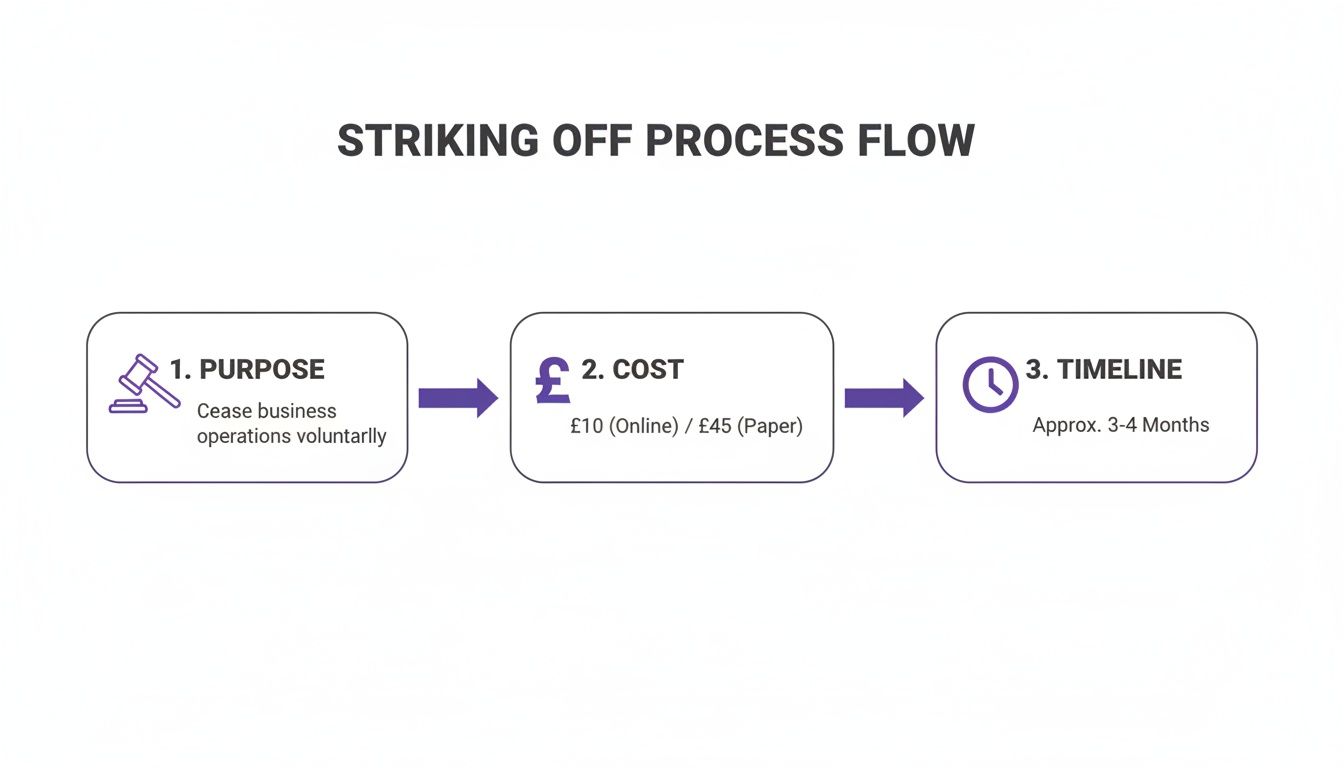
As the visual shows, you really need to think about the purpose, cost, and timeline before deciding on this path.
The Reactive Consequence: Compulsory Striking Off
The second path is a compulsory strike-off, and it’s one you want to avoid. This is what happens when the official company registrar forces the issue because a company isn't meeting its legal duties. It’s not a choice the directors make; it's a direct consequence of their inaction.
The most common triggers are simple failures, like not filing annual accounts or confirmation statements on time. From the registrar's perspective, this inaction suggests the company has been abandoned, so they step in to clear it from the public record.
A compulsory strike-off is often viewed as a sign of director negligence. It points to a failure to manage the company's affairs properly and can attract unwanted attention from creditors and government bodies, sometimes even leading to investigations or director disqualification.
It might sound like an easy way to let a company disappear, but a compulsory strike-off is riddled with risk. Any assets left behind, like cash in a bank account, can be seized by the Crown as bona vacantia (ownerless goods). Worse, creditors can easily object and have the company restored to the register to chase what they're owed, which can leave directors personally liable.
A planned, voluntary closure is always the safer and more professional way to exit. If you want to understand the mechanics of a controlled shutdown better, you can learn more about how to wind up a company in our detailed guide.
Is Striking Off the Right Move for Your Business?
Figuring out the best way to close down your company is a major decision, one with real financial and legal consequences that can stick around for years. Striking off can be a beautifully simple and cheap exit, but it's not a free-for-all. It’s only meant for businesses in a very specific, clean-cut situation.
Get this choice wrong, and you could be walking into a minefield of trouble, from director investigations to being held personally liable for company debts. Think of it this way: striking off is an administrative tidy-up, not an escape hatch for a business in trouble.
When Striking Off Is the Ideal Path
So, when does it make sense? A voluntary strike-off is perfect for companies that have simply run their course. We're talking about businesses with a completely clean bill of health that are ready to be formally closed without any drama.
It's likely the right move for you if your company checks these boxes:
It’s dormant or has completely stopped trading, with no plans to start up again.
It is solvent. This is the big one. It means you can pay every single one of your bills – from the tax authorities to your last supplier.
The owner is retiring, and there's no succession plan or buyer in the wings.
The company was set up for a specific project that's now finished.
In these scenarios, striking the company off the register is the most logical and cost-effective way to close the book. It’s a clean break, avoiding the cost and hassle of a full-blown liquidation.
Red Flags: When Striking Off Is the Wrong Choice
Now for the warning signs. Trying to strike off a company that doesn’t meet the strict criteria isn't just a bad idea; it can be illegal. This is where many directors trip up, opening the door to serious personal risk. If your company is facing any kind of financial difficulty, striking off is absolutely not the answer.
A crucial point to remember: trying to use the strike-off process to sidestep your creditors can be seen as fraud. Creditors have the power to block the dissolution, and they can even apply to have the company restored to the register later to chase what they're owed. This often leads back to the directors being held personally responsible for the debt.
If there are any unresolved financial loose ends or legal disputes, you need to go down the formal liquidation route. It’s designed to handle these complexities properly and protect the directors.
To make this crystal clear, let's break down when each path is appropriate.
When to Choose Striking Off vs Liquidation
This table should help you quickly see which path aligns with your company's current situation.
Criteria | Striking Off (Appropriate) | Liquidation (Necessary) |
|---|---|---|
Financial State | The company is solvent and can pay all its debts. | The company is insolvent and cannot meet its financial obligations. |
Trading Activity | The business has stopped trading and has no future plans. | The company may still be trading but is facing creditor pressure. |
Company Assets | All assets have been distributed or realised. There is nothing left. | There are remaining assets that must be sold to repay creditors. |
Legal Disputes | There are no active or pending legal actions against the company. | The company is involved in ongoing legal disputes or investigations. |
Ultimately, choosing correctly comes down to one simple question: is the company solvent with a clean slate, or are there debts and complications? Your answer will point you in the right direction.
Legal Consequences for Directors and Creditors
Thinking of striking off your company? It might look like a simple bit of paperwork, but the legal ripples can turn into a tidal wave for both directors and creditors. Treating it as just an administrative task is a classic mistake, one that can quickly escalate a clean exit into a messy legal fight. It’s vital to understand that this isn’t just closing a door; it’s a formal legal event with some very firm rules.
For directors, the absolute number one rule is to act honestly and in good faith. Trying to use a strike-off to dodge company debts is a huge red flag for regulators. If a company is dissolved while it still owes money, directors can find themselves facing serious allegations like wrongful trading. This isn't just a slap on the wrist; authorities actively investigate these situations.

Director Liabilities and Personal Risks
The "corporate veil" is the legal shield that separates a director's personal assets from the company's. But if you deliberately misuse the striking-off process to sidestep creditors, that veil offers zero protection.
Here’s what’s really at stake for directors:
Personal Liability: A court can make you personally liable for the company's debts. This usually happens if it's proven you knew (or should have known) the company was heading for insolvency but carried on regardless.
Director Disqualification: If you're found guilty of misconduct, you could be banned from being a company director for up to 15 years. That’s a career-ending penalty for most entrepreneurs.
Financial Penalties: On top of everything else, you could be hit with hefty fines and ordered to pay all the legal costs.
These aren't just worst-case scenarios; they happen. It really drives home how crucial it is to be certain the company is solvent before even thinking about a voluntary strike-off. We dive deeper into this in our guide on director liability for company debts.
The Power of Creditors to Object and Restore
Creditors aren't just sitting on the sidelines watching this happen. They have powerful tools to protect their interests if they hear a company that owes them money is about to be struck off.
When a notice to strike off a company is published, it’s basically a public announcement. This gives any creditor the chance to raise an official objection. If they do, the whole process grinds to a halt until the debt is sorted out.
But what if they don't spot it in time? Their power doesn’t just vanish once the company is dissolved. A creditor can go to court and apply to have the company restored to the register, even after it has been officially closed.
Restoring the company is like hitting a rewind button—suddenly, the company is legally active again, just as it was before. This re-opens the door for the creditor to chase the debt, and that chase often leads right back to the directors who thought the matter was closed for good.
Common Pitfalls in the Striking Off Process
The path to striking off a company might look straightforward on paper, but it’s often riddled with small, easily overlooked traps. For directors trying to manage this process themselves, what seems like a minor oversight can quickly snowball, causing delays, triggering objections, and sometimes even leading to serious legal trouble. Knowing what these hurdles are is the first step to navigating around them.
One of the most common mistakes is not settling every single liability. It’s easy to remember the big invoices, but it’s the forgotten little things that tend to trip people up. An old utility bill, a forgotten software subscription, or a small outstanding balance with a supplier—any of these can be enough for a creditor to object and bring the whole process to a screeching halt.
Another classic pitfall is leaving a bank account open. Even a dormant account with just a few pounds in it is still technically a company asset. When the company is dissolved, those funds become bona vacantia—literally "ownerless goods"—and legally belong to the Crown. This not only creates a messy situation but also signals that the company wasn't properly wound up in the first place.
Overlooking Notifications and Timelines
Beyond the financial loose ends, procedural slip-ups are just as common. Directors have a legal duty to notify all interested parties, and forgetting even one small creditor or government agency is a serious breach of the rules. Every stakeholder has the right to object, and a missed notification can get your application thrown out or, even worse, lead to the company being restored to the register later on.
It’s also worth remembering just how public this process is.
As soon as you apply for a strike-off, a notice gets published in the official gazette. This is designed to give creditors a heads-up, but it also alerts anyone with a potential claim, potentially turning what you hoped would be a quiet closure into a very public matter.
Finally, many directors simply underestimate how long it all takes. Striking off isn't a quick fix; it typically takes several months from start to finish. This long waiting period can leave you in a state of limbo, unable to properly draw a line under the business and move forward. These are the kinds of practical headaches that show why a DIY approach, while tempting, is often a false economy. One wrong move can turn a simple administrative task into a drawn-out, stressful ordeal.
Looking for a Faster Way Out Than Traditional Dissolution?
Let's be honest, the standard striking off process can feel like a marathon of paperwork and waiting. It often drags on for months, leaving founders stuck in administrative limbo when all they want is to move on. If speed, certainty, and a clean break are what you’re after, there's a much more direct route.
It's called Liquidation Via Sale. Think of it less like slowly closing down and more like a strategic exit. Instead of navigating the registrar's slow-moving process, you sell your company to a specialist firm that takes over the entire winding-down operation for you.

How a Strategic Sale Gives You That Clean Break
The concept is surprisingly simple. You sell the company, and with that sale, 100% of the legal and administrative responsibilities transfer to the new owner. It’s a single, decisive transaction that accomplishes what a traditional strike-off takes months to do.
The moment the ink is dry on the sale agreement, your name is off the company register. You're no longer the director or shareholder. This instantly shields you from any further admin, creditor calls, or the procedural headaches that come with closing a business.
This immediate hand-off is the real game-changer. The new owner handles all the filings and manages the formal dissolution according to the law, freeing you up to focus on what's next.
The Key Benefits of This Approach
Choosing a Liquidation Via Sale offers some very tangible advantages over waiting out a standard dissolution:
Unmatched Speed: Your exit can be finalised in days, not months. This lets you close one chapter and dive straight into your next venture without looking back.
Complete Finality: The sale is a legally definitive endpoint. There's no long waiting period or the nagging risk of the company being restored to the register down the line.
Stress Offloaded: All the tedious and often stressful tasks of winding down—from mountains of paperwork to dealing with creditors—become someone else's problem.
For any founder who can't afford to get bogged down by bureaucracy, this method provides a clear, swift, and conclusive way to exit. It’s about more than just speed; it’s about getting that invaluable peace of mind.
Unpacking the Fine Print: Common Questions About Striking Off
When you're looking at winding down a company, the practical details matter. Let's tackle some of the most common questions that come up about the striking off process so you can get a clearer picture of what’s involved.
What Happens to Company Assets After It Is Struck Off?
This is a big one. Once a company is officially dissolved, any assets left behind are considered bona vacantia, which is a Latin term for "ownerless goods."
Essentially, anything from cash in a bank account to physical property still registered in the company's name automatically transfers to the Crown. It's a critical point that underscores why you absolutely must deal with all company assets before you even think about applying for a strike-off.
Can a Struck Off Company Be Brought Back?
Surprisingly, yes. A dissolved company can be brought back to life through a process called restoration. It effectively rewinds the clock, putting the company back on the official register as if it had never been dissolved.
There are generally two ways this can happen:
Administrative Restoration: This is the simpler route, usually for companies that were struck off by the registrar for not filing paperwork on time.
Court Order Restoration: This path is necessary if the company was struck off voluntarily or if creditors need to resurrect it to chase a debt.
It's crucial to understand that creditors can apply to have your company restored to pursue what they're owed. This means striking off isn't a get-out-of-jail-free card for unpaid liabilities—it just makes it harder for them, not impossible.
How Long Does the Striking Off Process Take?
Striking off is definitely not an overnight affair. From the moment you submit your application to the final dissolution, you're typically looking at a timeline of several months.
This built-in delay is intentional. It gives the authorities time to publish the notice and allows anyone with a legitimate objection, like a creditor you forgot to pay, a window to speak up.