Feb 17, 2026
What Happens When You Liquidate a Company: A Complete Guide
When a company enters liquidation, it's essentially being formally shut down for good. This isn't a chaotic free-for-all; it's a very structured legal process designed to sell off everything the business owns, use that cash to pay back its debts, and then officially strike the company from the record. It’s the final chapter in the company's story.
The Reality of Company Liquidation
For many founders, the thought of liquidating their company can feel like stepping into a fog of legal jargon and financial unknowns. But the reality is far more methodical than you might think. It’s less of a sudden collapse and more of a controlled wind-down, designed to bring a company’s operations to an orderly and fair conclusion.
A good way to picture it is like decommissioning an old ship. You don't just sink it. You carefully unload the cargo, settle all the accounts at the port, and then formally retire the vessel from service. Liquidation follows a similar, carefully managed script.

This process involves a cast of key players, and understanding who does what is the first real step to demystifying the whole thing.
Who Is Involved in a Liquidation?
At the heart of the entire operation is the liquidator. This is a licensed insolvency practitioner whose job is to take control of the company. Their duty isn't to the directors or shareholders, but to all the creditors. They are legally bound to get the best possible price for the company's assets and then distribute the proceeds according to a strict order of priority set out in law.
Beyond the liquidator, several other people are central to the process:
Directors: In a voluntary liquidation, the directors are the ones who get the ball rolling. Once the liquidator is in place, their main job is to cooperate completely, handing over all company records and information.
Shareholders: As the ultimate owners of the company, the shareholders must pass a formal resolution to put the company into liquidation. This is the official starting gun.
Creditors: These are all the people and businesses the company owes money to. They have a right to be notified about the liquidation and can submit a formal claim to try and recover their money from the sale of the assets.
The entire point of liquidation is to ensure a fair and organised distribution of whatever value is left in the company. It stops a potential "grab what you can" scenario and replaces it with a regulated system that respects everyone's legal rights.
To give you a clearer picture of the journey, here’s a quick overview of what to expect.
The Liquidation Journey at a Glance
The table below breaks down the typical stages of a liquidation, from the initial decision to the final dissolution of the company. It's a high-level roadmap of the key actions and goals at each step.
Phase | Key Action | Primary Goal |
|---|---|---|
1. The Decision | Directors and shareholders agree the company is insolvent or no longer viable. | To formally acknowledge the need to wind up the company and start the legal process. |
2. Appointing a Liquidator | A licensed insolvency practitioner is officially appointed to take control. | To hand over control to an impartial expert who will manage the process legally. |
3. Asset Realisation | The liquidator identifies, values, and sells all company assets. | To convert all physical and intangible assets into cash to repay creditors. |
4. Creditor Claims | Creditors are formally notified and submit their claims for debts owed. | To establish a clear and official list of all the company's liabilities. |
5. Distribution of Funds | The liquidator pays creditors according to a strict legal hierarchy. | To ensure a fair and lawful distribution of the realised funds. |
6. Final Dissolution | Once all matters are settled, the company is struck off the official register. | To legally and permanently close the company, ending its existence. |
This structured approach brings order, but it doesn't always bring speed.
The traditional liquidation route can be a long and drawn-out affair. Founders often find themselves bogged down for 6-24 months in paperwork, creditor negotiations, and administrative filings. You can find more details on these typical business closure timelines from official EU sources.
This lengthy timeline is a major pain point for entrepreneurs who just want to move on to their next project without being legally tied to a defunct business. The goal here is to help you understand that while liquidation is a serious and defined procedure, there are alternatives that can make the process much faster.
Choosing Your Path: Solvent vs. Insolvent Liquidation

When most people hear the word "liquidation," they immediately think of a business in deep financial trouble, selling everything off to pay its bills. While that's certainly one side of the coin, it’s not the whole story. The journey a company takes when it liquidates hinges on one simple but critical question: is it solvent or insolvent?
Think of it this way. A solvent company is like a homeowner deciding to sell their valuable, well-maintained house. They're in control, they sell the property, pay off the mortgage, and keep the leftover profit. An insolvent company is more like a house that's falling apart with multiple loans against it. The bank steps in to salvage what it can, and the homeowner is no longer in charge.
Grasping this fundamental difference is the first real step in understanding what happens when you liquidate a company, because it determines who’s calling the shots, who gets paid, and what the entire process looks like.
When the Company Can Pay Its Debts
Let's start with the positive scenario. If your company has more than enough assets to clear all its debts and still has a healthy sum left over for shareholders, it’s solvent.
In this case, it’s the directors and shareholders who decide to close up shop. It's a strategic move, not a forced one. Maybe the owners are retiring, the market has shifted, or it's simply the most tax-efficient way to release the profits locked inside the business. The formal process for this is a Members' Voluntary Liquidation (MVL).
Who starts it? The directors and shareholders make the call.
What's the key requirement? The directors must sign a legal document called a Declaration of Solvency, swearing the company can pay every last penny it owes within 12 months.
What's the goal? To wind down the business in a structured, orderly way and distribute all the remaining cash and assets to the shareholders.
An MVL is a planned, controlled exit. It’s about decommissioning a successful business, not abandoning a sinking ship. For shareholders, it often means a significant final payout.
When Debts Outweigh Assets
Now for the other side. A company is insolvent when it simply can't pay its debts as they become due. Here, the entire focus flips. The priority is no longer about getting money to shareholders; it's all about looking after the creditors—the people and businesses the company owes money to.
When a company becomes insolvent, the directors' legal duties shift. They are no longer working for the shareholders' benefit but must act in the best interests of the creditors. Getting this wrong can lead to serious personal consequences.
An insolvent company typically goes down one of two paths.
Creditors' Voluntary Liquidation (CVL)
This is the most common route when a business is in trouble. A Creditors' Voluntary Liquidation (CVL) is started by the company's own directors. They've looked at the numbers, realised they can't trade their way out of debt, and have decided to do the responsible thing by calling a halt.
Even though it’s called "voluntary," the process is run for the benefit of the creditors. The directors appoint a licensed insolvency practitioner whose job is to sell off the company's assets and distribute the money to creditors according to a strict legal hierarchy.
Compulsory Liquidation
This is when things get serious. Compulsory Liquidation isn't a choice; it's forced on the company by a court order.
This usually happens when a frustrated creditor—often a tax authority or a major supplier that's been left unpaid for too long—petitions the court to have the company shut down. If the court agrees, it issues a winding-up order, and an Official Receiver is appointed to take over. At this point, the directors lose all control. It's a clear signal that the company has completely lost its grip on its finances.
You can learn more about the legal nuts and bolts of these processes in our guide on how to wind up a company.
The Step-by-Step Liquidation Process
People often imagine liquidation as a chaotic free-for-all, but the reality is quite different. It's a highly structured, legally-defined process. Think of it less like a sudden collapse and more like a carefully managed project designed to formally close a business, making sure everything is handled fairly and by the book.
Breaking down this journey into clear stages removes a lot of the fear and uncertainty. Let’s walk through what actually happens, from the moment the decision is made to the company legally ceasing to exist.
The Opening Act: Kicking Things Off
It all starts with the formal decision to stop trading and wind up the company. In a voluntary liquidation, this usually begins when the directors take a hard look at the books and realise that closure is the only viable or sensible path forward.
From there, they need to call a shareholder meeting to pass a winding-up resolution. This is the official green light that gets the legal process rolling. It's a significant decision, so it requires a strong majority—typically 75% of shareholders—to vote in favour.
Appointing the Liquidator
As soon as the shareholders pass that resolution, the next move is to appoint a licensed insolvency practitioner as the liquidator. This is a crucial step, as this person (or firm) immediately takes the wheel and assumes full control of the company.
The liquidator isn't there to represent the directors or the shareholders. Their primary legal duty is to the company's creditors. Their job is to oversee the entire wind-down, acting as an impartial professional to make sure the company’s assets are sold for the best possible price. The moment they’re appointed, the directors' powers are effectively suspended.
A key part of the liquidator's job is making the process public. They have to file official documents with the company registry and place a notice in a public gazette. This ensures everyone knows the company is formally 'in liquidation'.
Taking Control and Cashing in the Assets
Once the liquidator is in charge, the business grinds to a halt. Trading stops, employees are usually made redundant, and the company's bank accounts are frozen. The liquidator then takes possession of everything the company owns.
This kicks off the realisation of assets phase, which is a methodical process of turning physical items into cash. It involves:
Finding everything: The liquidator creates a detailed inventory of all company assets. This includes the obvious stuff like buildings, vehicles, and stock, but also intangible things like patents, brand names, and money owed to the company (debtors).
Valuing it all: Professional valuers are brought in to get an accurate, realistic market price for everything.
Selling it off: The liquidator then sells the assets, whether through auctions, private sales, or other channels. The goal is simple: get the best possible return to repay the creditors.
Sorting Out the Creditor Claims
While the assets are being sold, the liquidator starts untangling the company’s debts. They will reach out to all known creditors and invite them to submit a formal proof of debt—a document that outlines who they are, how much they’re owed, and the evidence to back it up.
The liquidator carefully reviews every claim to verify it's legitimate. This process results in a final, official list of the company's liabilities, which is critical for figuring out who gets paid. If you're wondering about the timing for all this, you can learn more about how long company liquidation typically takes in our guide.
Distributing the Money: The "Payment Waterfall"
Once all the assets are converted to cash and the creditor claims are sorted, it’s time to distribute the money. This isn’t done randomly. The law sets out a very strict order of priority, often called the "payment waterfall," to ensure the funds are paid out in a specific sequence.
Here’s how the hierarchy typically looks:
Priority Level | Who Gets Paid | Example |
|---|---|---|
1st | Secured Creditors with a Fixed Charge | A bank that holds a mortgage over the company's building. |
2nd | Liquidation Expenses | The liquidator's fees and other costs of the winding-up. |
3rd | Preferential Creditors | Mostly employee wage arrears and unpaid holiday pay (up to a legal limit). |
4th | Secured Creditors with a Floating Charge | Lenders with a general claim over assets like stock or cash. |
5th | Unsecured Creditors | Your suppliers, tax authorities, contractors, and customers. |
6th | Shareholders | The company owners, who are last in line and only get paid if every single creditor has been paid in full. |
The hard truth is that in most insolvent liquidations, unsecured creditors often get back only a fraction of what they are owed, if anything at all.
The Final Step: Dissolution
With all the money paid out according to the waterfall, the liquidator will hold final meetings with creditors and shareholders. At these meetings, they'll present a final report that details everything that happened—what was sold, for how much, and where every penny went.
After that, the liquidator files the last bit of paperwork to have the company struck off the public register. A few months later, the company is formally dissolved. It legally no longer exists, and the liquidation process is officially complete.
The Human Impact: What Liquidation Means for Directors, Employees, and Creditors
Deciding to liquidate a company isn't just a financial or legal move; it sends ripples through the lives of everyone involved. From the directors who steered the ship to the employees who powered it and the suppliers who trusted it, the consequences are very real and deeply personal.
The process itself is governed by a strict legal framework, designed to create a fair and orderly wind-down. But let's be clear: "fair" doesn't mean everyone walks away happy. The outcome looks vastly different depending on where you stand. So, let's break down exactly what happens to the people at the heart of the business when the doors close for good.
The timeline below gives you a bird's-eye view of the key stages, showing how a professional oversees the entire process from start to finish.
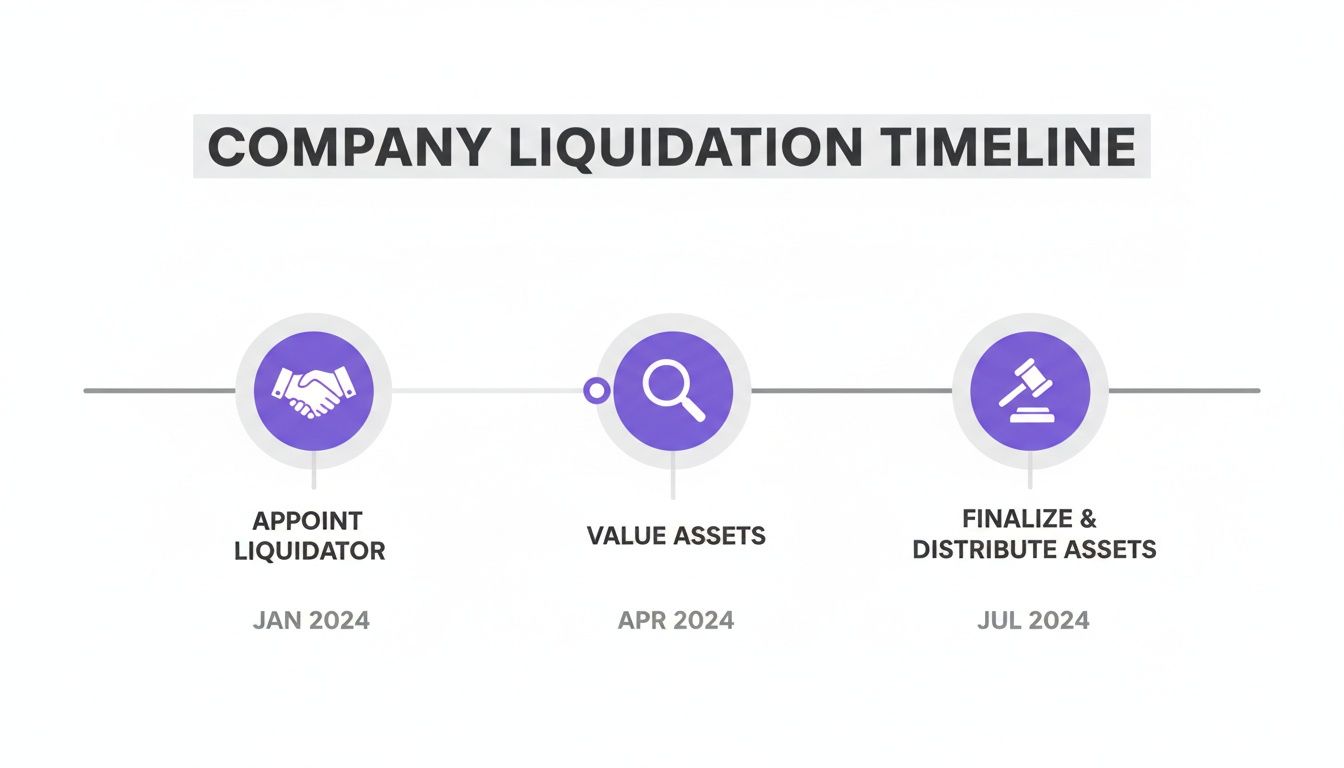
As you can see, this isn't a sudden collapse but a structured sequence of events managed by an expert.
The Consequences for Company Directors
For a director, liquidation can feel like putting your entire professional history under a microscope. While your limited liability company was set up to shield your personal finances, that protection isn't a bulletproof vest.
Once a liquidator steps in, one of their first jobs is to investigate how the company was run, especially in the months leading up to its failure. They're looking for red flags like wrongful trading (carrying on business when you knew, or should have known, there was no reasonable prospect of avoiding insolvency) or, even more seriously, fraudulent trading. If they find evidence of misconduct, the courts can make you personally liable for some of the company’s debts.
The other major landmine is personal guarantees. If you signed one for a bank loan or a lease, that's a separate contract between you and the lender. The company’s closure doesn't wipe it out. The bank will come knocking on your personal door for the money. It's a complex area, and we dive deeper into the specifics of director liability for company debts in our dedicated guide.
What Happens to Employees
When a company goes into liquidation, all employment contracts are usually terminated immediately. It’s a brutal reality, but the law does provide a safety net.
Employees are given a special status as preferential creditors. This bumps them up the queue, putting them ahead of many other people the company owes money to.
Their claims typically cover:
Unpaid Wages: Any salary they've earned but haven't yet received.
Accrued Holiday Pay: Money owed for holiday time they've built up but not taken.
Redundancy Pay: Statutory payments based on their age and how long they've worked for the company.
If the company's bank accounts are empty and there's no money from selling assets, employees aren't left high and dry. Most countries have a government-backed fund (like a national insurance fund) that will step in to cover these specific payments up to a set limit.
The Reality for Creditors and the Payment Waterfall
For suppliers, lenders, and anyone else owed money, liquidation is often a long and frustrating waiting game. After the liquidator is appointed, all creditors get a formal notice asking them to submit a "proof of debt," which is essentially an official invoice for what they're owed.
The hard truth for most unsecured creditors is that they are near the bottom of the payment hierarchy. In many insolvent liquidations, they receive only a few cents on the dollar owed, and sometimes nothing at all.
As we touched on earlier, any money recovered by the liquidator has to be paid out according to a strict legal pecking order, often called the "payment waterfall." This hierarchy is non-negotiable. Secured creditors (like a bank with a mortgage on the company's property) get paid first from that specific asset. Unsecured trade creditors, unfortunately, are near the very bottom.
The Final Outcome for Shareholders
And what about the shareholders, the ultimate owners of the business? In an insolvent liquidation, their situation is the most straightforward and, sadly, the most brutal. They are the absolute last in line.
Shareholders only get a single cent back after every other creditor has been paid in full—from the tax authorities and banks right down to the local stationery supplier. Since a company is being liquidated precisely because it can't pay its debts, this almost never happens. For all practical purposes, the value of their shares drops to zero, and their investment is lost.
A Faster Exit with Liquidation Via Sale
As we've seen, the traditional path to closing a company can feel like a marathon you never signed up for. For founders of startups, e-commerce stores, or small businesses, the thought of spending the next six months to two years buried in legal paperwork and fielding calls from creditors is more than just a headache—it’s a dead weight on your next big idea.
But what if you could sidestep that entire ordeal? Imagine getting a clean break and being able to walk away in a matter of days, not years. That’s the entire premise behind a modern alternative called Liquidation Via Sale.

This approach completely changes the answer to the question: what happens when you liquidate a company? Instead of you personally navigating the slow and public process of winding down, a specialised firm steps in and takes the entire burden off your shoulders.
How Does Liquidation Via Sale Work?
It’s actually a surprisingly straightforward concept. A company like EndCorp acquires all the shares in your business for a nominal fee, often just one dollar. The moment that happens, you legally transfer ownership and your directorship.
From that day forward, the acquiring firm is fully responsible for seeing the company through its final chapter. They’re the ones who handle all the legal steps and filings required to close the company down, all in full compliance with the law. For you, the founder, your involvement ends the day the deal is signed.
This method is purpose-built for one thing: to give founders a swift, clean, and legally compliant exit. It creates a firewall between you and the administrative drain of closure, freeing you to focus on your next venture immediately.
This isn’t some back-alley loophole. It’s a structured business service where you hand over the procedural workload to experts. The acquiring company has the experience and resources to manage the wind-down far more efficiently than a founder trying to juggle it all alone.
The Key Benefits of a Quicker Exit
Opting for this route has some powerful advantages over a conventional liquidation. It all boils down to speed, finality, and your own peace of mind.
Immediate Clean Break: Your legal connection to the company is severed in days. Your name is removed as a director from public registries, putting a definitive end to your formal association.
An End to Creditor Calls: Once the sale is finalised, every creditor call, email, and demanding letter gets redirected to the new owners. You are completely out of the line of fire.
No Administrative Burden: Forget about dealing with liquidators, accountants, or government agencies. All the filings and legal obligations are now the new owner’s problem to solve.
Cost Certainty: Instead of unpredictable liquidator fees that can creep up over time, you pay one single, fixed fee for the entire service. You get total financial closure from day one.
In essence, you are trading the time, stress, and uncertainty of a traditional wind-down for a professional, one-and-done service. This is a game-changer for entrepreneurs who know their time is their most valuable asset—something best invested in a new project, not spent closing down an old one.
Is This Approach Right for You?
While it’s a fast and effective exit, this method is designed for specific situations. It's the perfect solution for founders of failed or dormant limited companies who simply want to move on without the drawn-out drama of a traditional closure.
It’s important to note, however, that this isn't a get-out-of-jail-free card for anyone with undisclosed personal guarantees or who is under active investigation for fraud. The aim is to provide a clean exit from a business that has simply run its course, not to help anyone sidestep legitimate personal liabilities.
Ultimately, the choice becomes much clearer when you see the two paths side-by-side.
Traditional Liquidation vs Liquidation Via Sale
This table gives a clear, at-a-glance comparison between the long, traditional process and the modern alternative offered by firms like EndCorp.
Feature | Traditional Liquidation | EndCorp's Liquidation Via Sale |
|---|---|---|
Exit Timeline | 6–24+ months | 3–30 days |
Director Status | Remains on public record until final dissolution | Removed from public record upon share transfer |
Creditor Contact | You and the liquidator handle all communication | The new owner handles all communication after the sale |
Process Control | You initiate but a liquidator controls the process | You sign a sale agreement and the process is managed for you |
Cost Structure | Variable, based on liquidator's time and expenses | Fixed, upfront fee with no hidden costs |
As you can see, the difference isn't just about timing—it's about reclaiming your focus and energy. One path keeps you tied to the past, while the other gives you a fast-forward button to your future.
Your Top Questions About Liquidation Answered
Even when you understand the process, thinking about liquidation brings up some tough, personal questions. These are the practical, "what-if" scenarios that can cause sleepless nights for any founder. Let's tackle some of the most common concerns head-on to give you the clarity you need.
Will I Have to Pay the Company’s Debts Myself?
For the most part, no. That’s the whole point of a limited liability company—it creates a legal wall between the business’s finances and your personal assets. But that wall isn't indestructible, and you need to know where the weak spots are.
The biggest exception is a personal guarantee. If you signed one for a bank loan, a property lease, or even a major supplier agreement, you are personally on the hook for that specific debt. The company closing down doesn't make that personal contract disappear.
A liquidator will also scrutinise how the directors acted leading up to the insolvency. If they find you were guilty of wrongful trading (basically, carrying on business when you knew you couldn't pay your debts) or any kind of fraud, a court can make you personally liable to contribute money to pay back creditors.
Can I Start Another Company After This One Is Liquidated?
Yes, absolutely. The end of one company doesn't stop you from starting another one. Plenty of successful entrepreneurs have a failed business in their past—it's often part of the journey.
There are, however, some important rules to follow, especially when it comes to the company's name. For a period of five years, you're generally barred from being a director of a new company that has the same name—or a name so similar it could be confusing—as the one that was liquidated.
This rule is in place to stop what's known as 'phoenixing', where directors might try to just ditch their debts and immediately restart the exact same business with a clean slate. Trying to get around this without the court's permission is a serious matter and could make you personally responsible for the new company's debts.
Starting a completely new venture with a totally different name and purpose is usually no problem at all.
How Much Does It Actually Cost to Liquidate a Company?
The cost of liquidation can vary massively, depending on how messy the company's finances are and which route you take. The fees are normally paid out of whatever money is made from selling the company's assets.
Here’s a rough idea of what to expect:
Members’ Voluntary Liquidation (MVL): If your company is solvent (can pay its bills) and you're just closing it down neatly, this is the way to go. Costs typically fall somewhere between $1,000 and $3,000.
Creditors’ Voluntary Liquidation (CVL): For an insolvent company, the process is far more involved for the liquidator. You can expect fees to start at around $5,000 and easily go past $10,000 if the situation is complicated.
This is where an alternative like a Liquidation Via Sale stands out. It often comes with a fixed, upfront fee. You know exactly what you’re paying from day one, which eliminates the stress of watching professional fees climb during a long and unpredictable process. For founders who just want a clean break, that kind of certainty is invaluable.