
Feb 21, 2026
Best Way to Liquidate a Company in Finland in 2026
Deciding how to close your Finnish company in 2026 is a balancing act. You're weighing speed, cost, and your own personal liability. A traditional voluntary liquidation works if you have plenty of time and a solvent business. But for a business that's struggling, the fastest and cleanest exit is often a Liquidation Via Sale, which can see you walk away in a matter of weeks, not years. This guide will walk you through your options so you can make the right call.
Choosing Your Company Exit Strategy in Finland for 2026
Let's be honest: winding down a company in Finland's current economic climate is tough. Having a smart, efficient exit plan isn't just a good idea—it's essential. Old, slow methods can easily burn through your remaining cash and drag out the stress for months, or even years.
The economic data paints a clear picture of this urgency. In 2025, Finland saw a staggering 3,906 companies go into bankruptcy, the highest number since the recession of 1996. That's a 12% jump from the 3,488 cases in 2024, and it continues a worrying trend.
With bankruptcies now averaging 3,600 per year over the last three years—a huge increase from the 2,700 annual average in the 2010s—it's obvious many businesses are finding it impossible to continue. You can read more on these statistics in the full Statistics Finland report.
Your Primary Exit Options at a Glance
When you’re thinking about your next move, the first step is to get a handle on the fundamental differences between your exit options. The path you choose will have a direct impact on your time, your money, and your future business activities. Each method is built for a different scenario, from a carefully planned and orderly shutdown to a rapid escape from a failing company.
To help you see the differences immediately, the table below gives a high-level comparison of the main ways to close a Finnish limited company (Osakeyhtiö or Oy). It breaks down the key factors you need to weigh before you commit to one path.
Quick Comparison of Finnish Company Liquidation Methods
This table provides a high-level summary of the key differences between the main company exit strategies available in Finland for 2026.
Method | Typical Timeline | Estimated Cost | Owner Liability & Involvement |
|---|---|---|---|
Voluntary Liquidation | 6–12+ months | €3,000–€10,000+ | High involvement; owner/director remains liable until the process is finalised. |
Bankruptcy (Konkurssi) | 12–24+ months | Varies widely; legal fees can be substantial. | Public record; potential for director scrutiny and business prohibition. |
Liquidation Via Sale | 3–30 days | Fixed fee (e.g., from €2,000) | Immediate removal from company registry; liability transfers to the new owner. |
Key Insight: The most significant trade-off you face is between control and speed. Voluntary liquidation gives you control but demands significant time and effort, while a Liquidation Via Sale offers a swift, final exit by transferring control to a third party.
Think of this comparison as your starting point. In the sections that follow, we'll dive much deeper into each of these options. We’ll explore the specific steps, who is eligible, and the common mistakes to avoid. This detailed analysis will help you figure out which approach is truly the best way to liquidate a company in Finland in 2026 for your unique situation.
A Detailed Comparison of Finnish Liquidation Paths
Closing your Finnish company is a major decision, and the path you choose will have lasting effects. Whether you're considering a traditional liquidation, facing insolvency, or looking for a quick exit, your choice hinges on your company's financial health, how much risk you're willing to take, and how fast you need to move on.
Each method comes with its own distinct process, price tag, and consequences for you as the owner. Let's dig deeper than a simple overview and get into the practical details you need to decide on the best way to liquidate a company in Finland in 2026. This comparison will lay out the core differences to help you make a sharp decision that protects your interests and gives you a clean break.
Voluntary Liquidation: A Controlled but Lengthy Process
Voluntary liquidation is the classic, formal way to close a solvent company. It's a structured and orderly process designed to make sure all assets are sold, every creditor gets paid, and any leftover cash is distributed to shareholders. Because you kick off and manage the process, it’s a solid choice if your company's finances are in good shape.
But all that control comes at a cost—mostly in time and complexity. The Finnish Companies Act dictates the entire affair, and it's loaded with mandatory steps.
The Initial Resolution: It all starts with a shareholders' meeting. You'll need to pass a resolution to liquidate and appoint a liquidator, who could be a board member or an outside expert. This person then takes over the company's management.
Public Notice: The liquidator has to file the decision with the Finnish Trade Register and then issue a public summons to all creditors, both known and unknown. This summons period is legally required and lasts for several months, which builds a significant delay right into the process.
Selling Assets & Paying Debts: During this time, the liquidator’s job is to turn all company assets into cash, chase down any money owed to the company, and pay off all its debts. For a simple business, this might be easy. For one with a lot of stock or complex contracts, it can get tricky.
Final Accounts & Dissolution: Once every last bill is paid, the liquidator draws up the final accounts for the shareholders to approve. After one last meeting, the company is officially struck from the Trade Register, and it ceases to exist.
You can rarely get through a voluntary liquidation in less than six to eight months, and it’s not uncommon for it to stretch well over a year if anything unexpected pops up. The costs aren't trivial either, starting from a few thousand euros for a straightforward case and climbing to over €10,000 if you need to bring in accountants and lawyers for a more complicated situation.
Bankruptcy: An Involuntary Path for Insolvent Companies
Bankruptcy, or konkurssi as it's known in Finnish, isn't a strategic move—it's a legal obligation when your company is insolvent. A company is considered insolvent when it can’t pay its debts as they come due, and this isn't just a temporary cash-flow problem. As a director, you are legally required to file for bankruptcy without delay once you're in this position.
The entire process is then taken out of your hands and managed by the courts.
Bankruptcy Filing: A bankruptcy petition is filed with the District Court, either by the company itself or by one of its creditors.
Court Decision and Administrator: If the court agrees, it declares the company bankrupt and appoints an administrator (pesänhoitaja) to take full control of everything the company owns.
Estate Administration: The administrator’s first duty is to the creditors. They will seize and sell all company property, then distribute the money to creditors based on a strict legal priority order.
Public Scrutiny: Bankruptcy is a very public process. Your company's name—and by association, your own—will be linked to a business failure. The administrator also has the power to investigate the directors' actions leading up to the insolvency to check for any misconduct.
The economic pressure on businesses is real. Recent statistics show that in January 2026 alone, 385 bankruptcy proceedings were started in Finland. This is the highest monthly number seen since October 1997 and continues a worrying trend of rising insolvencies, which you can read about in the official Statistics Finland release.
For a business owner, bankruptcy means losing all control, getting a public black mark, and being stuck in a process that can drag on for one to two years, sometimes even longer. While it does provide a way out of overwhelming debt, the damage to your reputation and the risk of personal investigation make it an outcome you should try to avoid at all costs.
Deregistration: A Niche Option for Dormant Companies
Deregistration, which is simply having the company removed from the Trade Register, sounds easy, but it’s an option with very limited use. The Finnish Patent and Registration Office (PRH) can force a company to be deregistered if it has been inactive for more than ten years and hasn't filed any financial statements.
This isn't something you can just choose to do. It’s an administrative cleanup tool for the government to get rid of truly abandoned companies. If you try to just walk away from a company that still has assets or debts, you'll find it doesn't work. The liabilities stick around, and directors can be held personally responsible for not managing the company's affairs correctly. For most owners looking for a clean and final closure, this isn't a realistic path.
Liquidation Via Sale: The Swift and Private Alternative
A Liquidation Via Sale offers a modern, practical solution built for speed and finality. It's a perfect fit for founders of companies that are struggling but not yet bankrupt, who want a fast exit without the long, drawn-out timeline of voluntary liquidation or the public shame of bankruptcy.
Instead of going through the process of dissolving the company yourself, you sell 100% of the company shares to a specialist firm. A firm like EndCorp then becomes the new legal owner.
Here’s how the dynamic completely changes for you:
Your Involvement Ends Instantly: As soon as the share transfer agreement is signed and notarised, your time as a director and owner is over. Your name is removed from the Finnish Trade Register, usually within a matter of days.
Liability Is Transferred: The legal responsibility for the company—its assets, its debts, and the duty to complete the final winding-down process according to Finnish law—all moves to the new owner.
Speed and Certainty: The whole sale can be done and dusted in as little as 3 to 30 days. This gives you a clean, fast, and definite end to your involvement, freeing you up to focus on your next venture without being chained to the old company for months or years.
This approach is especially powerful for non-resident owners, e-commerce sellers facing logistical headaches, or any founder who places a higher value on a quick, confidential exit than on a long, administrative wind-down. For anyone prioritising speed and a clean break, it is the definitive best way to liquidate a company in Finland in 2026.
Which Exit Method Fits Your Business Scenario?
Deciding on the "best" way to close your company isn't about finding a single correct answer; it's about matching the method to your unique circumstances. The right path depends entirely on your company’s financial health, your personal goals, and how much time and money you're willing to spend.
Let’s walk through a few common scenarios to see how these choices play out in the real world. This decision tree gives you a bird's-eye view of the first, most critical question: is your company solvent?
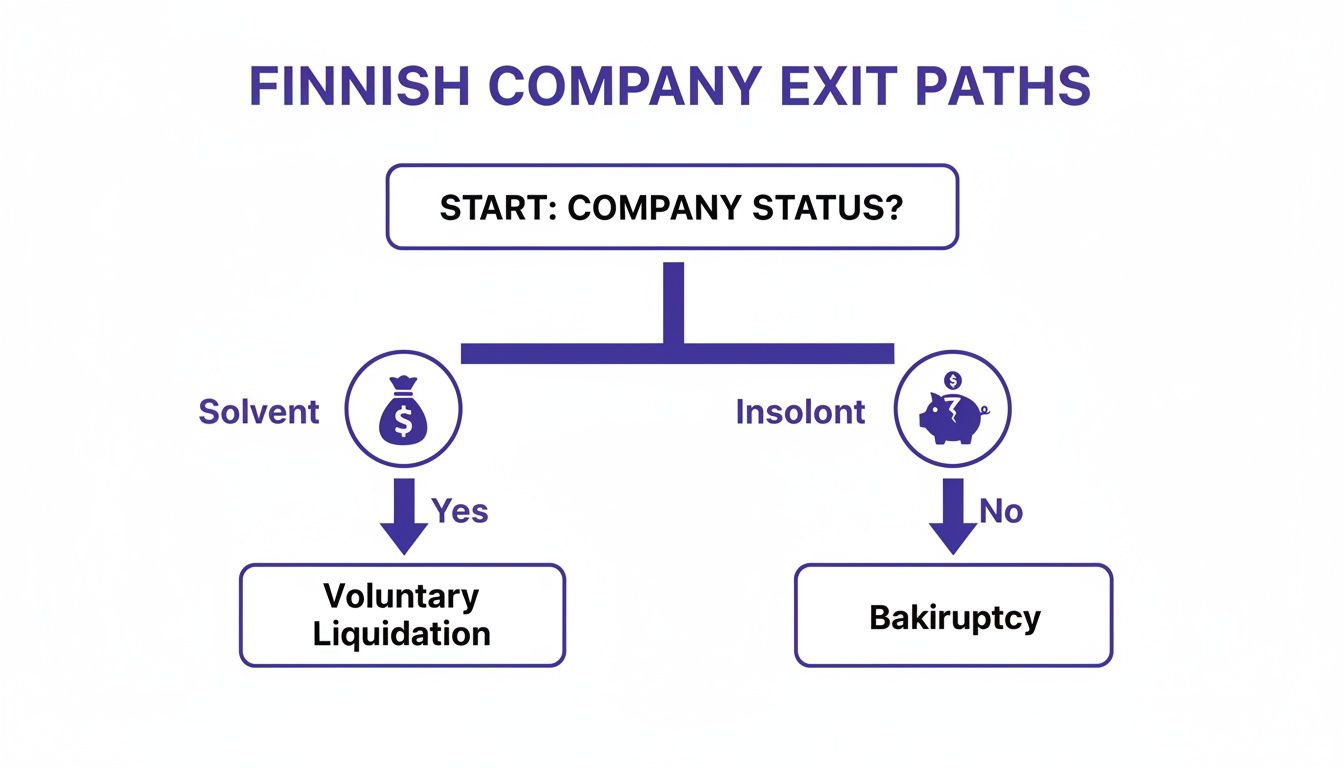
As you can see, your company's solvency immediately pushes you down one of two very different routes—either a controlled, voluntary process or one mandated by the courts.
The Founder Eager to Pivot
The Situation: You’re an entrepreneur, and your Finnish Oy (limited company) has run its course. It’s not drowning in debt, but it’s not growing either. More importantly, a new, exciting business idea needs your complete attention. You need to move on quickly and cleanly.
Traditional Voluntary Liquidation: This is far too slow. The 6-12+ month timeline would be a massive drag on your energy just when you need to be focused on your next venture.
Bankruptcy: This doesn't apply, as your company is still solvent.
Our Recommendation: Liquidation Via Sale. This is your best bet. You can be free of the company in just a few weeks, clearing your head and your schedule. Crucially, all liability transfers to the new owner, giving you a clean break to start fresh.
The Non-Resident Owner of a Dormant Company
The Situation: You live outside Finland and set up an Oy for a project that never got off the ground. Now it's just sitting there—no assets, no debts, but you’re still stuck with annual compliance costs and administrative headaches. You need a simple, remote way to shut it down.
Traditional Voluntary Liquidation: For a non-resident, this is a logistical nightmare. You'd have to deal with Finnish bureaucracy from another country, likely involving expensive trips for notary appointments or hiring costly local representatives.
Deregistration: While it might seem like a passive solution for a dormant company, just waiting for the PRH to strike it off is unpredictable. You can learn more about the pitfalls of this hands-off approach in our guide on striking off a company.
Our Recommendation: Liquidation Via Sale. This process is tailor-made for remote owners. The entire share transfer can be handled digitally or by courier. Once the sale is done, you walk away, and a professional team handles all the Finnish legal requirements. It's the most straightforward "fire-and-forget" solution.
Key Insight: For directors living abroad, the ability to close a company without setting foot in Finland is the most critical factor. Liquidation Via Sale is designed for exactly this, whereas traditional methods were built with local presence in mind.
The E-commerce Seller with Frozen Stock
The Situation: Your e-commerce business, run through a Finnish Oy, has just had its main marketplace account suspended. Your entire inventory is now stuck in a warehouse, sales have ground to a halt, and supplier bills are piling up. You need to cut your losses before things spiral into bankruptcy.
Traditional Voluntary Liquidation: Trying to sell off stranded inventory to pay creditors is tough and slow. All the while, the debts keep growing, making the situation worse.
Bankruptcy: This is where you're headed if you don't act quickly. A public bankruptcy filing could also seriously damage your reputation for any future e-commerce projects.
Our Recommendation: Liquidation Via Sale. Selling the company means you transfer the entire problem—the locked inventory, the supplier debts, everything—to the new owner. It’s an immediate exit that stops creditor pressure in its tracks and helps you avoid a damaging bankruptcy. In a crisis like this, it's often the best way to liquidate a company in Finland in 2026.
Understanding The Liquidation Via Sale Process

For business owners who need a clean and decisive end to their company's story, the Liquidation Via Sale model offers a modern, incredibly effective path forward. It’s a world away from traditional methods that can drag on for months, or even years. This approach completely changes the exit by transferring the entire burden of winding down the company to a specialised buyer.
Instead of getting tangled in the complex web of Finnish dissolution laws yourself, you simply sell 100% of your company's shares. A firm like EndCorp steps in, buys the shares, and becomes the new legal owner. That single transaction is the heart of the process, giving you a clean, legal, and final break from a struggling business.
How Liquidation Via Sale Works Step-by-Step
The entire process is intentionally simple. It’s designed to keep your involvement to a minimum and give you a clear, predictable timeline, stripping away the red tape that plagues other liquidation methods. It all boils down to a swift transfer of ownership.
Here’s a transparent look at how it typically unfolds:
Initial No-Cost Consultation: It all starts with a free chat to go over your company's current situation. This first step is crucial to confirm if your business is a good candidate for this type of exit.
Contract Review and Signing: If you’re eligible, you’ll receive a straightforward contract outlining the terms of the share sale. There are no hidden clauses or surprises; you get to review and understand every detail before you commit.
Share Transfer and Payment: Once the agreement is signed (which can often be done remotely with a notary), you transfer the shares to the new owner. At this point, the fixed service fee is paid.
Immediate Director Removal: As soon as the transfer is officially registered, your name is removed from the Finnish Trade Register. This is a critical moment, as it formally severs your legal ties and liabilities to the company.
Final Winding-Down by Experts: The new owner, backed by a professional legal team, takes on full responsibility for the company. They handle everything that’s left—from administrative tasks and creditor negotiations to the final legal dissolution under Finnish law.
The value here is hard to overstate: complete closure in as little as 3 to 30 days, a full transfer of liability, and the immediate removal of your name from public records. To better understand what the new owner handles in these final stages, you can learn more about what happens when you liquidate a company in our detailed guide.
With a success rate where 99.7% of clients never hear from their old company again, the finality of this process is its most compelling feature. It offers peace of mind that is simply not available with longer, more public dissolution methods.
Who Is The Ideal Candidate For This Service?
Liquidation Via Sale isn’t for everyone, but it is the definitive best way to liquidate a company in Finland in 2026 for a specific kind of entrepreneur. It’s built for founders who value a quick, confidential exit far more than squeezing every last cent out of a failing business.
This service is an excellent fit if you are:
An entrepreneur with a new venture who needs to move on without being held back by an old one.
A non-resident owner struggling to navigate Finnish bureaucracy from abroad.
An e-commerce seller with blocked inventory and escalating supplier debts.
A small or medium-sized enterprise (SME) owner facing mounting pressure from creditors and looking to avoid a public bankruptcy.
On the other hand, it's just as important to know who this service is not for. Cases involving active fraud investigations, undisclosed personal guarantees for company debts, or any attempt to dodge legitimate personal liabilities are not eligible. The goal is to provide a clean legal exit, not a loophole for misconduct. This protects the integrity of the process for everyone involved.
Avoiding Common Pitfalls in Finnish Company Liquidations
Choosing an exit path is one thing; navigating it without getting tripped up is another challenge entirely. Every method for closing a Finnish company has its own set of traps that can cost you precious time, money, and peace of mind. A clean exit isn't just about finishing the process—it's about foreseeing these issues before they happen.
Understanding these risks is more critical than ever. The economic pressures in Finland are very real. While the construction sector was hit particularly hard in 2025 with 768 firms filing for bankruptcy, Statistics Finland’s Mira Kuussaari pointed out that “practically all other sectors” also saw a rise in insolvencies. The total number of bankruptcies hit 3,906—a 30-year high that affected 14,300 jobs, mostly in SMEs. You can explore these worrying trends in the recent Yle report. This backdrop makes finding the best way to liquidate a company in Finland in 2026 an exercise in careful, strategic planning.
The Pitfalls of Voluntary Liquidation
The most common mistake business owners make with voluntary liquidation is grossly underestimating the time and administrative work it takes. Many see it as a simple checklist, but they don't account for the mandatory waiting periods and bureaucratic snags that are built into the system.
Timeline Creep: The legally required public summons to creditors automatically adds months to the process. If any unexpected issues pop up—like a dispute over an asset's valuation or a surprise creditor claim—your six-month plan can easily drag out to over a year.
Paperwork Overload: The procedure demands meticulous record-keeping, multiple filings with the Trade Register, and the preparation of final accounts. One small error can get your filing rejected, causing even more delays and keeping you legally tied to the company for far longer than intended.
Lingering Liability: You and the liquidator you appoint are on the hook for the company’s affairs until the very end. If a forgotten debt or obligation comes to light after you thought it was all over, you can be pulled right back into the mess.
Key Takeaway: Don't mistake 'solvent' for 'simple'. A voluntary liquidation requires your sustained attention and a realistic view of its slow, methodical pace. It is definitely not a quick way out.
The Dangers of Bankruptcy and Standard Sales
For an insolvent company, bankruptcy might seem like the only option, but it comes with permanent baggage. The biggest pitfall is the public mark it leaves on your reputation. Every bankruptcy is recorded and made public, which can seriously damage your ability to secure funding or find partners for your next venture. Directors also face intense scrutiny from the court-appointed administrator, a notoriously stressful and invasive experience. You can read about director liability for company debts in our dedicated article to understand these risks better.
Trying to sell a distressed business through a standard sale presents its own set of problems, the main one being finding a real buyer. It’s incredibly difficult to persuade someone to take on a struggling company that already has debts and operational headaches. This often leads to months wasted searching for a buyer who may never appear, all while the company's financial health gets worse.
How to Proactively Avoid These Traps
The single most effective way to sidestep these issues is to act decisively before your options narrow. If your company is struggling financially, waiting too long will likely force you into bankruptcy, taking away all your control.
Here are a few strategic actions to consider:
Be Realistic: Take an honest look at how much time and energy you can actually commit. If you need to move on to a new project or just want your life back, the long, drawn-out timeline of a voluntary liquidation becomes a significant liability in itself.
Act Early: Address financial distress before it spirals into a full-blown crisis. An exit through a Liquidation Via Sale is most effective for companies that are struggling but are not yet legally insolvent.
Prioritise a Clean Break: Figure out what truly matters most to you. Is it squeezing every last euro out of the company, or is it achieving a fast, clean, and final exit that frees you from all future responsibility?
For many entrepreneurs, the most reliable way to avoid these common traps is to hand the entire problem over to a specialist. A Liquidation Via Sale sidesteps the timeline creep, eliminates the administrative burden, and prevents the public fallout of bankruptcy. It offers a definitive and predictable end to a difficult chapter.
Got Questions About Closing a Finnish Company? We Have Answers.
Closing down a business raises a lot of questions. It's a big decision, and you need to get it right. Here are straightforward answers to some of the most common things entrepreneurs ask when they're looking to liquidate their Finnish company in 2026.
Can I Close My Finnish Company if I Live Abroad?
Yes, you can, but your experience will be wildly different depending on the path you take. Traditional voluntary liquidation or bankruptcy can be a real headache to manage from another country. You're often looking at a process that demands physical signatures, meetings with notaries in Finland, and direct back-and-forth with local authorities.
This is precisely where a Liquidation Via Sale shines. The entire process is built for remote execution, which makes it a perfect fit for non-resident owners. Once you’ve signed the share transfer agreement, that’s it for you. A local representative takes over and handles every single filing and administrative step in Finland, meaning you never have to book a flight.
What Happens to the Company's Debts?
How outstanding debts are handled is one of the most important distinctions between your options.
Voluntary Liquidation: In this scenario, all known company debts must be paid off in full from its assets. The company can't be officially closed until every creditor is settled.
Bankruptcy: Here, a court-appointed administrator takes control. They sell off the company's assets and distribute the proceeds to creditors. Often, creditors only get a percentage of what they were originally owed.
Liquidation Via Sale: This is different. When you sell the shares, the legal responsibility for the company's debts transfers to the new owner. As long as you haven’t personally guaranteed any loans, your liability as the former director is completely severed.
A Crucial Point: The transfer of liability is the core benefit of a Liquidation Via Sale. The new owner—in our case, EndCorp's holding structure—assumes the duty of winding down the company and its obligations according to Finnish law. This gives you a genuine clean break.
How Do I Know if We're Insolvent and Have to File for Bankruptcy?
Under Finnish law, a company is legally insolvent when it can't pay its debts as they fall due, and this isn't just a temporary cash-flow problem. As a director, you have a legal obligation to file for bankruptcy promptly once you realise the company has reached this point.
If you continue to operate an insolvent company, you can be held personally liable for any new debts it accumulates. If you're unsure whether your company has crossed this line, getting professional financial or legal advice is critical. A Liquidation Via Sale is designed for companies that are struggling but aren't yet legally insolvent, providing an exit before you hit that point of no return.
Will Liquidating My Company Stop Me From Starting Another One?
This is a huge consideration for any entrepreneur. A bankruptcy is a public matter that leaves a permanent mark. In cases of mismanagement, it can even lead to a temporary business prohibition (liiketoimintakielto), which would legally bar you from serving as a director in Finland for a specified time.
A standard voluntary liquidation, on the other hand, is an orderly process for a solvent company and carries no such stigma. With a Liquidation Via Sale, your name is removed from the old company's records quickly and privately. Since you aren't the one filing for bankruptcy, this exit has no negative impact on your ability to start a new business, whether in Finland or elsewhere. It allows you to move forward without a black mark on your record.