
Feb 19, 2026
Best Way to Liquidate a Company in Germany in 2026: A Practical Guide
Deciding on the best way to close your German GmbH in 2026 really comes down to what you want to achieve. If a fast, clean exit with the least amount of paperwork is what you're after, then a liquidation via share sale is almost always the better option. On the other hand, if your company has significant assets that need to be properly distributed among shareholders, the traditional voluntary dissolution is still the go-to, albeit much slower, legal path.
Choosing Your Company's Exit Path in Germany
Let's be honest, closing a business is one of the toughest parts of the entrepreneurial journey. This guide is designed to cut through the legal jargon and give you a straightforward roadmap for shutting down your German GmbH in 2026. Getting this right boils down to three things: the financial state of your company, how quickly you need to move on, and your appetite for personal liability risk.
This conversation couldn't be more timely. Germany is seeing a record-breaking wave of corporate insolvencies, with 2025 hitting a 20-year high. We saw 17,605 companies go under last year, a number that eclipses even the fallout from the 2009 financial crisis. This backdrop explains why so many founders are looking for a quick and efficient way out.
To help you see the options clearly, I've put together a quick comparison table. It lays out each method side-by-side, focusing on the critical factors of speed, cost, and your personal liability. This should give you an immediate sense of which path fits your situation.
German Company Liquidation Methods at a Glance
This table gives you a high-level summary of the three main ways to close a GmbH in Germany, helping you quickly compare the most important aspects of each.
Method | Typical Timeline | Estimated Cost | Founder Liability Exposure |
|---|---|---|---|
Voluntary Dissolution | 12-24+ months | €3,000 - €10,000+ | Low (if procedures are followed correctly) |
Insolvency Proceedings | 1-5+ years | €5,000 - €25,000+ | High (risk of director liability claims) |
Liquidation via Share Sale | 3-30 days | Fixed Fee (from €2,000) | Minimal (transferred to new owner) |
As you can see, the timelines and risks vary dramatically. The best choice for you will depend entirely on your company's specific circumstances.
The real game-changer here is the mandatory Sperrjahr, or "blocking year," that's part of a traditional dissolution. It’s a full 12-month waiting period legally required to protect creditors. A liquidation via share sale completely sidesteps this, letting you finalise the closure almost immediately.
Getting a handle on how each of these processes works is the first real step toward a clean exit. As you dig into the details, think about your own situation. Are you juggling creditor demands? Simply closing a dormant company? Or do you just need to get out fast to focus on your next project? Each of these scenarios points to a different solution. For a broader overview, you can also read our guide on what happens when you liquidate a company.
The next sections will break down each path in detail, giving you the insights you need to make the right call for 2026.
A Detailed Look at Your German Liquidation Options for 2026
Choosing how to close your German GmbH isn't a one-size-fits-all decision. The right path for you in 2026 really boils down to your company's financial health, what you still owe, and frankly, how much time and personal risk you're willing to take on. Each legal route comes with its own unique set of trade-offs.
Let's break down the three main choices you have: the traditional Voluntary Dissolution, the legally mandated Insolvency Proceedings, and the much faster, modern alternative of a Liquidation via Share Sale. We'll get into the nitty-gritty of what each means for your timeline, wallet, creditors, and personal liability to give you a clear picture.
Option 1: The Traditional Path - Voluntary Dissolution and Winding-Up
Known in German as Regelabwicklung, a voluntary dissolution is the standard, by-the-book procedure for closing a solvent company. It’s a very formal process designed from the ground up to make sure every creditor gets paid, all assets are sold off, and any money left over is distributed correctly to the shareholders. Think of it as the meticulously correct, but slow, way to do things.
This route makes sense for founders whose GmbH is solvent—meaning it can easily cover all its debts—and has a straightforward, uncomplicated history. If you're not in a rush and want to personally oversee the shutdown to squeeze every last euro out for the shareholders, this can work.
But there's a big catch, and it's all about the clock.
The core of this process is the ‘Sperrjahr’, or "blocking year." This is a mandatory, 12-month waiting period that only starts after you've publicly announced the dissolution. Its entire purpose is to give every possible creditor, known or unknown, a chance to raise their hand and stake a claim. You can't speed it up or skip it, and it's the single biggest factor that drags out the timeline.
For most entrepreneurs eager to move on to their next project, this year-long limbo is a massive drawback.
What to Expect on Timeline and Cost
The timeline is easily the biggest headache with a voluntary dissolution. You're looking at a process that typically lasts between 12 and 24 months, and honestly, it often runs longer. The whole thing isn't officially over until that blocking year is complete and you've received the final tax clearances from the Finanzamt (tax office), which can tack on several more months of waiting.
The costs can also add up quickly, usually landing somewhere between €3,000 and €10,000 or more. This figure covers:
Notary Fees: You'll need a notary to officially record the shareholder resolution to dissolve the company.
Court and Registration Fees: For filing the dissolution and, eventually, getting the company struck from the Commercial Register.
Liquidator Fees: The person appointed to manage the wind-up (often a former director) is entitled to be paid for their work.
Accounting and Tax Costs: You'll need an expert to prepare the opening and closing liquidation balance sheets and all final tax returns.
It's a methodical way to close up shop, but that thoroughness costs a lot of time and money, making it a poor fit for any founder who needs a clean, quick exit.
Founder Liability and the Step-by-Step Process
As long as you follow the procedure to the letter, a voluntary dissolution carries a pretty low risk of personal liability for the directors. Where you can get into trouble, however, is if the appointed liquidator messes up. Distributing assets to shareholders before the blocking year is over or failing to pay a known creditor can bring that liability right back to your doorstep.
The process generally looks like this:
Shareholder Resolution: First, you pass a notarised resolution to formally dissolve the GmbH.
Appoint a Liquidator: You then nominate a liquidator (usually yourself or another director) to manage the entire winding-up process.
Go Public: The dissolution is filed with the Commercial Register and published in the Federal Gazette.
The Blocking Year (Sperrjahr): The clock starts on the mandatory 12-month waiting period. No assets can be distributed to shareholders during this time.
Wind-Up Activities: The liquidator gets to work selling assets, paying off creditors, and ending all company contracts.
Final Filings: Once the blocking year is up, the liquidator prepares the final accounts and files to have the company officially deleted from the register.
Option 2: The Forced Route - Insolvency Proceedings
Insolvency proceedings (Insolvenzverfahren) aren't really a choice; they are a legal duty. If your GmbH can't pay its bills (illiquid) or if its debts are greater than its assets (over-indebted), the managing directors are legally required to file for insolvency immediately—usually within three weeks of that reality becoming clear.
Don't mess around with this. Failing to file on time is a criminal offence in Germany called Insolvenzverschleppung (insolvency delay). It can result in serious personal liability, heavy fines, and even jail time for the directors. This path is strictly for companies in deep financial trouble with no way back to solvency.
Timeline, Cost, and Control During Insolvency
The timeline for an insolvency is notoriously long and unpredictable. It can easily drag on for one to five years, sometimes even longer, depending on how messy the company’s finances are. From the moment you file, a court-appointed insolvency administrator takes complete control of the company and everything it owns.
Costs are also significant, usually starting at a minimum of €5,000 and climbing much higher based on the value of the assets and the complexity of the case. These fees are paid out of whatever assets the company has left, which almost always means there is nothing left for the shareholders at the end.
But the most critical point here is the absolute loss of control.
The insolvency administrator calls all the shots.
Their legal duty is to the creditors, not to you or the other shareholders.
Every decision you made in the run-up to the insolvency will be put under a microscope, and they will look for any reason to hold you personally liable.
Option 3: The Fast-Track Exit - Liquidation Via Share Sale
A liquidation via share sale is a modern, clean, and increasingly popular way to close a German GmbH. Instead of going through the long formal dissolution process, you simply sell 100% of your company shares to a specialised firm. That firm becomes the new owner and shareholder, taking on the full legal responsibility of winding the company down properly.
This route is perfect for founders of solvent (or nearly solvent) companies who just want a fast, final exit. It’s a fantastic solution for non-resident owners struggling with German bureaucracy, e-commerce sellers stuck with inventory, or any entrepreneur who wants to sidestep the administrative nightmare and long waits of a traditional closure.
It's important to understand this isn't the same as a "strike-off," which is typically an administrative action taken by the authorities when a company is non-compliant. To see how they differ, check out our guide on what striking off a company entails. A share sale is a proactive, strategic, and fully legal transfer of ownership.
Speed, Finality, and a Clean Break from Liability
The biggest draw of a share sale is pure speed. The whole thing, from the first chat to the final signature at the notary, can be wrapped up in as little as 3 to 30 days. The moment that notary appointment is done and your name is removed from the Commercial Register, your legal ties to the company are cut.
With a liquidation via share sale, the dreaded ‘Sperrjahr’ becomes the new owner’s problem, not yours. You get an immediate exit, freeing you up to focus on your next venture without a year of administrative duties hanging over your head. This instant finality is what sets this option apart.
Crucially, this process transfers future administrative liability to the buyer. Since you are no longer a director or shareholder, you are completely removed from the process of dealing with creditors, the tax office, and the endless filings. The new owner manages the wind-up from that point on, shielding you from the procedural mistakes that can so easily happen in a self-managed dissolution. For anyone looking for a swift and definitive closure in 2026, this is often the smartest way forward.
The Common Traps That Can Derail Your GmbH Closure
Closing a company isn't just about following a procedure; it's about sidestepping the hidden traps. When it comes to shutting down a German GmbH, the path is littered with legal landmines that can have serious personal and financial fallout for founders, long after you think the chapter is closed. Knowing where these traps are is the best way to ensure you get a clean exit.
We’re not talking about simple paperwork issues here. These are the kinds of mistakes that can put your personal assets and future career at risk. The most frequent errors I see range from forgotten clauses in old contracts to a fundamental misunderstanding of how unforgiving German insolvency law can be. Each misstep can turn a standard administrative process into a personal nightmare.
The Ghost of Personal Guarantees and Hidden Liabilities
One of the most dangerous pitfalls is the persönliche Bürgschaft – the personal guarantee. It’s common for founders to sign these in the early days to get a loan, a commercial lease, or a credit line from a key supplier. Years later, they're often completely forgotten. But during a liquidation, these guarantees have a nasty habit of coming back to haunt you, making you personally liable for company debts.
Make no mistake, if the company’s assets don't cover its obligations, creditors will come after you directly. Before you even think about starting the liquidation process, you absolutely must dig through every contract you've ever signed. You need to find and deal with any personal guarantees. Simply hoping they'll be forgotten is not a strategy.
I’ve seen this happen countless times. A founder personally guaranteed a five-year office lease. The company closes down after three years, but the landlord legally pursues the founder for the remaining two years of rent. That one oversight can push someone into personal bankruptcy, completely detached from the company's own fate.
Failing to get a full picture of these obligations is the fastest way to find yourself in financial trouble. This is exactly why you need a complete and honest assessment of every liability before you decide how to close your company in Germany in 2026.
The Criminal Offence of Waiting Too Long to File for Insolvency
German law is incredibly strict about insolvency. If your GmbH can't pay its bills as they fall due (a state known as Zahlungsunfähigkeit) or its debts outweigh its assets (Überschuldung), you are legally obligated to file for insolvency immediately. The grace period is short, typically just three weeks.
Ignoring this duty is a criminal offence called Insolvenzverschleppung (insolvency delay). The consequences are severe: we're talking about heavy fines, being banned from acting as a director in the future, and even prison time of up to three years. Pleading ignorance won't get you anywhere in court.
Wrongful Trading: If you keep running the business and racking up new debts when you know it's insolvent, you can be held personally responsible for those new bills.
Asset Stripping: Trying to move assets out of the company right before an insolvency filing is a huge red flag. An administrator will investigate and almost certainly reverse those transactions.
On top of all this, if there are any ongoing criminal or fraud investigations into the company or its directors, some exit routes will be completely off the table. This is especially true for faster options like selling the company shell. In these situations, your only real defence is to be transparent and act quickly.
The Sneaky Costs of Simple Administrative Errors
Even with a straightforward voluntary dissolution, simple procedural mistakes can end up costing you a fortune. The financial drain of the mandatory Sperrjahr (the "blocking year") is one of the most underestimated factors. For those 12 months, even if the business isn't trading, it’s still incurring costs – think accounting fees, bank charges, and tax advisory services.
Other subtle but costly errors include:
Fuzzy Asset Valuations: Selling assets for less than they're worth to speed things up can trigger challenges from the tax office or angry creditors.
Botched Tax Filings: Failing to correctly prepare and file the opening and closing liquidation balance sheets can lead to penalties and will definitely delay the final tax clearance from the Finanzamt.
Distributing Assets Too Soon: This is a big one. Paying out the company's remaining cash to shareholders before the blocking year is officially over is a serious breach of duty. The liquidator can be held personally liable for the full amount.
Every one of these blunders adds time, money, and personal risk to the process. It just goes to show why getting professional, meticulous guidance from the very start is so critical.
Finding the Right Way to Close Your GmbH
Knowing the legal theory is one thing, but applying it to your actual situation is where it counts. The best way to close a German GmbH in 2026 isn't found in a textbook; it depends entirely on your company's specific circumstances. Looking at abstract comparisons of timelines and costs will only get you so far.
To really get to the heart of the matter, we need to walk through a few common, real-world scenarios. I'll break down the decision-making process for three distinct founder profiles to show you how these options play out on the ground. This should help you see your own situation more clearly and identify the critical factors for your decision.
Scenario 1: The Non-Resident E-commerce Seller
Let’s start with a classic one: a UK-based founder ran a successful Amazon FBA business using a German GmbH. They’ve stopped trading, but the company is left with inventory stuck in a German warehouse, a bit of cash in the bank, and an unresolved VAT issue with the Finanzamt. What they need is a clean break, handled remotely, without the headache of flying to Germany or getting bogged down in tax bureaucracy.
A voluntary dissolution is a complete non-starter here. The process is painfully long and demands active, hands-on management, which is a total nightmare for anyone not living in Germany. It would involve hiring a local liquidator, navigating German bureaucracy from abroad for over a year, and somehow trying to sort out the VAT liability from a distance.
An insolvency proceeding is also the wrong tool for the job. The company isn’t actually insolvent, just dormant with loose ends. Filing for insolvency would be a massive overreaction, inviting intense scrutiny from the authorities and creating far more problems than it solves.
This is precisely the situation where a liquidation via share sale shines. By selling the company’s shares, the founder gets an immediate and final exit. The buyer takes over everything – the trapped inventory, the bank account, and the VAT liability – managing the entire wind-down process on German soil. The founder simply pays a fixed fee, signs the sale contract (which can be done remotely), and is completely free within days.
Scenario 2: The SME Founder Under Creditor Pressure
Now, picture a German SME in the manufacturing game, hit hard by supply chain chaos. The company is still solvent, but suppliers are getting nervous and shortening their payment terms. The founder has personally guaranteed a hefty business loan and wants out before the situation spirals into a full-blown insolvency, which would put their personal assets directly in the firing line.
In this case, speed and liability protection are everything. A voluntary dissolution is far too slow. The mandatory 12-month "blocking year" is a creditor's dream, giving them ample time to call in debts as the company's finances worsen. That personal guarantee would almost certainly get triggered.
Filing for insolvency is exactly what the founder is desperately trying to avoid. While it might be an eventual outcome if nothing is done, it means a complete loss of control, an official investigation into their conduct as a director, and the near certainty of the personal guarantee being called in.
The liquidation via share sale provides the quickest and safest escape route. It lets the founder exit cleanly while the company is still solvent, handing over all operational and administrative headaches to the new owner. Most importantly, this swift exit freezes the situation before it deteriorates, creating the best possible chance to negotiate a release from the personal guarantee as part of the deal and protecting their personal wealth.
Scenario 3: The Founder of a Dormant GmbH
Finally, consider a founder who set up a GmbH for a project that never got off the ground. The company is a pure shell: no assets, no debts, no employees, and no trading history. All the founder wants is to shut it down with minimal fuss and cost, because paying for annual accounts and tax filings on a useless entity is just throwing good money after bad.
For this straightforward case, a voluntary dissolution is technically a viable path. Since there are no creditors, the "blocking year" is just a procedural delay. The founder could even act as the liquidator themselves to save money. But they still have to deal with the notary, the court filings, and the year-long wait.
Even in this simple scenario, a liquidation via share sale often makes more sense. It’s a true "fire and forget" solution. For a fixed fee, the founder can hand off the company in a week or two and be done with it forever. This completely removes the 12+ months of administrative hassle and the risk of making a mistake during a self-managed dissolution.
When you're weighing a cheap but labour-intensive voluntary dissolution against a fixed-fee, zero-effort share sale for a dormant company, it really boils down to what your time is worth. For most entrepreneurs, being tied to a pointless administrative task for a year is a much bigger cost than the fee for an instant exit.
The decision tree below can help you map out some of the key risks to think about as you choose your path.
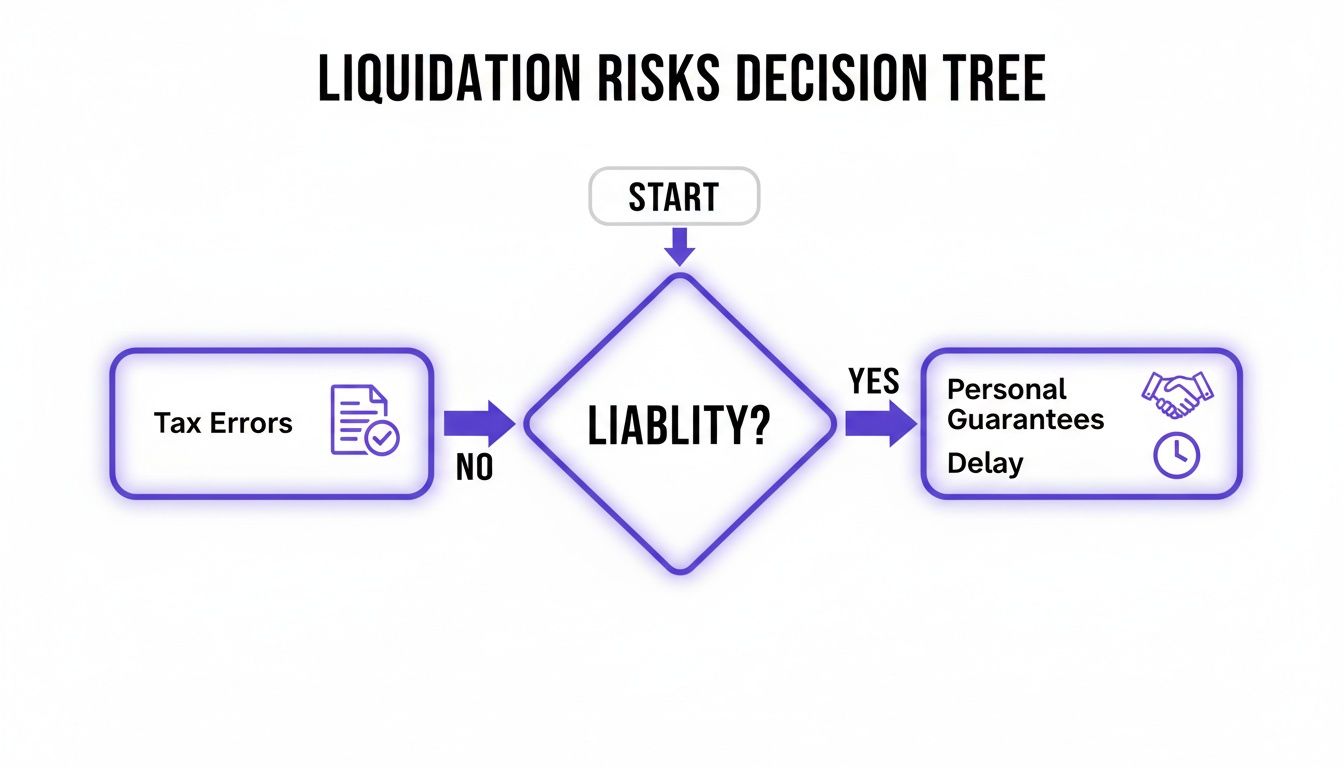
This flowchart makes it clear how quickly things like personal liability and administrative delays can derail your company's closure.
It’s also worth noting that some sectors are just more vulnerable to financial trouble, making a quick exit even more critical. The transportation and warehousing industry, for example, currently has the highest insolvency rate at 12.73 bankruptcies per 10,000 companies, with hospitality not far behind. If you're in one of these high-risk fields, the case for a swift and decisive liquidation becomes incredibly compelling. You can discover more insights about German corporate insolvencies on TaylorWessing.com.
Planning Your Next Steps for a Clean Company Exit
When it comes to closing a German GmbH in 2026, it all boils down to a trade-off: your time, your money, and your personal risk. There’s no single “best” way; the right path is dictated entirely by your company’s unique situation—its assets, its debts, and how quickly you need to move on. As we've seen, each option delivers a vastly different outcome for you as the founder.

The single biggest mistake you can make right now is doing nothing. Kicking the can down the road doesn't just prolong the stress; it actively burns through your available options. A company teetering on the edge of insolvency simply doesn't have the same clean exit routes as a solvent one. Inaction often turns out to be the most expensive choice of all.
Your immediate priority should be getting a brutally honest, professional assessment of where things stand. That means cataloguing every liability—from bank loans and supplier invoices to tax obligations and those personal guarantees you might have forgotten about. You can only make a smart decision with a complete financial picture in front of you.
A Modern Path to a Swift Exit
For most founders, the traditional wind-down process feels completely out of sync with the pace of modern business. The mandatory 12-month Sperrjahr (blocking year) is a huge administrative drag, keeping you legally and mentally chained to a dead company long after you’re ready to start something new. This is exactly where a modern alternative changes the game.
A Liquidation Via Sale gives you a fast, clean, and final exit. Instead of you managing a year-long administrative marathon, you simply transfer the company’s ownership to a specialist firm that handles the formal wind-down. The benefits are clear:
Immediate Closure: The entire transaction can be done and dusted in as little as 3-30 days.
No Blocking Year: You completely sidestep the mandatory 12-month waiting period.
Reduced Liability: Once the sale is notarised, the new owner takes on the responsibility for the wind-down, shielding you from procedural mistakes.
This approach was designed for entrepreneurs who need to close one chapter cleanly and pour their energy into the next, free from the weight of a past business. You can get a better sense of the timelines involved by reading our guide on how long liquidation can take.
Key Takeaways for Making Your Decision
As you weigh your options, keep these critical points front and centre. They cut to the heart of what separates each path and will help you pick the right one for your situation in 2026.
Voluntary Dissolution is for solvent companies where the founder isn't in a rush and has the appetite to personally manage a process that takes 12+ months.
Insolvency Proceedings are a legal duty, not a strategic choice. This is the required path for any company that cannot pay its bills.
Liquidation Via Share Sale is the best route for founders who want a fast, final, and clean exit with the least possible administrative hassle and personal involvement.
The most important thing to remember is this: the 'best' method is the one that fits your needs. For any founder looking for speed and certainty, a share sale delivers a clean break that traditional methods simply can't match.
Take Action and Get Clarity
Closing a business is complicated, but you shouldn’t have to figure it out alone. The right advice early on can mean the difference between a clean exit and a long, expensive headache. If a fast and final closure sounds like the right solution for your German GmbH, your next step is to get a professional evaluation.
Book a free, no-obligation consultation with our team. We’ll help you assess your company's situation and determine if a Liquidation Via Sale is the best way forward for you in 2026.
Frequently Asked Questions About Company Liquidation
Closing down a business throws up a lot of pressing questions. We've gathered the most common queries we get from founders trying to navigate the best way to close a German company in 2026, breaking down the real-world consequences of each decision.
What Happens If I Just Abandon My German GmbH?
It might be tempting to just walk away, but abandoning your German company is one of the riskiest moves you can make. The authorities won't simply forget about it. Sooner or later, it will be flagged for an administrative strike-off (Löschung von Amts wegen) for failing to keep up with legal duties, like filing annual accounts.
This is far from a clean break. The process can drag on for years, and all that time, you remain the legally registered director with all the responsibilities that entails. You're on the hook for potential fines for non-compliance, and if any old debts pop up down the line, creditors can push to have the company reinstated, pulling you right back into the mess.
Can I Liquidate a German Company From Abroad?
Technically, yes, but it's a genuine headache. A standard voluntary dissolution demands a lot of hands-on management. You'll need to get documents notarised, communicate with the German tax office (Finanzamt), and handle administrative tasks for a full year. Trying to juggle all of that from another country is a logistical nightmare that usually means hiring expensive local professionals.
One of the biggest hurdles for non-resident founders is how hands-on a traditional German wind-down is. The process simply wasn't designed to be managed from afar, which makes it incredibly impractical and costly for anyone living outside of Germany.
This is exactly where a share sale shows its strength. The deal can typically be handled entirely remotely. You legally transfer the company and all its obligations to a new owner without ever having to set foot in Germany, offering a clean and final exit for international founders.
How Long Is the Sperrjahr and Can I Get Around It?
The Sperrjahr, or "blocking year," is a mandatory 12-month waiting period at the heart of every traditional voluntary dissolution in Germany. It officially kicks off only after the company's dissolution is published in the Federal Gazette. Its entire purpose is to give any and all potential creditors ample time to step forward and stake their claims.
This waiting period is a non-negotiable legal requirement; you can't shorten it or skip it if you go the traditional route. For many founders, it's the single most frustrating part of the process, tethering them to a dormant company for an entire year.
But there is a way to legally sidestep it. When you choose to liquidate by selling the company's shares, you're transferring ownership to a specialised firm. That new owner takes on the full responsibility for the wind-down, including seeing out the Sperrjahr. For you, the exit is instant. You’re free and clear the moment the sale is complete.