
Feb 15, 2026
Best Way to Liquidate a Company in Romania in 2026 A Definitive Guide
When it comes to liquidating a company in Romania, the "best" way really boils down to your specific situation. Are you looking for the cheapest route, the fastest exit, or the path with the least personal hassle? Your priorities will point you towards one of three main options: a traditional Voluntary Dissolution, a court-managed Insolvency Proceeding, or a modern Liquidation Via Sale. For many founders I speak with, the last option provides the cleanest and quickest break.
Understanding Your Core Liquidation Options
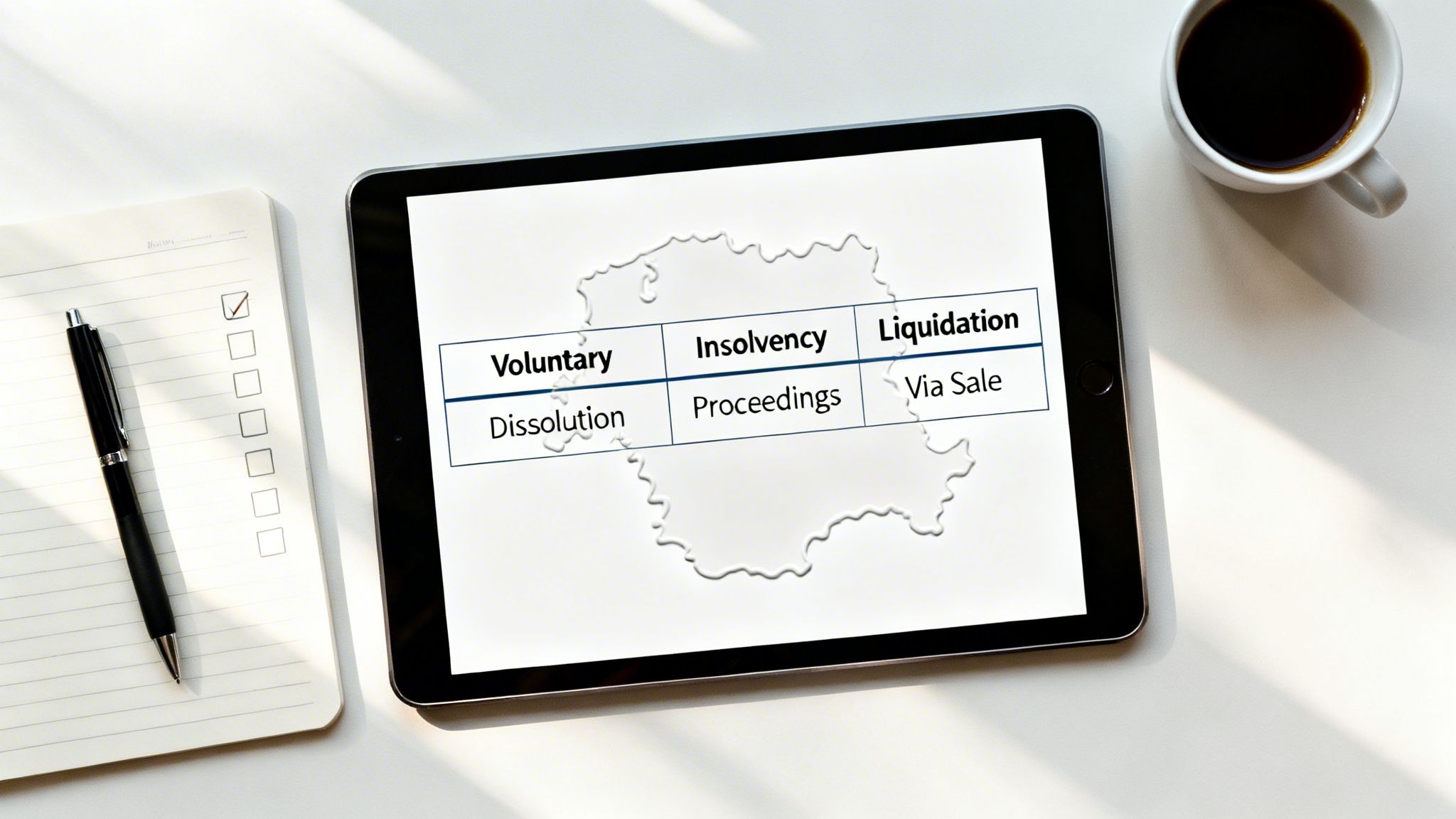
As your business journey in Romania draws to a close, you're faced with three very different ways to shut things down for good. Each path is designed for a specific scenario, whether you're dealing with a healthy company with few obligations or a business weighed down by debt that needs a fast resolution. Getting a handle on these differences is the first crucial step.
The current economic environment makes this decision more important than ever. In just the first 11 months of 2025, Romania saw a staggering 26.23% jump in company dissolutions, with 51,805 firms shutting their doors. This wasn't a minor trend; it was especially noticeable in major business hubs like Bucharest and Cluj, which tells us that effective exit strategies are in high demand. You can find more details on this dramatic rise in Romanian company closures.
Comparing Company Liquidation Methods in Romania (2026)
To give you a clear, at-a-glance view, this table breaks down the three primary methods for closing a Romanian company. It’s designed to quickly highlight the trade-offs you’ll face in terms of time, cost, and the hands-on effort required from you as a director.
Method | Typical Timeline | Estimated Cost | Director Involvement | Best For |
|---|---|---|---|---|
Voluntary Dissolution | 6–24+ Months | Medium | High (continuous paperwork) | Solvent companies with no debts or disputes. |
Insolvency Proceedings | 12–36+ Months | High (court & legal fees) | Very High (intense scrutiny) | Insolvent companies with significant, complex debts. |
Liquidation Via Sale | 3–30 Days | Low (fixed fee) | Minimal (sign & transfer) | Founders seeking a rapid, remote, and final exit. |
The single biggest difference here is time. Traditional methods can drag on for years, keeping you tied to the process. A Liquidation Via Sale, on the other hand, gives you a clean break in a matter of days, completely severing you from any future administrative headaches.
Ultimately, choosing the best way to liquidate a company in Romania in 2026 is about matching the method to your circumstances. If your business is simple and solvent, the traditional route might work. But for the many founders who need to move on quickly without lingering liabilities, a faster alternative is often the only practical solution. We'll dive deeper into each of these options next.
Why Are So Many Romanian Companies Shutting Down?
Before you can pick the right way to close your company in 2026, it helps to understand why so many founders are making this tough call. The decision to dissolve a business is rarely a happy one. It's usually a direct response to a tough, and frankly, worsening economic climate here in Romania.
The pressure is coming from a few different angles, mainly shifting tax laws and heavier government oversight. For small and medium-sized businesses, this combination can make it impossible to operate, forcing them to get out before things get even worse.
The Taxman Cometh: Romania's Fiscal Squeeze
One of the biggest reasons for the spike in company closures is the changing tax rules. The government's recent fiscal tweaks are hitting many businesses, especially smaller ones, right where it hurts—the bottom line. We're talking higher tax bills, more complicated paperwork, and a much stricter ANAF (the national tax agency).
Think about it: a small change to the microenterprise tax code or a hike in social security contributions can flip a profitable business into the red almost instantly. This kind of pressure is forcing many directors to pull the plug themselves rather than get buried under tax debt they can't pay. It’s about making a controlled exit, not waiting for a forced one.
Many founders aren't closing because their idea failed. They're closing because the cost of just staying compliant has become too high. It's a strategic retreat from a battlefield that's getting harder to win.
The numbers don't lie. In the first eight months of 2025, formal insolvencies actually dipped slightly by 2%. But at the same time, voluntary dissolutions—companies choosing to close—shot up by a massive 34%. This isn't a coincidence; it shows a clear trend of owners rushing to deregister before the rules get even tighter. You can dig into the specifics in this Coface study on Romanian company insolvencies.
Economic Headwinds and Regional Hotspots
It's not just taxes. Broader economic problems are adding to the strain. We've all felt the pain of supply chain chaos, rising inflation, and unpredictable customer spending. These create a volatile market that’s incredibly difficult for smaller companies to navigate.
These problems are felt most sharply in the major business hubs, where competition is brutal and the cost of doing business is high. Just look at where most of the closures are happening:
Bucharest: As the capital, it always has the highest number of both insolvencies and voluntary shutdowns.
Cluj-Napoca: A major tech and business centre where rising costs are squeezing margins.
Bihor & Ilfov: These surrounding counties are feeling the economic pinch just as hard.
These four areas are home to almost half of all active companies in Romania. When businesses struggle here, it sends shockwaves through the entire economy. For a director trying to operate in one of these pressure-cooker environments, finding a clean, predictable way to close up shop isn't just a nice-to-have. It’s essential for protecting their personal assets and being able to move on.
Comparing Your Liquidation Options In Detail
Deciding how to close your Romanian company is a serious move with long-term effects. Each option involves a different set of compromises on your time, money, and personal risk. Let's move past the high-level summary and dig into a detailed, side-by-side comparison of Traditional Voluntary Dissolution, Insolvency Proceedings, and Liquidation Via Sale. This will help you see clearly which path makes the most sense for your situation in 2026.
We'll break down each method across the factors that really matter: the actual steps you'll take, how long it will all last, the total cost, your liability as a director, public exposure, and the day-to-day administrative hassle. This structured comparison is designed to highlight the subtle but critical differences so you can make a properly informed decision.
Process And Director Involvement
The amount of hands-on work required from you as a director is drastically different across these three methods. One path is almost entirely hands-off, while the others demand your constant attention and personal involvement for months, if not years.
A Traditional Voluntary Dissolution puts the entire administrative weight squarely on your shoulders. You’re responsible for everything from start to finish.
Drafting and filing shareholder resolutions with the Trade Register (ONRC).
Appointing a liquidator—usually an accountant or lawyer—to manage the wind-down.
Overseeing the sale of all assets and making sure any known creditors are paid.
Submitting multiple, complex financial statements and final reports to the tax authorities (ANAF).
This process is a bureaucratic marathon, not a sprint. It’s heavy on paperwork and requires your active participation every step of the way. For a deeper look into the specific legal stages, our guide on the difference between dissolution and liquidation can be quite helpful.
On the other hand, Insolvency Proceedings are far more intrusive. This is a court-supervised process where an appointed judicial administrator seizes control of the company. Your role flips from manager to a subject of investigation. You’ll be required to provide exhaustive documentation and answer to the court, the administrator, and the creditors.
The Liquidation Via Sale method, which we offer at EndCorp, is specifically designed to eliminate this burden. Your involvement is minimal and front-loaded. You simply sign a share purchase agreement to transfer ownership, and your legal connection to the company is cut. The new owner then takes over all subsequent administrative and legal steps.
Timelines And Public Visibility
How long the process takes and how public it gets are huge concerns for any founder looking for a clean break. The traditional routes are notoriously slow and very public, creating a long, uncomfortable period of uncertainty.
Voluntary dissolution is a multi-stage affair that can easily drag on for 6 to 24 months, and often longer if any hitches occur. Every single step, from the initial decision to the final deregistration, is published in the Official Gazette of Romania. This makes your company's closure a matter of public record for a very long time.
Insolvency is even longer, typically lasting 12 to 36 months or more. It's also extremely public. Court filings and creditor meetings create a highly visible record of financial distress that can follow you around and damage your professional reputation.
The key differentiator with a Liquidation Via Sale is speed and discretion. The entire ownership transfer can be completed in as little as 3 to 30 days. While the share transfer is registered, it simply looks like a standard change in ownership, avoiding the public stigma that comes with formal dissolution or bankruptcy announcements.
The infographic below shows some of the economic pressures that are forcing founders to think very carefully about these timelines.
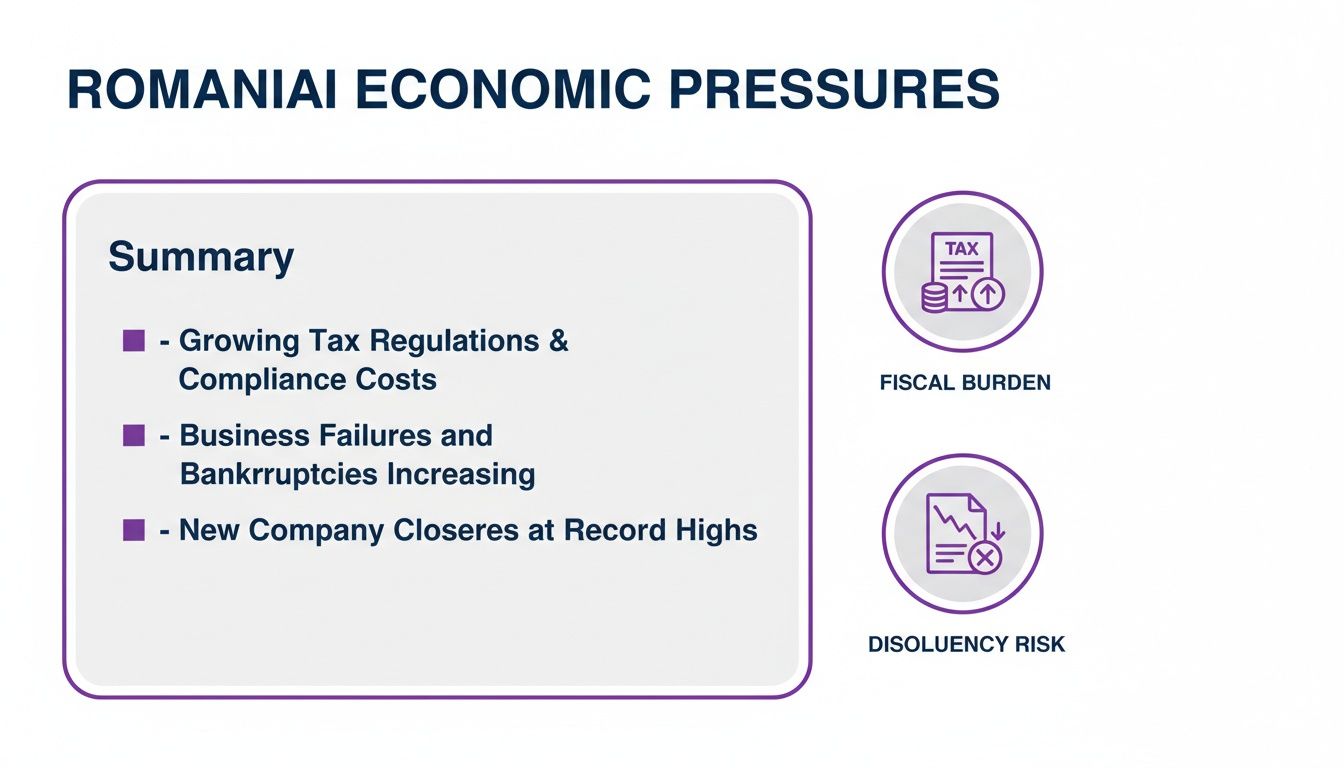
This visual highlights the interconnected problems of rising fiscal burdens, insolvency risks, and the flood of dissolutions that make a swift, predictable exit so valuable.
Costs And Financial Predictability
The financial side of closing a company can be a minefield of hidden fees and escalating professional costs. A fixed-fee model provides a level of certainty that the traditional paths just can't offer.
For a voluntary dissolution, you can expect costs to start at a few thousand euros and go up from there, depending on the complexity. You have to pay for a liquidator, an accountant for the final balance sheets, notary fees, and various publication charges. These costs add up quickly over the long timeline.
Insolvency is, by a huge margin, the most expensive route. Court fees, the judicial administrator's fees (often a percentage of recovered assets), and legal representation costs can spiral into tens of thousands of euros. There is virtually no cost predictability here.
The Liquidation Via Sale model works on a fixed, pre-agreed fee. You know the total cost from day one, with no risk of hidden charges or ballooning professional fees later. This financial certainty is a massive advantage for founders who need to manage their exit budget down to the last euro.
The pressure to find a cost-effective exit is mounting. In 2023 alone, over 280,000 Romanian companies were declared inactive by ANAF, and that number jumped another 12% in early 2024. Inactivity often leads to a forced dissolution, trapping directors in a costly and vicious cycle of compliance headaches.
To bring all these points together, here is a detailed breakdown comparing the methods across the most important criteria.
Detailed Feature Analysis of Romanian Liquidation Methods
This table provides a comprehensive breakdown comparing Traditional Dissolution, Insolvency, and Liquidation Via Sale across key operational and legal criteria.
Criteria | Traditional Voluntary Dissolution | Insolvency Proceedings | Liquidation Via Sale (EndCorp) |
|---|---|---|---|
Typical Timeline | 6 - 24+ months | 12 - 36+ months | 3 - 30 days |
Director Involvement | High; manages the entire process | High; must cooperate with court & administrator | Low; ends after share transfer |
Public Visibility | High; all steps published in Official Gazette | Very High; public court records & creditor meetings | Low; appears as a standard ownership change |
Cost Structure | Variable; hourly/project fees for professionals | Very High & Variable; court fees, administrator % | Fixed, pre-agreed fee |
Director Liability | Remains until final deregistration | High; investigated for mismanagement | Severed upon successful transfer of shares |
Predictability | Low; process can be delayed by bureaucracy | Very Low; dependent on court schedule & creditors | High; clear, defined process and timeline |
Administrative Burden | Very High; extensive paperwork and reporting | High; responding to legal and administrative requests | Minimal; handled by the new owner |
This comparison makes it clear that while each method has its place, they offer vastly different experiences. The choice ultimately comes down to your priorities: are you optimising for control, cost, or a fast and clean exit?
When to Choose Each Liquidation Method
Knowing the technical differences between liquidation methods is one thing, but figuring out which one actually fits your company is where the real decision-making happens. The best way to close your Romanian company in 2026 really comes down to a gut-check on your business’s health, your personal appetite for risk, and how fast you need to be done with it all.
Let's walk through three common situations founders find themselves in. I'll break down which path makes the most sense for each and, more importantly, why.
Scenario 1: The Dormant Company With No Debt
Picture this: you registered a Romanian SRL a couple of years back for a project that just never got off the ground. The company is sitting dormant, has zero assets or liabilities, and you've been diligent about keeping its tax filings current. Your only goal is to shut it down cleanly without it costing you an arm and a leg.
For a straightforward case like this, a Traditional Voluntary Dissolution is your go-to option.
Since the company is solvent and there are no creditors to worry about, the biggest headaches of this method—creditor fights and drawn-out negotiations—are completely off the table. The process is slow, no doubt, but it's methodical. You can either handle the paperwork yourself or, more realistically, pay a local accountant a modest fee to make sure everything is filed correctly with the ONRC and ANAF.
The main trade-off here is time. Even for a squeaky-clean company, you’re looking at a 6 to 12-month process, sometimes longer. If you need absolute certainty and speed, another method might be better. But for a founder who's more concerned with cost than speed, this is the textbook answer.
Scenario 2: The Overwhelmed SME Facing Creditor Pressure
Now, let's look at a much more stressful situation. You're running a small e-commerce business that's racked up serious debt with suppliers and the tax authorities. The phone won't stop ringing with creditors, and the financial weight is crushing. The company is insolvent, plain and simple, and you need a way out that protects you from personal liability.
This is a scenario where formal Insolvency Proceedings are not just a good idea—they're a legal obligation.
Trying to do a voluntary dissolution or a quick sale when your company can't pay its debts is a massive red flag. It can easily be interpreted as an attempt to defraud creditors, which could land you in serious legal trouble personally. Instead, the court steps in and appoints a judicial administrator to take over. They manage the entire process, ensuring assets are handled properly and creditors are treated fairly according to the law.
Choosing insolvency isn't a personal failure. It’s a structured legal tool designed to resolve an impossible financial situation with transparency and fairness. It acts as a legal shield, stopping further creditor action while the company's affairs are sorted out under a judge's supervision.
Yes, this path is long, public, and expensive. But when your company is insolvent, it’s the only responsible and legally defensible route to take. If you want to dig deeper into these distinctions, our article on the difference between bankruptcy and liquidation for EU founders is a great resource.
Scenario 3: The Non-Resident Founder Needing a Fast Exit
Here’s a final scenario we see all the time. You're a director living outside of Romania who set up an SRL for a service business. The venture didn't work out, and while you have a little bit of debt—maybe to your accountant or a virtual office provider—it's manageable. You have a new opportunity on the horizon and simply can't afford to be bogged down by Romanian bureaucracy for the next year. You need a fast, remote, and final exit.
This is precisely where the Liquidation Via Sale method shines.
The traditional route is a non-starter; trying to manage a 12-month dissolution from another country is a logistical nightmare. Insolvency is complete overkill for a company with only minor debts. This method, however, was practically designed to solve this exact problem.
Here’s why it’s such a good fit:
Speed: The whole deal can be done in 3 to 30 days. You can sign the papers and be on to your next venture before you know it.
Remote Process: From the contract to the final transfer, everything can be handled from wherever you are. No need to book a flight to Romania.
Finality: The moment the shares are sold and your name is off the company register, you're done. Your legal connection to the company is severed, and all future administrative tasks and creditor calls become the new owner's problem.
This approach gives international founders the clean break they need. It accepts the reality that your time and energy are far better spent building your next success, not getting tangled in the red tape of a past failure. For any founder who values their time, this is easily the best way to liquidate a company in Romania in 2026.
Liquidation Via Sale: A Modern Exit Strategy
Let's be honest, the traditional ways to liquidate a company in Romania can feel incredibly dated. They often involve a year—or more—of navigating bureaucracy, a process that just doesn't work for today's entrepreneurs, especially those running businesses remotely or looking to move on to their next project quickly. This is precisely why a more direct approach, known as Liquidation Via Sale, has become so effective. It’s the method we’ve perfected at EndCorp.

This isn’t some clever workaround; it's a straightforward application of Romanian corporate law. Instead of you personally getting bogged down in the lengthy dissolution process, you legally sell your shares in the company to a specialised third party. That single action—the share transfer—is the entire foundation of this method.
Once the sale is finalised, your legal ties to the company are cut. You're no longer the director or the shareholder, and your name is removed from all public records. From that moment on, the new owner takes on the full legal responsibility of winding down the company’s operations in complete compliance with Romanian law.
How The Process Actually Works
The real appeal of this method is its sheer simplicity and predictability. We’ve honed the procedure to bypass common bureaucratic hurdles, giving you a clear, step-by-step path to a clean exit. The entire process is designed to be completed in as little as 3 to 30 days.
Here’s what the journey looks like from our first conversation to your final exit:
Initial Consultation: It all starts with a free, no-strings-attached chat to see if your company is a good fit. We’ll look at its current status, any assets, and liabilities to confirm that a sale is a legally sound and practical option.
Share Purchase Agreement (SPA): Next, we prepare a formal SPA. This is the core legal document that lays out all the terms of the sale. You get to review it thoroughly before making any commitment, so everything is transparent from the start.
Ownership Transfer: Once you sign the agreement and the fixed fee is settled, the share transfer is officially executed. This is the pivotal legal step that passes ownership of the company over to our specialised holding structure.
Finalisation and Exit: Our local legal partners then file all the necessary paperwork with the Romanian Trade Register (ONRC). As soon as it's processed, your name is officially removed, and your duties as a director come to a complete end.
The critical point to grasp is this: after the share transfer, the company's debts and liabilities remain with the company—which is now under new management. Any subsequent communication from creditors or administrative bodies is directed to the new owners, not you.
This structured transfer of responsibility is what makes this the best way to liquidate a company in Romania in 2026 for founders who simply need to move forward.
Who Handles Debts and Creditors
One of the first questions people ask is what happens to the company's existing financial obligations. It's important to be clear: the debts don't just vanish. They stay with the legal entity of the company. What changes is who is responsible for managing them.
After the sale, the new management becomes the sole point of contact for all creditors, whether they're suppliers, landlords, or the tax authority (ANAF). This immediately puts a stop to the stressful phone calls and demand letters you might be receiving. Our team then manages the final wind-down according to Romanian law, ensuring every obligation is addressed correctly.
This clean handover provides a definitive and legally secure exit, freeing you up to focus your time and energy on your next venture without the weight of an old business holding you back. It’s a solution built for the realities of modern business.
Making the Right Call: Your Next Steps
Deciding how to close your Romanian company boils down to a straightforward assessment of your reality. There’s no single “best” way—only the best way for your specific situation. By answering a few honest questions, you can cut through the complexity and find the clearest path forward.
Let's get practical. We’ll look at three things: your company's financial health, your personal tolerance for a drawn-out process, and what you want to do next. The answers will point you directly to the right solution.
A Quick Self-Assessment
To figure out the best way to liquidate a company in Romania in 2026, run through these questions. The key is to be brutally honest with yourself.
1. Is Your Company Solvent?
Yes: Can you cover all known debts with the assets you have? If the answer is a clean "yes," then a Traditional Voluntary Dissolution is on the table. It's the standard, by-the-book method for a debt-free company, but be prepared for the timeline.
No: If the company is insolvent—meaning it can't pay its bills—you are legally obligated to look at Insolvency Proceedings. Taking this step protects you from potential accusations of fraudulent administration down the line.
It’s Complicated: What if there are some small, manageable debts, but you just don't have the time or energy for a long, bureaucratic wind-down? This is a very common scenario, and it’s where a Liquidation Via Sale often makes the most sense.
2. How Much Time and Risk Can You Handle?
High Tolerance: If you have 6-24 months to spare and are okay with managing the paperwork, appointments, and professional fees that come with it, the traditional path could work for you.
Low Tolerance: Do you need a clean break, finalised in under a month? A Liquidation Via Sale is built for exactly this. It’s designed for a fast, decisive exit, getting you out of the picture almost immediately.
3. What Are Your Plans for the Future?
Are you starting a new business that needs your full attention right now? The last thing you need is the administrative baggage of an old company dragging you down. A clean, quick exit lets you focus 100% on what’s next, not what’s behind you.
Your personal bandwidth is just as crucial as your company's balance sheet. A process that drags on for a year or more is a constant source of mental and administrative stress, which can seriously hamstring your ability to seize new opportunities.
Your Actionable Next Steps
Based on where you landed, here’s what to do now:
If You're Choosing Traditional Voluntary Dissolution: The first call you should make is to a local Romanian accountant or lawyer. They’ll get the ball rolling by helping you draft the shareholder resolutions and start the filing process with the Trade Register (ONRC).
If You're Facing Insolvency Proceedings: Don't wait. You need to contact a specialised insolvency lawyer immediately. They are the only ones who can correctly guide you through filing for bankruptcy with the court and initiating the official, court-managed procedure.
If You're Considering a Liquidation Via Sale: The process starts with a simple, no-obligation conversation. Get in touch with a firm like EndCorp to discuss your company's situation, check if you’re eligible, and get a clear, fixed-fee quote to finalise everything in days, not years.
Frequently Asked Questions
Closing a business brings up a lot of questions. Here are some straightforward answers to the things we hear most often from founders trying to figure out the best way to liquidate a company in Romania under the 2026 rules.
What Happens To Company Debts After A Liquidation Via Sale?
Once you sell your shares, ownership of the company legally changes hands. Crucially, the company’s debts and liabilities don’t disappear—they stay with the company, which is now run by the new owner.
The new management takes on the full legal duty of winding the company down correctly, which includes handling all creditor claims. For you as the former director, your role is over. Any future calls or letters from creditors will go to the new team.
Is Selling A Company For Liquidation Legal In Romania?
Absolutely. This method is 100% legal and is based on a standard share transfer, a process clearly defined in Romania's Companies Law no. 31/1990.
Instead of managing the long liquidation process yourself, you are simply selling your ownership stake. The buyer then takes on the legal obligation to complete all the necessary steps to close the company according to Romanian law. It's not a loophole; it's just a different, more efficient administrative route.
Key Takeaway: Think of it this way: the method uses standard corporate law to achieve the same compliant result—a fully closed company. Its legality comes from the lawful transfer of shares, which is a routine business transaction.
How Long Does Traditional Dissolution Take Compared To A Sale?
A standard voluntary dissolution and liquidation in Romania is a slow, step-by-step process. You're typically looking at 6 to 24 months, and that's if everything goes smoothly. We break down what can cause delays in our article on how long company liquidation takes.
The Liquidation Via Sale, on the other hand, is built for speed. We can usually complete the share transfer and get your name removed from the public registry in just 3 to 30 days. It’s designed to give you a clean and fast exit from all your old responsibilities.